
Reviewed · WALKING TOURS
Évora: Private walking tour with tickets to main monuments
Évora’s story comes at you in layers: Roman columns, medieval walls, royal chapels, Renaissance churches, and a 17th-century room lined with human bones. This private walk gives you a guide to connect those pieces, rather than leaving you to admire them as a string of unrelated sights. João, Paulo, John, and Elsa are among the guides associated with the experience, and the exact guide depends on the booking.
I like the private format, which lets you ask questions, set an easy pace, and sometimes shape the walk around your interests. I also like that tickets cover Évora Cathedral and the Chapel of Bones, including the cathedral roof, so you can focus on the city instead of sorting out admissions along the way.
The main drawback is the tight schedule. You cover a great deal in about two and a half hours, but several stops receive only five or ten minutes. This is an excellent introduction, not a complete exploration of every church, museum, or corner of Évora.
In This Review
- The key points at a glance
- Why a private walk makes sense in Évora
- Praça do Giraldo and the darker side of Évora
- Évora Cathedral and the best view of the city
- The Roman Temple and Pátio de São Miguel
- Mannerist art and the Igreja da Graça
- The Chapel of Bones and Igreja de São Francisco
- Royal remains and a romantic garden
- Évora’s walls and the Aqueduto da Água de Prata
- What the $105.26 price buys you
- How the guides shape the experience
- Who should book this Évora tour?
- Should you book it?
- FAQ
- How long does the Évora private walking tour last?
- Where does the tour begin?
- Where does the tour end?
- Is the tour private?
- Is the tour offered in English?
- Are entrance tickets included?
- Are meals included?
- Can I cancel for a full refund?
The key points at a glance
- A private English-language walk lets your group ask questions and adjust the pace.
- Cathedral admission includes the cloisters and roof, giving you one of Évora’s best city views.
- The Chapel of Bones is included, with its unsettling but thoughtful meditation on mortality.
- The Roman Temple, city walls, Renaissance sites, and aqueduct create a wide sweep through Évora’s past.
- Local culture enters the walk through Alentejo cork goods, pottery, painted furniture, cloaks, and traditional rattles.
- The $105.26 price per person makes the most sense for couples, families, or small groups who value private guiding and included tickets.
Why a private walk makes sense in Évora
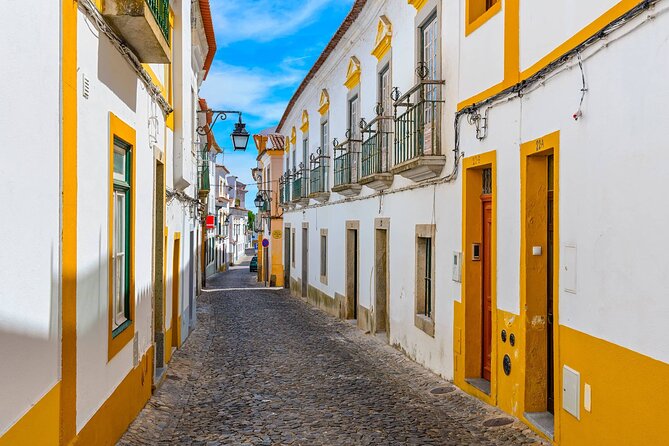
Évora is easy to walk, but it is not always easy to read. A plain whitewashed building may hide a royal connection. A square that looks like a pleasant café stop was also the setting for some of Portugal’s darkest public ceremonies. A guide gives you the links between those places.
The private setup is the strongest feature here. You are not sharing the guide with a large crowd, so you can ask about archaeology, Portuguese kings, religious art, the Inquisition, or local customs as they arise. Several guides, including João and Paulo, are described as comfortable with questions and able to explain both Évora and wider Portuguese history.
The walk is offered in English and lasts about 2 hours 30 minutes, though the time can stretch when conversation runs freely. That matters because the route has a lot packed into it. You will see the main historic sights, but you will not spend long inside each one.
The meeting point is by the fountain at Praça do Giraldo, at Praça do Giraldo 7. The tour returns there at the end, which is handy if you want to continue with lunch, shopping, or your own museum visit.
More Private Tours in Arrábida
- Évora: Private walking tour, By Local Guide
★ 5.0 · 87 reviews - Private Lisbon Arrabida Wine Tour: Food & Wines, Mountain and Sea
★ 5.0 · 907 reviews - Private Wine Tasting in the Setúbal Wine Region, from Lisbon
★ 5.0 · 611 reviews
Praça do Giraldo and the darker side of Évora
Praça do Giraldo is the right place to begin. It is Évora’s central square and the natural point for getting your bearings inside the UNESCO World Heritage city. The guide sets the city into Portuguese and wider European history before the walk moves into the smaller streets.
I appreciate this opening because it gives meaning to the route. Évora is not simply an old town with attractive stonework. Its fortunes rose and fell with Portugal’s political power, religious institutions, royal families, and overseas expansion.
The next stop recalls the Portuguese Inquisition, which began in 1536 and continued for almost 300 years. The square was used for public executions, and Évora’s court was the deadliest of Portugal’s four Inquisition courts. This is difficult material, but it belongs in the city’s story. The guide’s role is especially useful here, since a short explanation can provide context without turning the stop into a grim spectacle.
The traditional shopping street follows. You may see Alentejo crafts such as cork objects, pottery, painted furniture, chocalhos, or traditional capotes. This is a small but welcome change of pace after the political and religious history. If you want a practical souvenir, cork is the obvious local specialty, and the guide can help explain what is genuinely tied to the region.
Évora Cathedral and the best view of the city
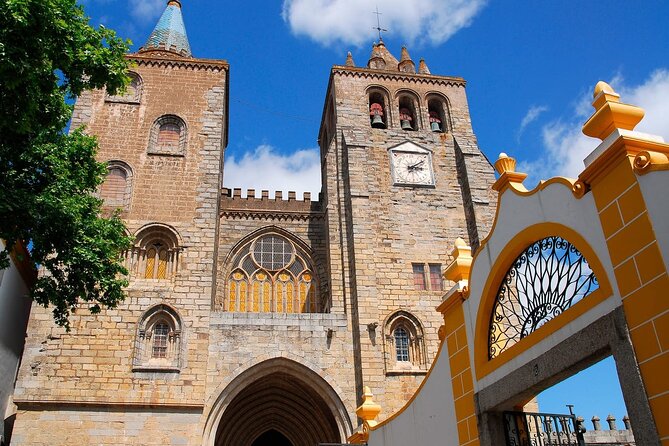
The Sé de Évora is the tour’s major architectural stop. It is Portugal’s largest Gothic cathedral, built with an imposing scale and medieval character. The route includes the cathedral, cloisters, and roof, so you get more than a quick look at the facade.
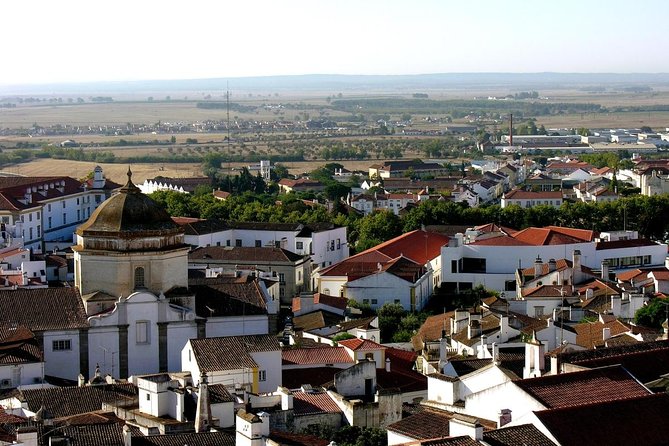
The roof visit is a real advantage. From above, Évora’s white buildings, tiled roofs, defensive walls, and surrounding Alentejo setting come together in a way that is hard to grasp from street level. It also makes the admission ticket more worthwhile.
Inside, the guide points out unusual references and symbolic details, including connections to older pagan traditions. You do not need to be an art expert to enjoy this. The best part of a guided cathedral visit is learning what to look for before you walk on.
The cathedral stop is scheduled for about 30 minutes. That is enough for a strong introduction, the cloisters, and the roof, but not enough for a slow study of every chapel and artwork. If religious art matters greatly to you, plan to return later on your own.
The Roman Temple and Pátio de São Miguel
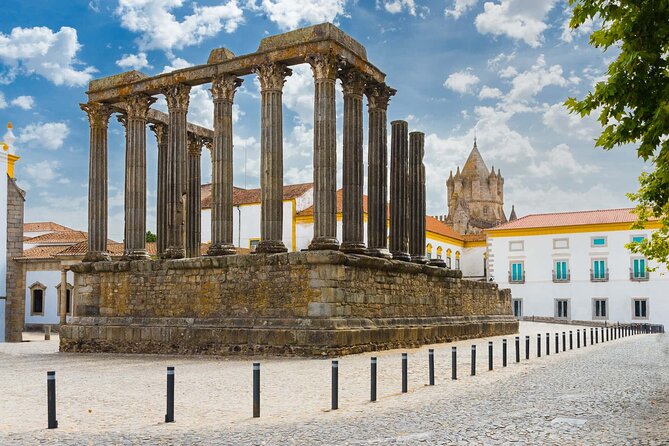
The Roman Temple of Évora, often called the Temple of Diana, is one of the city’s unmistakable landmarks. Its surviving columns recall the Roman power that shaped the early city, and the monument is about two thousand years old.
The guide adds value here by explaining the temple’s place in Évora’s origins and the stories attached to its name. You spend only about ten minutes at the site, so this is more about understanding the monument and taking in its setting than examining it in detail.
Pátio de São Miguel offers a quieter contrast. This former fortified area once housed the city governor and provided lodging for kings visiting Évora. It is also tied to the Knights of Évora, whose later development into the Order of Avis helped shape a new Portuguese royal dynasty.
This stop will appeal to anyone interested in military orders, royal politics, or the way medieval power worked inside a city. It is also one of the places where a private guide can make a difference. Without explanation, it can look like a pleasant courtyard. With context, its position and history become much clearer.
More Private Tours in Évora
- Private Day Tour With Guide to Évora and Monsaraz
★ 5.0 · 134 reviews - Tour Évora and Alentejo in a private tour
★ 5.0 · 124 reviews - Évora: Private tour with entrance tickets to main monuments
★ 5.0 · 57 reviews - Private Evora Heritage and Alentejo Wine Tour from Lisbon
★ 4.5 · 31 reviews
Mannerist art and the Igreja da Graça
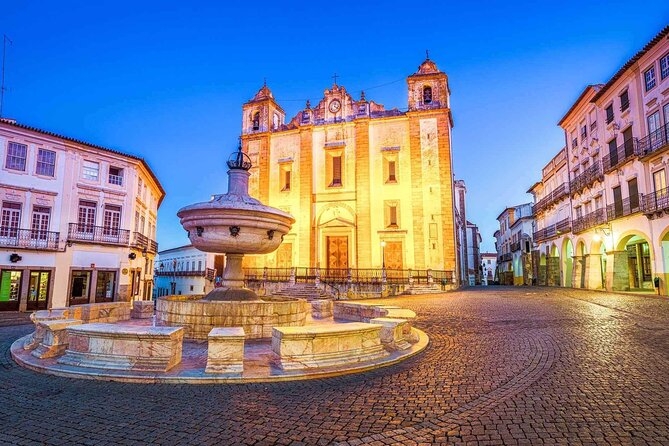
The walk continues past a fountain inaugurated in 1556, an early example of Mannerist urban art in Portugal. It represents the political confidence and public building projects associated with Cardinal D. Henrique, a major patron of Évora and the last king of the Avis dynasty.
At the Igreja da Graça, you see one of Portugal’s important Renaissance buildings. Its design includes Mannerist ideas, and the facade has the famous Graça boys, sculpted figures that carry their own local stories and symbolism.
The church receives roughly ten minutes, so expect an explanation of its design rather than a long interior visit. That short stop works well in the overall route because it keeps the walk moving while still showing how Évora changed from a medieval center into a Renaissance city.
The Chapel of Bones and Igreja de São Francisco
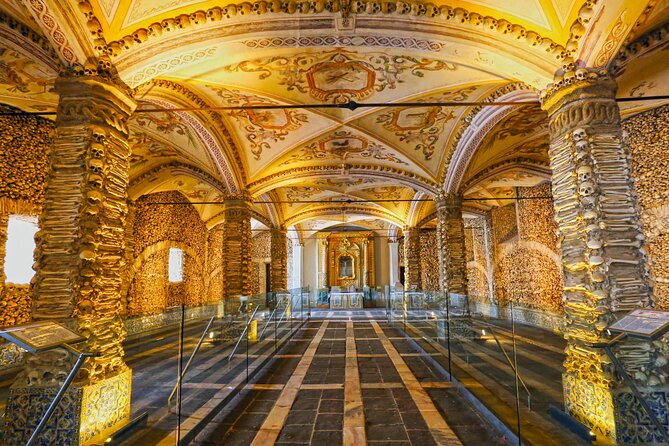
The Chapel of Bones is the most unusual stop. Its walls are covered with the actual bones of thousands of people from Évora, arranged as a stark reminder that human life is temporary. The chapel was built in the 17th century, and its message is macabre without being merely sensational.
Some people will find it fascinating; others may find it uncomfortable. I would not treat it as a novelty photo stop. It is more meaningful when you take a moment to consider why religious communities created spaces like this and how the chapel fits into the spiritual life of its period.
Admission is included, and the visit is scheduled for about 30 minutes. That gives the guide time to explain the chapel’s legends and purpose. The inclusion is useful because this is one of the places many people specifically want to see in Évora.
Next comes Igreja de São Francisco, once known in the 16th century as the golden convent. Built over an older Franciscan complex, it was connected with royal weddings and baptisms that affected Portugal’s future. The church is an important architectural stop, but its royal associations are just as interesting as its design.
Together, the chapel and church create one of the strongest parts of the walk. One deals with death and religious reflection. The other shows wealth, royal ceremony, and the power of the Franciscan institution.
Royal remains and a romantic garden
The Palacio de Dom Manuel is represented today by the Ladies’ Gallery, the surviving part of a former royal palace complex. The gallery is described as one of the most beautiful and romantic sections left from the 16th-century palace.
You will not spend long here, only about five minutes, but the stop helps explain how Évora functioned as a royal city. It also provides a more delicate architectural note after the severity of the Chapel of Bones.
The Ruínas Fingidas, or false ruins, continue that romantic mood. This setting was assembled with pieces and ruins from an old 16th-century palace during the late 19th century, when Romantic taste favored poetic scenes and carefully arranged fragments.
This is a quick photo stop, and the guide can help you find a good angle. It is also a useful reminder that not every old-looking ruin is an untouched remnant of the Middle Ages. Some historic-looking places were shaped by later ideas about beauty and the past.
Évora’s walls and the Aqueduto da Água de Prata
Évora’s defensive walls are a history lesson in stone. Parts began as Roman defenses in the 3rd or 4th century. Later communities, including the Visigoths and Muslims, reused and changed the city’s defenses. Medieval walls followed in the 14th century, with bastioned structures added in the 17th century and reinforced during the early 19th century.
You see how one defensive system can be adapted by different powers over many centuries. The stop is mostly an exterior look, but it gives you a strong sense of Évora’s strategic importance.
The final major sight is the Aqueduto da Água de Prata, or Aqueduct of the Silver Waters. Opened in 1537, it extends for about 18 kilometers and is regarded as one of Portugal’s great Renaissance civil works.
The most striking detail is the way houses were built between its arches. This is not just an isolated engineering monument placed outside the town. It becomes part of Évora’s streets and buildings, showing how public works shaped daily life.
The aqueduct receives about five minutes, so you will get the essential story and a look at its most photogenic sections. If this is a favorite subject, you will want extra time afterward to follow more of it independently.
What the $105.26 price buys you
At $105.26 per person, this is not the cheapest way to walk around Évora. The value comes from the private guide, the English-language service, the tailored pace, and admission to the cathedral and Chapel of Bones.
For a couple or family, the price can be reasonable if you want a personal introduction and prefer to avoid a large group. Group discounts may improve the calculation for a larger party. If you are traveling alone, the per-person cost is harder to justify unless having a private guide is a high priority.
You also save the time of researching how the sights connect. The tour covers Roman, medieval, Renaissance, royal, religious, and Romantic Évora in one concentrated route. I would see it as a first-day orientation, then return to the places that caught your attention.
The experience is booked an average of 52 days ahead, so I would not leave it until the last moment, especially if you want a particular date or guide. Free cancellation is available up to 24 hours before the start time. Meals are not included.
How the guides shape the experience
The guide is central to the value. João is associated with archaeology studies at the University of Évora and is described as speaking clear English, asking questions, and adapting the walk to a family’s interests. Paulo is praised for explaining Évora across a very long span of history while keeping the tone friendly and light.
John is described as engaging and strong on local history. Elsa, who was born in Évora, brings a personal connection to the city and is associated with an easy pace and clear answers.
Guides have also helped with restaurant suggestions, souvenirs, winery arrangements, and onward plans. Those extras are not guaranteed elements of the route, but they show why a private walk can be useful beyond the monuments themselves.
Who should book this Évora tour?
I would recommend it to first-time visitors who want the main historic sights explained in one sitting. It is also a good fit for families, couples, and small groups who enjoy asking questions and do not want to follow a fixed large-group pace.
History and architecture fans will get the most from it, especially if you like seeing how Roman, Islamic, medieval, royal, and Renaissance layers overlap. The Chapel of Bones makes it suitable for people comfortable with serious religious history and human remains, but it may not suit young children or anyone who dislikes macabre sites.
You need moderate physical fitness. This is a walking tour through a historic city, and the cathedral roof adds a physical element. Wear comfortable shoes, and remember that the route covers many sights quickly.
Should you book it?
Book this tour if you want a strong, personal introduction to Évora and value explanation as much as sightseeing. The cathedral roof and Chapel of Bones tickets add clear value, while the private format lets you pause, ask questions, and follow your interests.
Skip it if you prefer a slow, self-guided day or already know Évora’s history. The schedule is brisk, and several sites receive only a short visit. For most first-time visitors, though, this is a smart way to understand the city before wandering back to the places you want to explore at your own pace.
FAQ
How long does the Évora private walking tour last?
The tour lasts approximately 2 hours and 30 minutes. Some walks may run longer when the group has many questions or the guide spends extra time explaining a site.
Where does the tour begin?
The meeting point is at the Giraldo Square Fountain, at Praça do Giraldo 7, 7000-508 Évora, Portugal.
Where does the tour end?
The tour ends back at the meeting point in Praça do Giraldo.
Is the tour private?
Yes. Only your group participates in the activity.
Is the tour offered in English?
Yes. English is the stated tour language.
Are entrance tickets included?
Tickets to Évora Cathedral and the Chapel of Bones are included. Cathedral admission covers the cathedral, cloisters, and roof visit.
Are meals included?
No. Meals are not included in the tour price.
Can I cancel for a full refund?
Yes, if you cancel at least 24 hours before the experience begins. Cancellations or changes made less than 24 hours before the start time are not refunded or accepted.
More Walking Tours in Évora
- Évora: Flexible Walking Tour in Historic Center
★ 4.4 · 13 reviews
More Walking Tours in Arrábida
- Évora Walking Tour
★ 5.0 · 35 reviews - Skip the Lines & Sip the Wines: Évora’s Ultimate Walking Tour!
★ 5.0 · 19 reviews
Fresh finds around Setubal District
- Dolphin Watching at the Arrabida (Lisbon region)★ 5.0 · 51 reviews
- Tour Arrábida / Azeitão★ 5.0 · 68 reviews
- Half Day Megaliths Cromlech Tour from Evora by Archaeologists★ 5.0 · 69 reviews
- Lisbon: Kayaking and snorkeling in Sesimbra with photos!★ 5.0 · 74 reviews
- Arrábida: Guided Transparent Kayaking Tour★ 5.0 · 81 reviews
- Sesimbra Discovery by Kayak★ 5.0 · 84 reviews
- Lisbon: Try Scuba Diving in Arrabida Marine Reserve with photos★ 5.0 · 99 reviews
- Arrábida Secret Beaches and Caves with Snorkeling Stop★ 5.0 · 109 reviews
Walking Tours, compared.
Lisbon: History, Stories and Lifestyle Walking Tour
Read our review →
Best of Lisbon Small-Group Guided Walking Tour
Read our review →
Lisbon: Food and Wine Small Group Walking Tour
Read our review →
Best of Lisbon Walking Tour: Rossio, Chiado & Alfama
Read our review →
Sintra & Cascais Day Tour with Pena Palace Entry and Gardens Walk
Read our review →
Lisbon Roots – Small group Food & Culture Walking Tour w/tastings
Read our review →
Lisbon: Starter Walking Tour to the highlights in German
Read our review →Browse the lists this tour appears in