
Reviewed · WALKING TOURS
Lisbon: Starter Walking Tour to the highlights in German
Lisbon reveals itself best on foot, and this two-hour German-language walk packs the city’s central sights into a useful first look. You move from grand Rossio Square through Baixa, Chiado, and Bica, with stops at the Santa Justa Lift, Carmo Convent ruins, tiled buildings, and Time Out Market. I especially like the small groups of no more than 12 and the focus on present-day Lisbon, not just dates and monuments.
I also like that guides such as Pedro make room for questions and conversation. You get local tips on food and neighborhoods while learning why the city looks and feels the way it does. The trade-off is a brisk pace and several slopes and stairs, so this is not a good fit if you need a gentle route or use a wheelchair.
In This Review
- Key points to know before you book
- Starting at Rossio Square with Lisbon under your feet
- Baixa and Rossio: Lisbon rebuilt in a practical grid
- Santa Justa Lift: a landmark with a practical purpose
- Carmo Convent ruins and the memory of the earthquake
- Chiado: elegant streets and a changing city
- Praça Luís de Camões and the move toward Bica
- The Elevador da Bica and Lisbon’s steep streets
- Finishing at Time Out Market Lisboa
- What the two-hour schedule means for you
- Who will get the most from this Lisbon walk
- Should you book the German walking tour?
- FAQ
- What language is the walking tour conducted in?
- How long does the tour last?
- Where does the tour begin?
- How will I recognize the guide?
- Where does the tour finish?
- Is the tour suitable for people with limited mobility?
- What should I bring, and what is not allowed?
Key points to know before you book
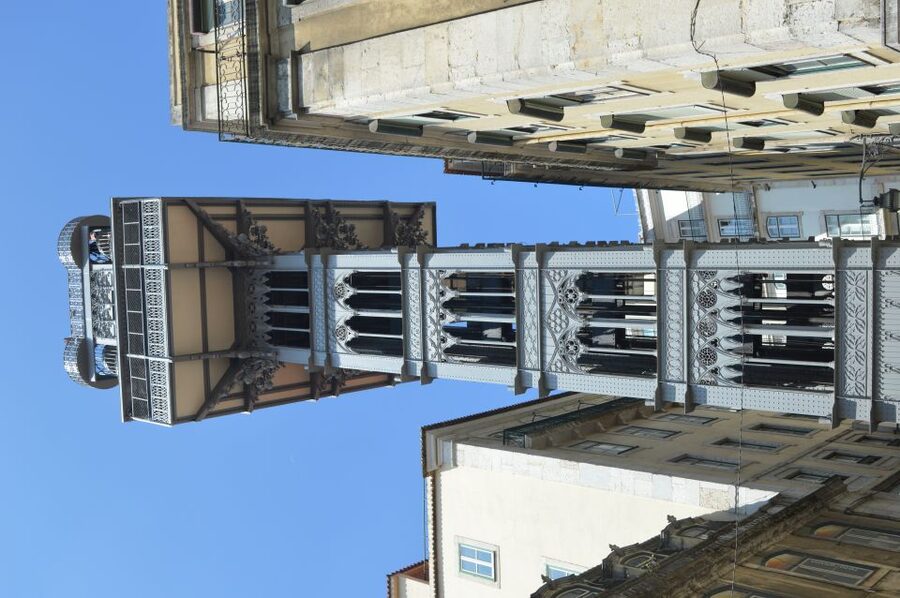
- German-language sightseeing: Your guide explains Lisbon’s history, culture, current events, and daily life in German.
- A compact central route: See Baixa, Rossio, Chiado, Bica, and the Tagus-side Time Out Market in two hours.
- Small group size: Shared tours are limited to 12 people, with private bookings also available.
- Excellent first-day orientation: The walk gives you practical ideas for food, sights, and the rest of your stay.
- A hilly city route: Wear comfortable shoes and expect a few stairs, slopes, and possibly slippery streets after rain.
- A useful finishing point: The tour ends at Mercado da Ribeira, now known as Time Out Market Lisboa.
Starting at Rossio Square with Lisbon under your feet
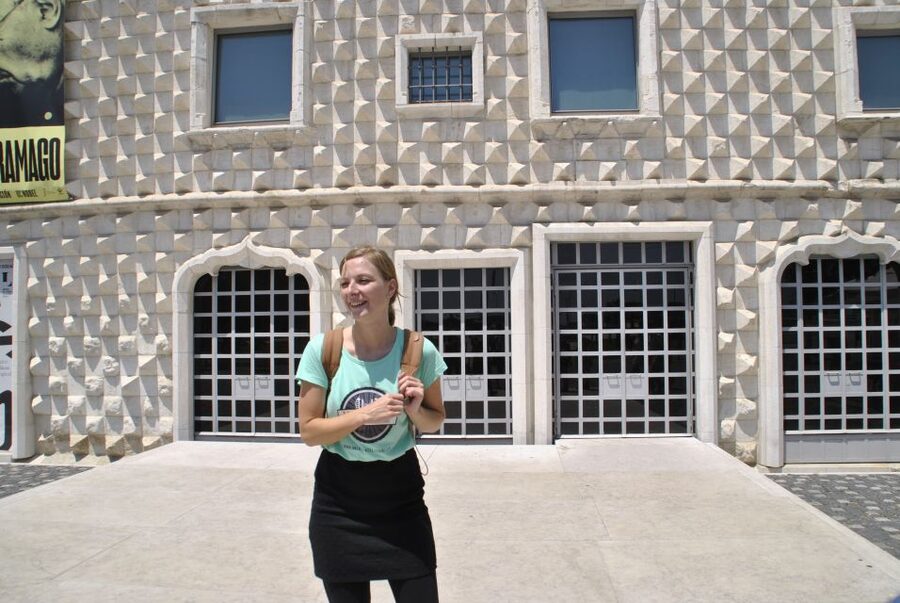
Meet at the northern fountain in Rossio Square, also called Praça Dom Pedro IV. Look between the National Theater and the statue of the Royal Statue for a guide wearing a mint-colored WALK ‘N’ ROLL T-shirt or carrying a matching burlap bag.
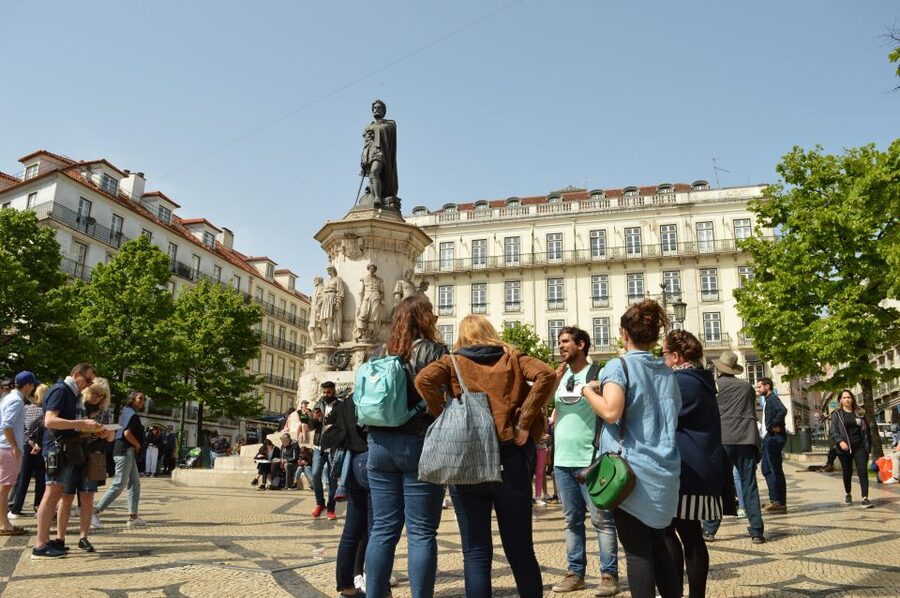
This is a smart starting place. Rossio sits at the heart of Lisbon’s historic center, so you can reach it easily from many central neighborhoods. It also gives your guide a natural place to explain the city’s layout before the walk begins.
The tour is designed as an introduction rather than a long museum visit. You will not spend extended time inside each monument. Instead, you move through the streets, pause at important places, and connect the city’s buildings, hills, public squares, and everyday life.
That format works well if you have just arrived and want to understand Lisbon quickly. It also suits you if you prefer a guide’s explanation to a long list of dates. Guides have been praised for being friendly, clear, and open to questions, with Pedro singled out for combining solid information with easy conversation.
More Walking Tours in Lisbon
- Lisbon: History, Stories and Lifestyle Walking Tour
★ 4.8 · 10,902 reviews - Best of Lisbon Small-Group Guided Walking Tour
★ 5.0 · 4,869 reviews - Lisbon: Food and Wine Small Group Walking Tour
★ 4.9 · 4,082 reviews
Baixa and Rossio: Lisbon rebuilt in a practical grid
From Rossio, the route moves into Baixa de Lisboa, the city center rebuilt after the devastating 1755 earthquake. The broad streets and ordered blocks here feel different from the winding lanes that climb toward the older hills.
Your guide can help you read the city rather than simply look at it. Baixa is a place where urban planning, commerce, and grand civic design come together. Pay attention to the contrast between the open squares and the tighter streets leading toward Chiado and Bica.
Back at Rossio, you get a closer look at one of Lisbon’s main public spaces. The square is formally called Praça Dom Pedro IV, but most people use its shorter name. The patterned pavement underfoot is part of Lisbon’s familiar calçada style, which gives the square much of its character.
A short stop here is useful because it anchors several parts of the city. You are close to Baixa, Chiado, the riverfront, and the hills. After the tour, you can use this area as a reference point when exploring on your own.
Santa Justa Lift: a landmark with a practical purpose
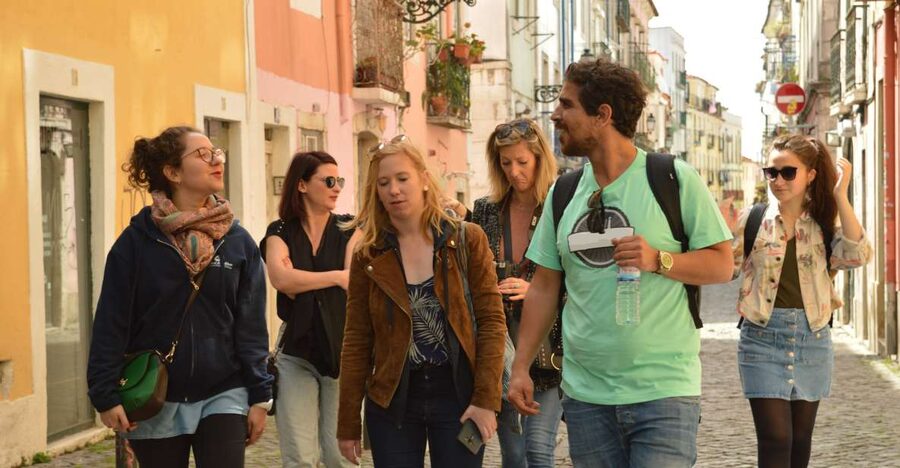
The Santa Justa Lift is one of Lisbon’s most recognizable sights. Its tall iron structure links the lower Baixa streets with the higher Carmo area, making it both a transport link and an architectural landmark.
On this walk, you see the lift as part of the city rather than as an isolated photo stop. Your guide explains its place in Lisbon’s streets and points out the details that are easy to miss when you are focused only on taking a picture.
The tour does not include a ride on the lift, and food, drinks, and admission costs are not included. That matters because lines can form at popular Lisbon sights, and you should not expect this short tour to cover every paid attraction along the way.
Still, seeing the lift from street level is valuable on a first visit. You can decide later if riding it fits your plans, or simply continue to the Carmo area with a better sense of how the two levels of the city connect.
Carmo Convent ruins and the memory of the earthquake
The Carmo Convent ruins offer one of the most striking stops on the route. The roofless Gothic structure gives you a direct visual reminder of the 1755 earthquake and the damage that shaped modern Lisbon.
This is one of the places where a guide adds real value. Without context, the open arches can look like a dramatic photo backdrop. With an explanation of the disaster and its effect on the city, the ruins become part of Lisbon’s larger story.
The stop is also a good example of the tour’s balance. You see a major landmark, but you are not stuck inside one attraction for the whole two hours. You continue through the surrounding streets, where history is mixed with shops, cafés, tiled façades, and daily city life.
Because the route includes slopes and a few stairs, take the warning about fitness seriously. Lisbon’s center is not flat, and the walk can feel more demanding than its two-hour length suggests.
More walking routes in Lisbon:
- Best of Lisbon Walking Tour: Rossio, Chiado & Alfama
★ 4.9 · 2,700 reviews - Age of Discoveries Walking Tour in Belém
★ 5.0 · 1,513 reviews - Sintra & Cascais Day Tour with Pena Palace Entry and Gardens Walk
★ 5.0 · 962 reviews - Lisbon Roots – Small group Food & Culture Walking Tour w/tastings
★ 5.0 · 910 reviews
Chiado: elegant streets and a changing city
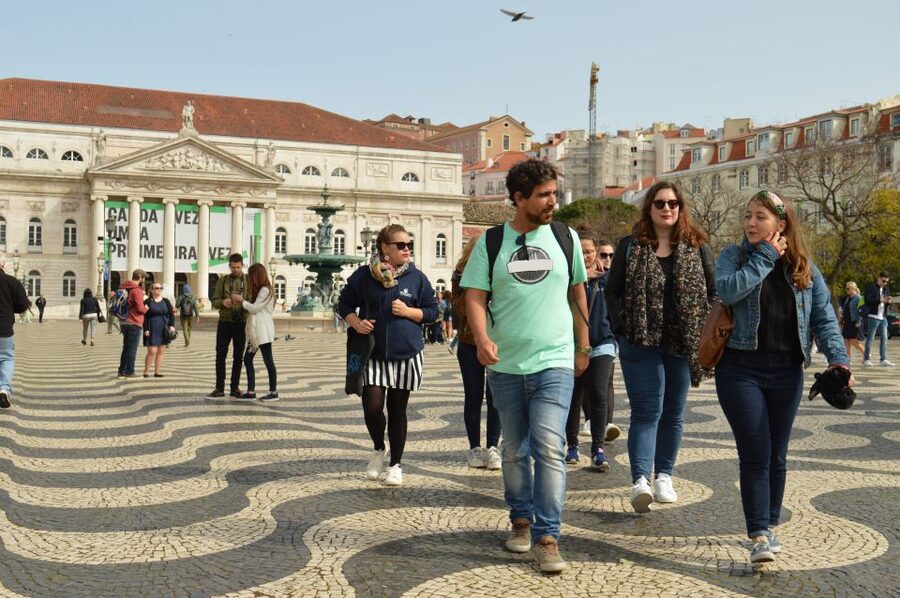
From Carmo, the route continues through Chiado, one of central Lisbon’s best-known neighborhoods. Here, the city shifts from the broad, planned streets of Baixa to a more layered mix of old façades, shops, cafés, public squares, and cultural landmarks.
Your guide discusses both the city’s past and its current life. That is important in Chiado, where historic architecture sits alongside modern businesses and a steady flow of people. You get a sense of how Lisbon uses its old center rather than seeing it as a preserved set piece.
Look for the decorative wall tiles known as azulejos. They are one of Portugal’s most familiar visual features, and a walking route gives you time to notice them across different buildings. The guide can point out why tiled façades matter and how they shape the look of the streets.
You will also see Art Nouveau details along the way. These touches reward a slower eye, but the schedule means you should not expect a specialist architecture lecture. The strength here is the broad picture: tiles, street design, building styles, and local stories tied together in a manageable walk.
Praça Luís de Camões and the move toward Bica
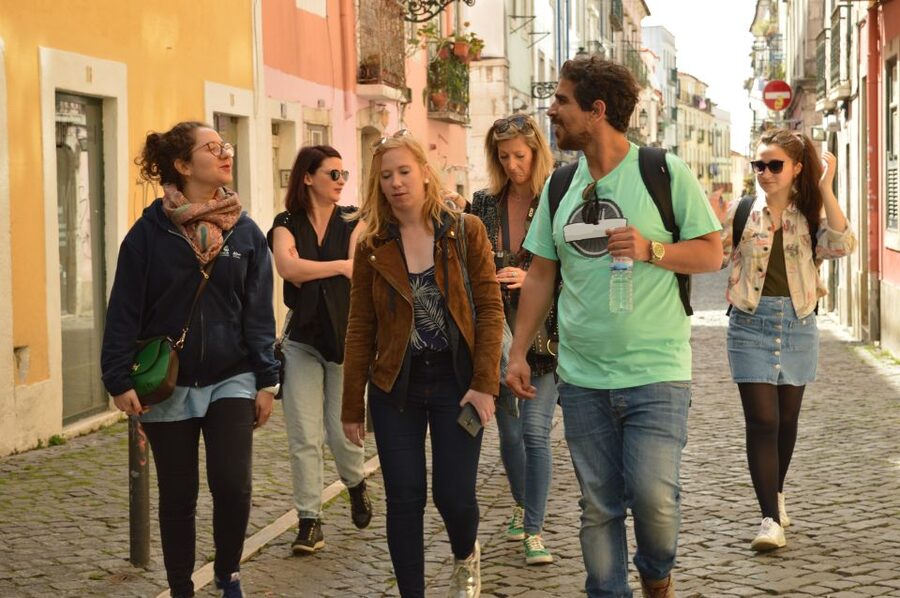
Praça Luís de Camões provides another useful pause between Chiado and Bica. The square acts as a meeting point between several central areas and gives the group room to take in the city before the route heads downhill.
This section helps explain Lisbon’s geography. The city’s historic center is shaped by hills, and neighborhoods that look close on a map can involve steep streets in practice. You start to understand why Lisbon’s lifts, trams, and funiculars are more than charming sights. They solve a real problem.
The guide also uses this part of the route to discuss Portuguese culture and daily life. The experience is not limited to monuments. You can ask about current events, local habits, and places to eat, which makes the walk more useful for the rest of your trip.
If you are choosing between a private tour and the shared option, this is one area where your decision matters. A group of up to 12 keeps the walk social while remaining fairly small. A private group gives you more control over questions and conversation, but the shared tour should already feel more personal than a large coach excursion.
The Elevador da Bica and Lisbon’s steep streets
The Elevador da Bica is one of Lisbon’s famous cable cars and a fitting sight on a walking tour through the city’s hills. The steep route and compact cars show how Lisbon has adapted transportation to difficult ground.
The walk does not include a ride, so think of this stop as a chance to see and understand the funicular rather than a transport ticket. If riding it is important to you, ask your guide for practical advice and plan that separately.
This is also where comfortable shoes matter most. The surface may be uneven, and the slopes can be tiring. In wet weather, Lisbon’s hills become more slippery, so the route may change during the final 30 minutes to reduce the risk of accidents.
That weather policy is sensible, but it also means the exact finish can vary in the rain. Bring water and sunscreen in warm weather, and avoid carrying a large bag. Baby strollers and luggage are not permitted, which is another reason to schedule this tour after checking into your accommodation rather than trying to join with all your bags.
Finishing at Time Out Market Lisboa
The route ends at Mercado da Ribeira, now called Time Out Market Lisboa, near the Tagus River. This is a practical finish because you can continue with lunch or explore the nearby riverfront after the guide leaves.
Food and drinks are not included, so budget separately if you want to eat there. The market is not part of a meal package. Instead, it gives you a convenient place to make your own choice after the walking portion ends.
Ending here also changes the mood of the tour. You have moved from grand squares and historic ruins to a modern market hall. That contrast helps show Lisbon as a living city, not only a collection of old landmarks.
Ask your guide for suggestions before the tour ends. One of the most useful features of this experience is the chance to get advice about where to eat and what to explore next. A short conversation at the finish can help you avoid spending the rest of the day in the wrong part of town.
What the two-hour schedule means for you
Two hours is long enough to cover a lot of central Lisbon, but short enough to fit into a busy arrival day. You will see the main route at a steady pace, with guided stops rather than long breaks.
That timing is a strength if you want orientation. You can use the walk to decide which places deserve a longer visit later. It is less suitable if you want to enter attractions, linger over photographs, or examine every tile and architectural detail.
The group limit of 12 is another plus. A small group makes it easier to hear the guide and ask questions, while still keeping the cost at about $33 per person. For a German-speaking visitor, the value is especially clear if finding a German-language guide independently would be difficult.
The price does not include transport, entry fees, meals, or hotel pickup and drop-off. You meet at Rossio Square and finish at Time Out Market, so allow time to reach the start and continue from the end. The route is central, but it is still a walking experience rather than a door-to-door sightseeing service.
Who will get the most from this Lisbon walk
I would choose this tour for a first visit, especially if you want German explanations and a quick grasp of the city center. It suits couples, solo visitors, and small groups who like to ask questions without committing to a full-day tour.
It is also a good choice for you if you want more than a monument checklist. The guide covers local life, current events, Portuguese culture, and practical food tips, so you leave with ideas for the rest of your stay.
You should think twice if you have limited mobility or dislike hills. The experience requires a moderate level of fitness, includes stairs, and is not suitable for wheelchair users or people with mobility impairments. Large bags and strollers are not allowed.
For uncertain plans, free cancellation is available up to 24 hours before the start, and you can reserve now and pay later. Check the available start times when booking, since the tour lasts two hours but the exact departure time can vary.
Should you book the German walking tour?
Book it if you want a clear, compact introduction to central Lisbon in German, with a small group and a guide who can explain both the past and the present. The 4.9 rating from 781 reviews matches the tour’s strongest features: friendly guides, strong information, lively conversation, and a lot of sightseeing in a short time.
The best value comes from using it early in your stay. Take notes on the food and neighborhood suggestions, then return to the places that catch your interest. At $33, it is a fair price for two hours of guided orientation, as long as you understand that admission tickets and refreshments are extra.
Skip it if you need a flat, slow route or want in-depth visits inside the monuments. For everyone else, this is a practical way to meet Lisbon on foot, learn how its central neighborhoods fit together, and start the rest of your trip with a better map in your head.
FAQ
What language is the walking tour conducted in?
The live tour guide speaks German. The activity focuses on Lisbon’s history, culture, current events, and local life.
How long does the tour last?
The walking tour lasts two hours. Starting times vary, so check availability for the date you want.
Where does the tour begin?
Meet at the northern fountain in Rossio Square, also known as Praça Dom Pedro IV. The meeting point is between the National Theater and the Royal Statue.
How will I recognize the guide?
The guide will wear a mint-colored WALK ‘N’ ROLL T-shirt or carry a mint-colored WALK ‘N’ ROLL burlap bag.
Where does the tour finish?
The tour finishes at Time Out Market Lisboa, the modern market hall at Mercado da Ribeira near the Tagus River.
Is the tour suitable for people with limited mobility?
No. A moderate level of fitness is required, and the route includes walking for the full two hours and climbing a few stairs. It is not suitable for wheelchair users or people with mobility impairments.
What should I bring, and what is not allowed?
Bring comfortable shoes, sunscreen, and water. Baby strollers, luggage, and large bags are not allowed.
Fresh finds around Lisbon
- Sanctuary of Fátima and Coimbra City Tour★ 4.5 · 51 reviews
- Sintra/Lisbon: Sintra & Quinta da Regaleira Tour with Ticket★ 4.4 · 51 reviews
- Jeronimos Monastery Guided Tour – Small Groups – Tickets Included★ 5.0 · 51 reviews
- Lisbon: Private Christmas Lights Tour by Eco Tuk Tuk★ 4.9 · 51 reviews
- Peniche: Berlengas Island Catamaran Tour – Round Trip★ 4.6 · 51 reviews
- Half day Spa Water Therapy experience at THE SPA at Corinthia Lisbon★ 4.5 · 51 reviews
- Lisbon: Private Tuk-Tuk Tour for 2 hours★ 4.7 · 51 reviews
- Premium Lisbon Airport Transfer to Lisbon★ 5.0 · 51 reviews
Walking Tours, compared.
Lisbon: History, Stories and Lifestyle Walking Tour
Read our review →
Best of Lisbon Small-Group Guided Walking Tour
Read our review →
Lisbon: Food and Wine Small Group Walking Tour
Read our review →
Best of Lisbon Walking Tour: Rossio, Chiado & Alfama
Read our review →
Sintra & Cascais Day Tour with Pena Palace Entry and Gardens Walk
Read our review →
Lisbon Roots – Small group Food & Culture Walking Tour w/tastings
Read our review →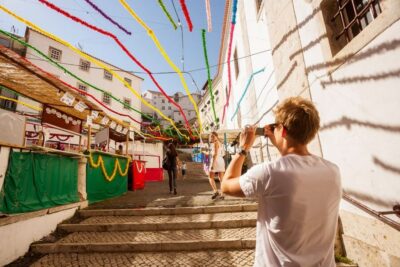
Browse the lists this tour appears in