
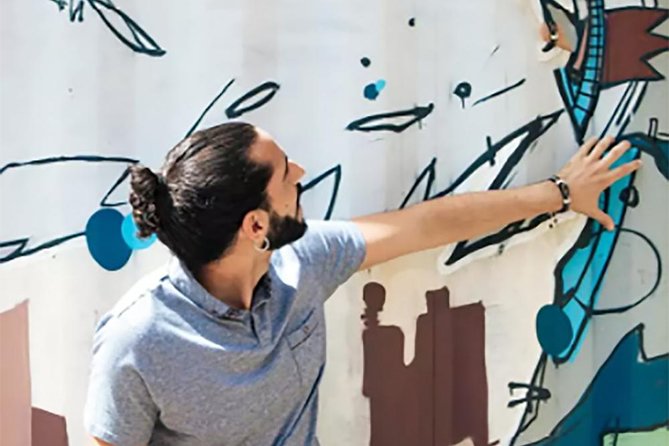
Reviewed · WALKING TOURS
Lisbon Street Art Walk
Lisbon’s street art is not confined to one gallery or a single famous wall. It appears on stairways, shop shutters, old facades, and tucked-away corners. This walk gives you a street artist’s view of the city, moving from Bairro Alto through Baixa Chiado and into Mouraria, where the narrow lanes make the experience feel local and unscripted.
I like the small maximum of eight people, which should make it easier to ask questions and keep up with the guide. I also like the included artistic souvenir, a modest but thoughtful reminder of the day. The main consideration is physical effort: three hours on foot through steep and narrow streets calls for moderate fitness, and the tour depends on good weather.
In This Review
- Key points to know before booking
- Seeing Lisbon through its painted walls
- Starting near the Bandstand of Graça
- Bairro Alto: street art in a historic quarter
- Praça Dom Pedro IV and Baixa Chiado
- Mouraria: narrow streets and unexpected corners
- What the guide adds to the experience
- Does the $40.84 price offer good value?
- Who should book this walk?
- Practical details for a smoother day
- Should you book the Lisbon Street Art Walk?
- FAQ
- How long does the Lisbon Street Art Walk last?
- Where does the tour start?
- Where does the tour end?
- Which neighborhoods are included?
- Is the tour offered in English?
- How many people can join?
- Is an artistic souvenir included?
- Can I cancel for a full refund?
Key points to know before booking
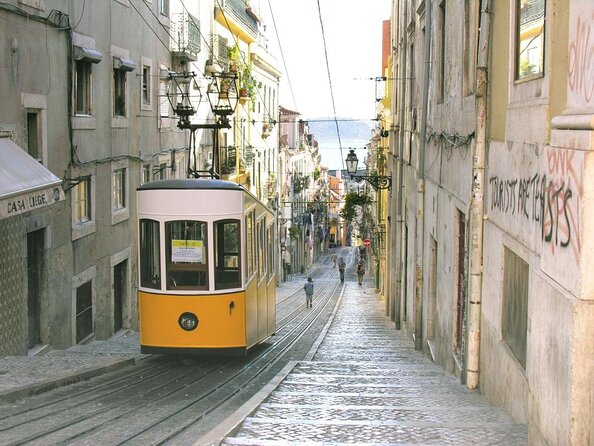
- A street artist’s view of Lisbon: Guide Igor explains the art, local neighborhoods, and stories behind the city’s painted surfaces.
- Three very different areas: You move from Bairro Alto to central Baixa Chiado, then into the tight lanes of Mouraria.
- Small-group format: No more than eight people can join, keeping the walk personal and easier to follow.
- A useful introduction to old Lisbon: The route combines street art with an overview of historic neighborhoods.
- English-language experience: The tour is offered in English, and Igor can speak calmly and clearly for younger participants.
- Souvenir included: You take home an artsy memento rather than only photographs.
Seeing Lisbon through its painted walls
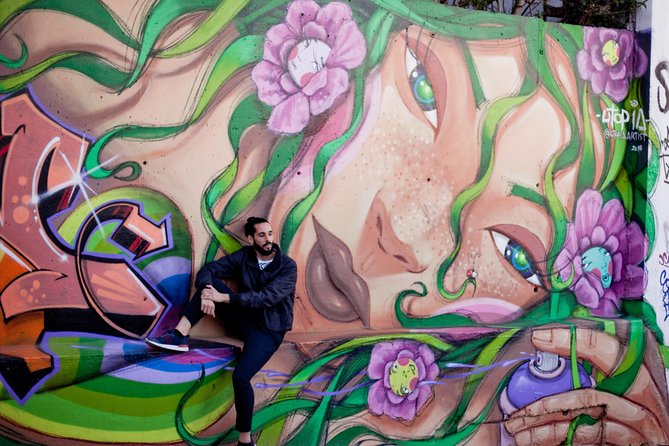
This is not simply a walk between large murals. The appeal lies in learning how to notice art that can be easy to miss when you are focused on tiled buildings, viewpoints, trams, and busy squares.
Igor guides you through Lisbon with the eye of an artist. One of the strongest reasons to book is that he does not treat the city’s art as decoration alone. He connects the work to the neighborhoods around it, helping you understand how street art fits into Lisbon’s older streets and changing urban culture.
That change in vision can last beyond the three-hour tour. Afterward, you may find yourself looking more closely at walls and shutters throughout Lisbon, spotting work that would otherwise blend into the background.
The pace also leaves room for conversation. With a maximum of eight people, you are not packed into a large group trying to hear a guide over city noise. The private-guide format is especially useful if you have questions about a particular piece, a neighborhood, or the difference between forms of street art.
The tour is offered in English. A useful detail for families is that Igor has been able to speak calmly enough for a 13-year-old to follow the explanations and enjoy the walk. That does not mean every child will be equally interested, but older children and teenagers with an interest in drawing, design, or city life should have plenty to notice.
More Walking Tours in Lisbon
- Lisbon: History, Stories and Lifestyle Walking Tour
★ 4.8 · 10,902 reviews - Best of Lisbon Small-Group Guided Walking Tour
★ 5.0 · 4,869 reviews - Lisbon: Food and Wine Small Group Walking Tour
★ 4.9 · 4,082 reviews
Starting near the Bandstand of Graça
The meeting point is the Bandstand of Graça at Largo da Graça, 1170-165 Lisboa. The walk ends at Escadinhas de São Cristóvão, 1100 Lisboa, so this is a point-to-point experience rather than a loop back to where you started.
That arrangement matters when planning your day. You will finish in the historic center, not at the starting point, so you can continue exploring from there or make your own way back. Hotel pickup and drop-off are not included.
The route begins in Graça and then takes you into the older central neighborhoods. The supplied information identifies the main stops as Bairro Alto, Praça Dom Pedro IV with Baixa Chiado, and Mouraria. The exact order may be adjusted by the guide, local conditions, or current street art events, but you should expect a walking route rather than a fixed series of indoor admissions.
Wear shoes suited to uneven streets and stairs. The moderate fitness requirement is worth taking seriously. Lisbon’s old quarters are known for hills and tight lanes, and the route spends much of its time outdoors.
Bairro Alto: street art in a historic quarter
The Bairro Alto section lasts about one hour. Admission is free because the art is encountered in the streets, not behind a ticket barrier.
Bairro Alto is a good place to begin because it shows how street art can sit beside older urban fabric. Here, your attention shifts between painted walls, narrow streets, traditional buildings, and the everyday life of the neighborhood. The point is not just to photograph a wall. It is to understand how art changes your reading of the street around it.
Igor’s role is important here. Without context, a piece may look like a colorful image that catches your eye for a few seconds. With an informed guide, you can ask why it is in that place, what details to notice, and how the work relates to Lisbon’s wider creative scene.
This hour also gives you a practical introduction to the tone of the walk. Expect to pause, look closely, and move on through the neighborhood. It is not a formal gallery visit, so you should not expect climate-controlled rooms, seats, or a fixed display. The reward is seeing art where people live, work, and pass through every day.
Praça Dom Pedro IV and Baixa Chiado
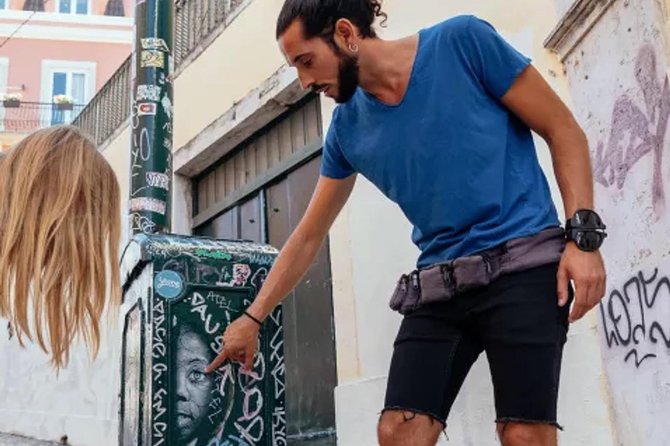
The route then passes through Praça Dom Pedro IV, commonly associated with Rossio, and the Baixa Chiado area. This portion takes about 30 minutes, making it the shortest named section.
The square provides a change of scale. After the tighter streets of Bairro Alto, you reach a more open and central part of Lisbon. Passing through Baixa Chiado helps connect the street art experience with the city’s main historic core, rather than treating the art scene as something separate from the rest of Lisbon.
This is also a useful orientation point early in a visit. If you are new to the city, the guide’s overview of old neighborhoods can help you understand how the central districts fit together. You will not be paying an entrance fee for this portion, though admission costs apply if you decide to enter monuments or art galleries during the walk.
The short time here means you should think of Praça Dom Pedro IV and Baixa Chiado as a linking section, not a full sightseeing tour of the area. If you want detailed visits to monuments, museums, or galleries, plan those separately. This experience is about outdoor art and neighborhood context.
A handful more Lisbon ideas to compare
- Lisbon: Street Art Tour
★ 4.9 · 1,324 reviews - Lisbon: Kickstart Street Art Walking Tour
★ 4.9 · 717 reviews - Lisbon: Street Art Tuk Tuk Tour
★ 4.9 · 372 reviews - LISBON Street Art Tour
★ 5.0 · 371 reviews
Mouraria: narrow streets and unexpected corners

The longest part of the experience is in Mouraria, with about two hours devoted to street art and the old lanes around Centro Comercial Mouraria. This is where the walk takes on its most exploratory character.
Mouraria is presented as a place to get slightly lost in narrow streets and see a more authentic side of Lisbon. That phrase should be understood in a practical way: the route is less about checking off one major landmark and more about noticing small details in an older neighborhood.
The lanes create a different setting from Baixa’s broad central spaces. You may find art in places that are easy to pass without a guide, and the tight layout makes the relationship between walls, doorways, stairs, and public space more apparent. The walk’s value here comes from time. Two hours gives Igor room to explain several works, discuss the surrounding area, and respond to questions without racing from one stop to the next.
Centro Comercial Mouraria serves as a focal point for this portion. The name can suggest a conventional shopping center, but the attraction here is the surrounding street art and neighborhood setting. The experience remains outdoors, and no gallery admission is included.
Mouraria is also the part most likely to test your legs. Narrow streets can mean stairs, slopes, and uneven paving. If you have limited mobility or prefer a flat route, ask about the walking demands before booking. The stated requirement is moderate physical fitness, and the length of this section makes it more than a quick photo stop.
What the guide adds to the experience
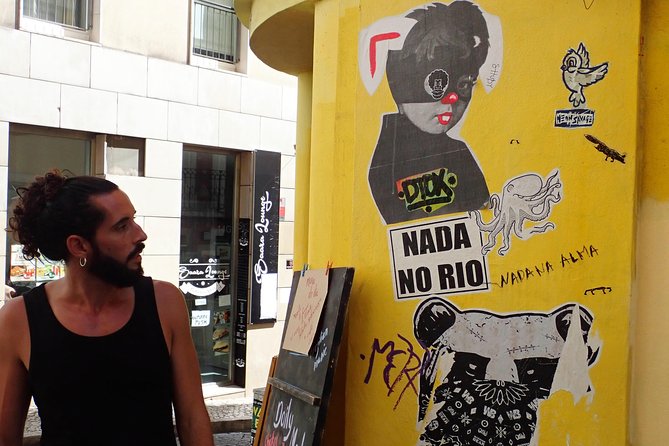
A street art walk depends heavily on the person leading it. Igor is identified as the private guide, and the strongest details available about his approach are his clear English, friendly manner, and ability to explain the subject through anecdotes.
That matters because street art can be hard to interpret from a photograph alone. A guide can point out details, give you a sense of the local scene, and explain how to look at work rather than simply label it. You are likely to get more from the tour if you ask questions and share what catches your eye.
The walk is also suitable for people who know little about street art. You do not need a background in art to follow the route. One useful outcome is learning a new way to read a city, from large pieces to small works that might otherwise pass unnoticed.
At the same time, you should not expect a formal art-history lecture or a complete survey of every artist working in Lisbon. The tour focuses on what can be seen along the route and on the neighborhoods that contain it. Current works can change, and the city’s outdoor art scene is naturally less fixed than a museum collection.
Does the $40.84 price offer good value?
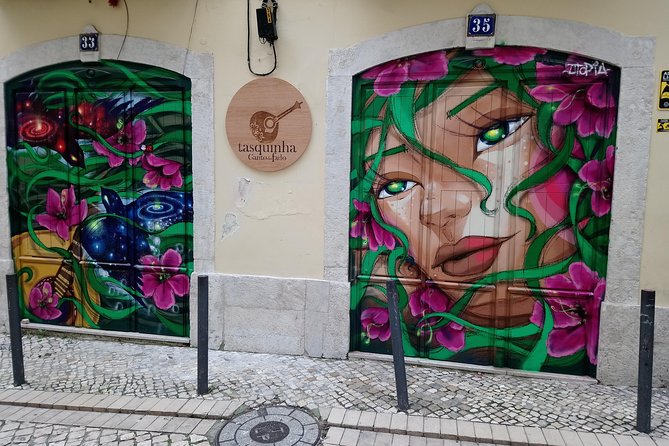
At $40.84 per person, the price is fair if you want interpretation rather than a self-guided stroll. You are paying for about three hours with a private guide, a deliberately small group, local neighborhood context, and a souvenir.
The value is strongest for first-time visitors who might otherwise walk past the art without understanding what they are seeing. It also makes sense for someone who has already visited Lisbon’s main monuments and wants an activity that feels more connected to daily streets than to major attractions.
The price is less attractive if you only want photographs or if you already know Lisbon’s street art scene well. You could explore the central neighborhoods without paying an entrance fee, but you would lose the guide’s explanations and the structure of the route.
The included souvenir adds a small personal touch, though it should not be the main reason to book. The real value is the way Igor connects the artwork to Bairro Alto, Baixa Chiado, Mouraria, and Lisbon’s older streets.
Who should book this walk?
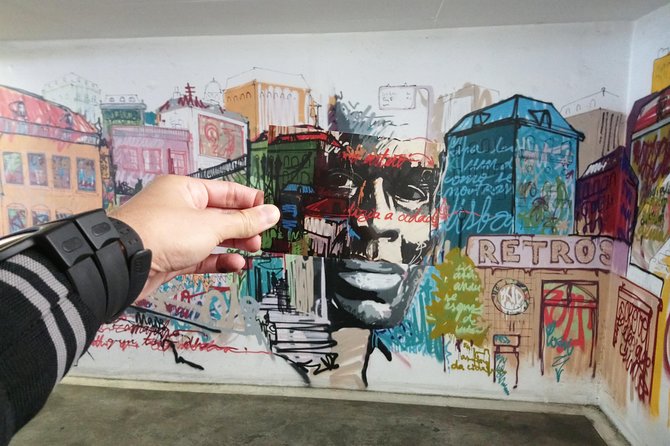
This experience fits several kinds of visitors:
- Street art fans who want local context and a better eye for work in public spaces.
- First-time visitors who want to combine sightseeing with a neighborhood walk.
- Couples and small groups who prefer a personal guide instead of a large tour.
- Families with older children or teenagers who are comfortable walking for three hours.
- Creative travelers interested in design, murals, urban spaces, and visual culture.
- Visitors with limited time who want a focused introduction to several central districts.
It is not the best match for someone seeking a seated activity, a museum tour, or a route with no hills or stairs. It is also not ideal if rain is likely, since good weather is required and the experience takes place outside.
The group limit of eight is a real advantage. You can usually expect a more direct exchange with the guide than on a large city tour, though the experience still includes other participants unless you book it for your own party.
Practical details for a smoother day
The tour lasts approximately three hours and is offered in English. A mobile ticket is provided, and confirmation arrives when you book.
Plan for an outdoor walk from the start at the Bandstand of Graça to the finish at Escadinhas de São Cristóvão. Since pickup and drop-off are not included, allow time to reach the starting point and decide what you want to do after the tour ends.
There are no included entrance fees. If you choose to visit a monument or art gallery during the walk, you pay that cost separately. The route itself focuses on free public art and neighborhood streets.
Book with the weather in mind. If poor weather causes cancellation, you can choose another date or receive a full refund. The same option applies if the minimum number of participants is not reached. You can cancel for a full refund up to 24 hours before the start time, but changes or cancellations inside that window are not accepted.
The experience is booked, on average, about 34 days ahead. That does not guarantee that every date sells out, but it is a useful reason to reserve early if the walk is important to your plans.
Should you book the Lisbon Street Art Walk?
Book it if you want to understand Lisbon’s street art rather than simply photograph it. The combination of Igor’s guidance, a group capped at eight, and time in Bairro Alto, Baixa Chiado, and Mouraria gives you a focused way to see parts of the city through public art.
I would especially choose it early in a Lisbon visit. The neighborhood overview can help you get your bearings, and the habit of looking closely at walls and side streets will improve the rest of your sightseeing.
Skip it if your priority is major monuments, indoor galleries, or a flat and effortless route. For everyone else, the $40.84 cost is reasonable for three hours of personal guidance, local atmosphere, and a new way to see Lisbon.
FAQ
How long does the Lisbon Street Art Walk last?
The experience lasts approximately three hours.
Where does the tour start?
It starts at the Bandstand of Graça, Largo da Graça, 1170-165 Lisboa, Portugal.
Where does the tour end?
The tour ends at Escadinhas de São Cristóvão, 1100 Lisboa, Portugal.
Which neighborhoods are included?
The route includes Bairro Alto, Praça Dom Pedro IV and Baixa Chiado, and Mouraria around Centro Comercial Mouraria.
Is the tour offered in English?
Yes. The experience is offered in English.
How many people can join?
The maximum group size is eight people.
Is an artistic souvenir included?
Yes. An artistic souvenir is included in the experience.
Can I cancel for a full refund?
Yes. You can cancel at least 24 hours before the start time for a full refund. If poor weather or an insufficient minimum number of participants causes cancellation, you can choose another date or receive a full refund.
Fresh finds around Lisbon
- Lisbon: Tuk Tuk City Tour★ 3.6 · 7 reviews
- Lisbon: Highlights and Hidden Gems Tour★ 5.0 · 7 reviews
- Fatima Full day Private Tour★ 5.0 · 7 reviews
- Private Tour to Evora and Monsaraz from Lisbon★ 5.0 · 7 reviews
- Discover Sintra Beauty with a Guided Journey from Lisbon★ 5.0 · 7 reviews
- Private Half-Day Tour to Sintra★ 3.4 · 7 reviews
- Lisbon: Sunset and Wine Catamaran Tour★ 5.0 · 7 reviews
- Nazaré: Beaches of Nazaré Guided E-Bike Tour★ 4.9 · 7 reviews
Walking Tours, compared.
Lisbon: History, Stories and Lifestyle Walking Tour
Read our review →
Best of Lisbon Small-Group Guided Walking Tour
Read our review →
Lisbon: Food and Wine Small Group Walking Tour
Read our review →
Best of Lisbon Walking Tour: Rossio, Chiado & Alfama
Read our review →
Sintra & Cascais Day Tour with Pena Palace Entry and Gardens Walk
Read our review →
Lisbon Roots – Small group Food & Culture Walking Tour w/tastings
Read our review →
Lisbon: Starter Walking Tour to the highlights in German
Read our review →Browse the lists this tour appears in