
Reviewed · ALFAMA & OLD TOWN WALKS
Walk Lisbon Like a Local: Bairro Alto & Downtown Experience
Lisbon’s best stories often appear between the big sights, and this walk takes you through exactly those in-between places. You start at Rossio, pass the grand horseshoe entrance of Rossio Station, then climb toward Bairro Alto, where old city walls, plague victims, noble families, and Saint Roque shape the story.
I like the route’s compact 2.5-hour length and its focus on places you can revisit on your own, especially Camões Square and Largo do Carmo. I also like the price: at $3.60 per person, it offers remarkable value if the tour runs as described. The main caution is the walking itself. Lisbon is hilly, and the moderate fitness requirement matters more here than the low price suggests.
In This Review
- Key points at a glance
- From Rossio Square into Lisbon’s old center
- Rossio Station and its theatrical entrance
- Camões Square and the poet behind Portugal’s language
- Bairro Alto’s story of plague, walls, and expansion
- Largo do Carmo and a medieval promise
- Ending at Miradouro de Santa Catarina
- What the $3.60 price really gives you
- Who will get the most from this walk
- Booking timing and cancellation
- Is Walk Lisbon Like a Local worth booking?
- FAQ
- Where does the walking tour begin?
- Where does the tour end?
- How long does the experience last?
- Is the tour offered in English?
- Is entry to the Santa Justa elevator included?
- Can I cancel for a full refund?
Key points at a glance
- Rossio to Bairro Alto: Follow a clear route from Lisbon’s central square into one of its most atmospheric historic neighborhoods.
- Rossio Station’s Neo-Manueline façade: See the famous intertwined horseshoe portals and learn why this train station looks more like a ceremonial building than a transport hub.
- Camões and Portuguese identity: Hear about Luís de Camões, the poet whose work helped shape how Portugal sees its age of exploration.
- Bairro Alto’s changing purpose: Learn how plague, population growth, churches, noble land, and urban planning reshaped the hill.
- Largo do Carmo: Visit the setting of a 14th-century convent founded after a Portuguese military victory.
- Practical value: The English walk includes a local guide and stories, but not private transport or entry to the Santa Justa elevator.
From Rossio Square into Lisbon’s old center
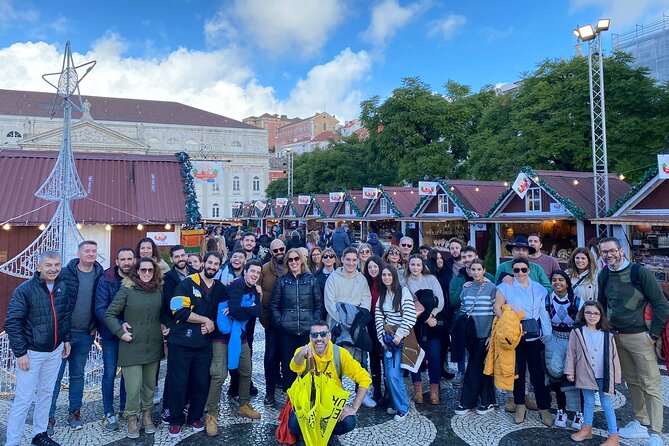
The walk begins at Praça Dom Pedro IV, usually called Rossio, at the heart of central Lisbon. This is a useful starting point because you are not being sent to some remote meeting place. Rossio sits near public transportation and gives you an immediate sense of how Lisbon’s downtown streets connect.
The opening portion lasts about 25 minutes. Your guide uses the square and nearby streets to set up the larger story before leading you toward Bairro Alto. That approach works well for a first visit because you begin with orientation, not a rush to a single monument.
I would treat this first section as a city lesson rather than a photo stop. You are learning how the center fits together, where the old routes ran, and how Lisbon expanded toward the hills. Since admission is free at every scheduled stop, the value comes from the explanation and the route itself.
The starting point also makes the tour easy to pair with other plans. You can reach Rossio by public transportation, and you finish at Miradouro de Santa Catarina rather than returning to the starting point. That one-way design saves you from retracing the walk, but you should plan your next move from the western side of the center.
More Walking Tours in Lisbon
- Lisbon: History, Stories and Lifestyle Walking Tour
★ 4.8 · 10,902 reviews - Best of Lisbon Small-Group Guided Walking Tour
★ 5.0 · 4,869 reviews - Lisbon: Food and Wine Small Group Walking Tour
★ 4.9 · 4,082 reviews
Rossio Station and its theatrical entrance
The next stop is Estação do Rossio, one of the most memorable buildings on the route. The station was commissioned by the Portuguese Royal Railway Company and designed in 1886 and 1887 by Portuguese architect José Luís Monteiro. It opened in 1890 and connected Lisbon with Sintra.
You do not need to enter a paid attraction to appreciate the building. The exterior is the point. Its Neo-Manueline style is a 19th-century revival of the ornate Manueline architecture associated with early 16th-century Portugal.
Look closely at the entrance. Two intertwined horseshoe portals form the most recognizable feature, with the words Central Station above them. The façade has a ceremonial quality that can make you forget you are looking at a working railway station.
The tour gives this building roughly 25 minutes. That is enough time for a guide to explain the architecture and its place in Lisbon, while giving you time to look up and take photographs. If you are already planning a train trip to Sintra, this stop adds useful context before you ever board.
I especially like this part of the walk because it rewards attention. Rossio Station is easy to pass while focusing on the surrounding square, but its design is unusually theatrical. A guide can point out why it matters instead of leaving you with just a quick photograph.
Camões Square and the poet behind Portugal’s language
Praça Luís de Camões marks the transition toward Bairro Alto. The square honors Luís de Camões, Portugal’s national poet and the author of Os Lusíadas, the epic poem about Vasco da Gama’s sea route to India.
The story attached to Camões has a dramatic edge. It is said that he lost one eye in a battle in Ceuta. His poem had such a strong influence that Portuguese is sometimes called the language of Camões.
You spend about 30 minutes here, which gives the guide room to connect one statue and one square to a larger national idea. This is useful because Portugal’s maritime expansion can otherwise become a string of names and dates. Camões gives that story a human voice, even if you are not a poetry reader.
The square also works as a visual marker. By this point, you are leaving the more formal downtown core and approaching the older hill streets of Bairro Alto. The walk does not treat the neighborhood as only a nightlife district. Instead, it explains why this part of Lisbon developed in the first place.
That historical frame is one of the strongest parts of the experience. You are not simply told that Bairro Alto is old. You learn about population pressure, city walls, religious institutions, and the people pushed toward this area during difficult periods.
Bairro Alto’s story of plague, walls, and expansion
The Bairro Alto stop takes about 30 minutes and provides the most substantial historical background on the route. In the late 15th century, Lisbon had drawn people from many parts of the world because of the discoveries. The city needed more room, and the area around today’s Camões Square became one of the entrances to Lisbon.
At that time, the Fernandine wall and the Santa Catarina gate marked the edge of the city. After the earthquake, two churches, Encarnação and Loreto, occupied part of the area near the former gate. Beyond the wall were lands belonging to wealthy noble families. A cemetery for victims of the Black Death was also located on the hill.
This is the kind of detail that turns a walk into a useful history lesson. You can look at today’s streets and understand that the neighborhood was shaped by several competing needs: wealthy landowners, sick people seeking care, city growth, religious devotion, and public health.
The account of Saint Roque adds another layer. In 1506, King Manuel I requested a relic of Saint Roque from Venice and placed it in a hermitage near the cemetery. As Lisbon’s population grew and plague reached the city, poorer and sick residents moved closer to the church. An urban plan was then developed to accommodate them.
The story is not polished into a simple tale of grand buildings and famous rulers. It includes illness, crowding, poverty, and the practical need to expand the city. I find that more useful than a list of decorative façades because it helps you read Bairro Alto as a place shaped by ordinary needs.
Expect some uphill walking through this section. The tour information calls for moderate physical fitness, and that warning should guide your choice. Lisbon’s hills can make a short distance feel longer, particularly if you are carrying a heavy bag or have trouble on uneven streets.
More old-town wanders:
- Alfama Tour in Lisbon Old Town
★ 5.0 · 4,936 reviews - Private Lisbon Sightseeing Tuk-Tuk Tour: Alfama, Belém & More
★ 5.0 · 4,277 reviews - Lisbon: Hills, Alfama, and Mouraria Tour by Electric Bike
★ 4.8 · 3,438 reviews - Best of Lisbon Walking Tour: Rossio, Chiado & Alfama
★ 4.9 · 2,700 reviews
Largo do Carmo and a medieval promise
The route continues to Largo do Carmo, a smaller square with one of Lisbon’s most important religious foundations. The church and convent were built in 1389 after Nuno Álvares Pereira vowed to construct the world’s most beautiful church if Portugal defeated Castilian forces at the Battle of Aljubarrota in 1385.
Portugal won, and Nuno Álvares Pereira kept his promise. He funded the Carmelite church and convent, completed in 1423. Afterward, he joined the Carmelite order and spent the rest of his life in the convent.
The stop lasts about 15 minutes, so expect a focused explanation rather than a long visit. The attraction here is the setting and the story. A military commander, a vow, a royal struggle, and a religious life all meet in one square.
Do not expect admission to a paid interior attraction to be part of the price. The tour describes the stop at Largo do Carmo, but the only specific paid sight excluded from the experience is the Santa Justa elevator. That means you should think of this walk as an outdoor history tour, not a pass covering Lisbon’s monuments.
Largo do Carmo is also a sensible place to pause. After the uphill portions, a short explanation in a contained square gives the route a calmer rhythm before the final stretch toward Santa Catarina.
Ending at Miradouro de Santa Catarina
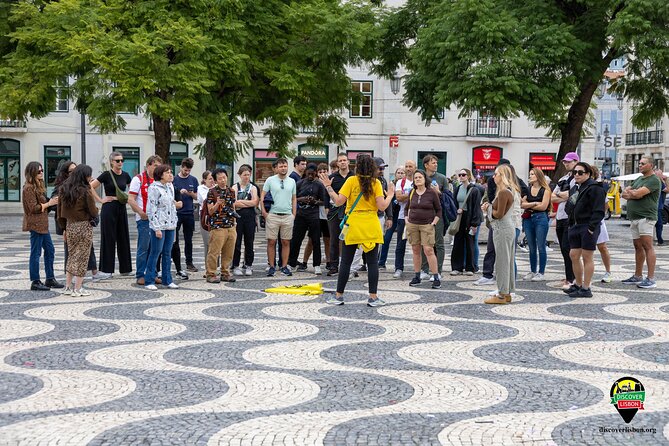
The walk ends at Miradouro de Santa Catarina, also known as a viewpoint in western central Lisbon. The listed end point is at Rua de Santa Catarina, 1200-262 Lisboa. You should note that the tour does not return you to Praça Dom Pedro IV.
That ending is useful if you want to continue exploring Lisbon on foot, but it requires a little planning. Check your next destination before you begin, especially if you have a timed booking elsewhere. The experience includes no private transportation, so you make your own way after the walk.
The route’s final location is one of its appealing features because you finish with a view rather than at a transport hub or inside a shop. The supplied feedback specifically praised the beautiful views and the guide’s interesting information. Those two points match the structure of the route: the walk builds the story through central Lisbon and finishes in a place suited to looking back across the city.
What the $3.60 price really gives you
At $3.60 per person, this is an unusually inexpensive way to spend two and a half hours in central Lisbon. The price includes an expert local guide, the walking route, and stories about the places you pass. It does not include private transportation or entry to the Santa Justa elevator.
The value is strongest if you want orientation. A guide can connect Rossio, the station, Camões Square, Bairro Alto, Carmo, and Santa Catarina into one route. You then have a better sense of which areas deserve a second visit.
The price is less important if you were hoping for a monument-heavy tour with interior access. This is primarily an outdoor walk, and the listed stops are free. You are paying for the route and the interpretation, not for admission tickets.
The maximum group size is 30 people. That is not a tiny private walk, so you should not expect constant personal attention. Still, the group limit gives the guide a defined audience and keeps the experience smaller than a large city bus excursion.
The published rating is 4.9 from 27 ratings, with 100 percent recommending the experience. One detailed rating gave it four out of five and described it as a short way to learn about an area the person might otherwise have missed. That is a fair way to judge the tour: its strongest feature is access to a part of Lisbon you may not reach naturally during a packed first visit.
Who will get the most from this walk
I would choose this tour if you are visiting Lisbon for the first time and want a quick sense of the central neighborhoods. The route covers major names, but it also explains how the city grew beyond its walls and how religion, disease, and social class affected that growth.
It also suits you if you prefer stories to checklists. Camões, Saint Roque, Nuno Álvares Pereira, the Castilian conflict, and the old city walls give the walk several memorable threads.
The experience is a good match for an independent visitor who wants help getting oriented, then plans to explore alone afterward. Since it ends at Santa Catarina, you can continue your day from a different part of central Lisbon instead of walking back over the same ground.
I would be more cautious if you have limited mobility or dislike hills. The physical requirement is moderate, but Lisbon’s terrain is not flat, and the route moves from downtown toward Bairro Alto. Wear sensible shoes and keep your bag light.
The tour is offered in English, and a mobile ticket is available. Service animals are allowed. Confirmation is provided at booking, which helps when you are arranging a tight schedule.
Booking timing and cancellation
The experience is booked an average of 13 days ahead, so I would reserve before your Lisbon dates are fixed if the schedule matters to you. The maximum group size is 30, and popular time slots may not remain open close to departure.
Free cancellation is available up to 24 hours before the local start time. A cancellation made less than 24 hours before the start is not refunded, and changes inside that window are not accepted. That policy is simple, but you should check the local time carefully if you are changing plans from another time zone.
Is Walk Lisbon Like a Local worth booking?
Yes, if you want an inexpensive, English-language introduction to Rossio, Bairro Alto, Carmo, and the viewpoints beyond downtown. I like the way the walk combines architecture, poetry, plague, religion, and city growth rather than treating Lisbon as a row of postcard stops.
Book it for orientation, local stories, and the chance to see an area you might otherwise skip. Do not book it expecting private transport, extensive interior visits, or a flat route. If you are comfortable with hills and want a short history walk with a scenic finish, the $3.60 price makes this an easy value choice.
FAQ
Where does the walking tour begin?
The tour begins at Praça Dom Pedro IV, 1100-200 Lisboa, Portugal, in the Rossio area.
Where does the tour end?
The walk ends at Miradouro de Santa Catarina, 1200-262 Lisboa, Portugal.
How long does the experience last?
The walking tour lasts approximately 2 hours and 30 minutes.
Is the tour offered in English?
Yes. The experience is offered in English.
Is entry to the Santa Justa elevator included?
No. Entry to the Santa Justa elevator is not included in the tour price.
Can I cancel for a full refund?
Yes, if you cancel at least 24 hours before the experience start time. Cancellations made less than 24 hours in advance are not refunded, and late changes are not accepted.
Fresh finds around Lisbon
- Lisbon: Tuk Tuk City Tour★ 3.6 · 7 reviews
- Fatima Full day Private Tour★ 5.0 · 7 reviews
- Lisbon: Highlights and Hidden Gems Tour★ 5.0 · 7 reviews
- Private Tour to Evora and Monsaraz from Lisbon★ 5.0 · 7 reviews
- Discover Sintra Beauty with a Guided Journey from Lisbon★ 5.0 · 7 reviews
- Private Half-Day Tour to Sintra★ 3.4 · 7 reviews
- Lisbon: Sunset and Wine Catamaran Tour★ 5.0 · 7 reviews
- Nazaré: Beaches of Nazaré Guided E-Bike Tour★ 4.9 · 7 reviews
Alfama & Old Town Walks, compared.

Private Lisbon Sightseeing Tuk-Tuk Tour: Alfama, Belém & More
Read our review →
Lisbon: Hills, Alfama, and Mouraria Tour by Electric Bike
Read our review →
Best of Lisbon Walking Tour: Rossio, Chiado & Alfama
Read our review →
Lisbon Small-Group Food Tour with 18 Tastings in Alfama District
Read our review →
Lisbon: Baixa District Food Tour with Dinner and Drinks
Read our review →
Lisbon E-Bike Tour Commerce Square, Mouraria and Alfama
Read our review →
Lisbon: Old Town TukTuk Tour and Scenic Viewpoints in Alfama
Read our review →Browse the lists this tour appears in