
Reviewed · WALKING TOURS
Lisbon Off The Beaten Track and Main Sights Private Walking Tour
The best thing about this walk is its route through Alfama’s steep old lanes, where famous viewpoints, medieval churches, Roman remains, and quiet residential corners appear within a short stretch. It gives you Lisbon’s headline sights without leaving out the small details that make the city feel lived-in.
I like the sweeping river view from Portas do Sol, and I like the private format, which lets you ask questions instead of following a fixed script. Guide Luis has also shown a welcome willingness to linger: one walk ran close to four hours and included a coffee stop. The main consideration is the terrain. You’ll walk uphill and downhill on old streets, and the tour runs in all weather.
- Portas do Sol and Santa Luzia viewpoints: Start with Lisbon’s best introduction, the Tagus River, Castle Hill, and layered azulejo work.
- Alfama beyond the postcard view: See residential lanes, old houses, a new garden, and the less polished side of the castle quarter.
- Roman Lisbon beneath the modern city: Visit the Teatro Romano ruins and Roman tombstones built into a later house.
- A private guide for a modest price: At $48.06 per person, the tour offers personal attention without the cost of a luxury excursion.
- A strong first-day route: Morning or afternoon departures make this useful for getting your bearings early in a Lisbon stay.
- A downhill finish by the river: End at Praça do Comércio, Lisbon’s grandest public square, rather than returning to the starting point.
In This Review
- Why this Lisbon walk works so well
- Portas do Sol gives you Lisbon in one broad view
- Santa Luzia explains Lisbon through tiles
- Igreja de Santiago and an older residential Alfama
- Beco do Recolhimento shows the castle quarter’s quieter side
- Teatro Romano reveals Lisbon’s Roman foundation
- Lisbon Cathedral is half church, half fortress
- Saint Anthony and the question of Lisbon’s favorite saint
- Roman tombstones in an unexpected wall
- Praça do Comércio opens Lisbon back to the river
- The final church facade and Lisbon’s decorative language
- What the private format is worth
- Who should book this walk
- Should you book Lisbon Off the Beaten Track and Main Sights?
- FAQ
- How long is the Lisbon walking tour?
- What language is the tour offered in?
- How much does the tour cost?
- Is this a private tour?
- How many people can join one booking?
- Where does the tour begin?
- Does the tour end where it starts?
- Are food, drinks, or transportation included?
- What happens if it rains?
Why this Lisbon walk works so well
Lisbon is easy to admire and surprisingly hard to read. The city’s hills, tiled walls, earthquake scars, churches, and riverfront squares all belong to different periods. A good guide helps you connect them.
This private tour does that in a compact three-hour route. You begin high above the river at Largo Portas do Sol, move through Alfama and the castle quarter, pass ancient Roman evidence, and finish in the rebuilt Baixa district at Praça do Comércio. The route is not just a checklist of monuments. It shows how Lisbon changed from Roman port to medieval stronghold, royal capital, earthquake survivor, and Atlantic trading city.
I especially like the contrast between the public views and the ordinary streets. Portas do Sol and Santa Luzia are classic stops, but Beco do Recolhimento and Largo do Contador give you a look at the residential side of old Lisbon. That balance matters. You get the city’s famous pictures, then see the worn steps, homes, and small corners that make the district feel real.
The tour costs $48.06 per person, with a minimum of two people and a maximum of 15 per booking. Since it is private, your group is the only group taking part. For two people, that is a fair price for a local guide and three hours of walking. For a larger group, the per-person cost becomes even more attractive, particularly if a group discount applies.
Portas do Sol gives you Lisbon in one broad view
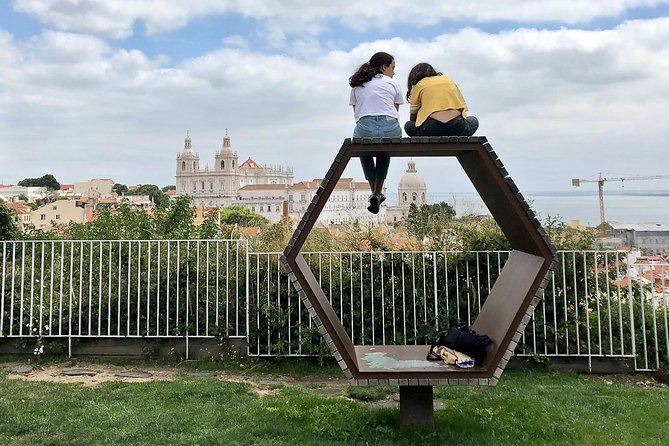
The walk begins at Miradouro das Portas do Sol, one of Lisbon’s most useful viewpoints. From here, the Tagus opens toward the Atlantic, while the old city climbs and folds around Castle Hill.
This is a smart starting point because the view gives you a map before the streets become confusing. Your guide can point out the castle area, Alfama, and the riverfront, then explain why Lisbon has always depended on the water. The river is not just scenery. It helped shape trade, travel, defense, and the city’s connection with the wider world.
You have about 15 minutes here. That is enough for photographs and an introduction, though not enough for a long private lecture. If you want extra time for pictures, ask at the start. The tour is private, so timing can be more flexible than on a large group walk.
More Walking Tours in Lisbon
- Lisbon: History, Stories and Lifestyle Walking Tour
★ 4.8 · 10,902 reviews - Best of Lisbon Small-Group Guided Walking Tour
★ 5.0 · 4,869 reviews - Lisbon: Food and Wine Small Group Walking Tour
★ 4.9 · 4,082 reviews
Santa Luzia explains Lisbon through tiles
A short walk brings you to Miradouro de Santa Luzia. The two platforms here are known for their azulejos, the painted ceramic tiles found across Portugal.
The appeal is not simply decorative. Tiles from different periods and styles sit together, much like Lisbon itself, where Roman, medieval, royal, religious, and modern layers overlap. Your guide can help you notice the difference between looking at a pretty wall and reading what it says about Portuguese design.
Allow about 15 minutes. This is another photo-friendly stop, but the value is in the explanation. Without context, the tiles can blur into a pleasant background. With a guide, you can connect them to the city’s buildings, churches, and long tradition of using ceramic surfaces for both beauty and storytelling.
Igreja de Santiago and an older residential Alfama
At Igreja de Santiago, the tour shifts from panoramic Lisbon to a quieter local corner. The Baroque church marks the beginning of the Portuguese route toward Santiago de Compostela, one of Europe’s major pilgrimage destinations.
The nearby Largo do Contador is just as important for understanding the neighborhood. Its houses predate the 1755 tsunami, giving you a rare sense of what survived before the disaster reshaped much of Lisbon. The stop lasts about 15 minutes, and the church and square offer a useful contrast between grand religious architecture and ordinary homes.
I like this part because it keeps the walk from becoming a parade of major monuments. You are not only looking at a church facade. You are seeing how a small square and its houses fit into the daily fabric of Alfama.
Beco do Recolhimento shows the castle quarter’s quieter side
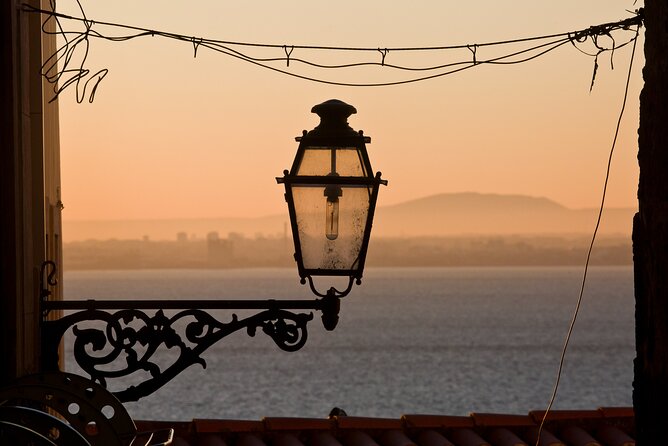
The route continues through Beco do Recolhimento, in the residential half of the Castle of St. George. This section is less about a single landmark and more about the shape of the old neighborhood.
You’ll explore narrow streets, local homes, and the Recolhimento garden and belvedere, which opened a view toward the eastern side of town. The scheduled time is about 20 minutes, making this one of the longer stops.
That extra time is useful. Old Lisbon is easy to rush through, especially when you are climbing or watching for traffic on narrow streets. Here, you can pause and see how the castle area is more than a fortress or tourist backdrop. It is also a residential quarter with its own rhythm and outlook.
The practical issue is footing. The route includes slopes and uneven old streets. Wear shoes with a firm sole, and avoid treating this as a casual stroll in dress shoes or smooth sandals. The tour operates in all weather, so a light rain layer is sensible even when the forecast looks uncertain.
More walking routes in Lisbon:
- Best of Lisbon Walking Tour: Rossio, Chiado & Alfama
★ 4.9 · 2,700 reviews - Age of Discoveries Walking Tour in Belém
★ 5.0 · 1,513 reviews - Sintra & Cascais Day Tour with Pena Palace Entry and Gardens Walk
★ 5.0 · 962 reviews - Lisbon Roots – Small group Food & Culture Walking Tour w/tastings
★ 5.0 · 910 reviews
Teatro Romano reveals Lisbon’s Roman foundation
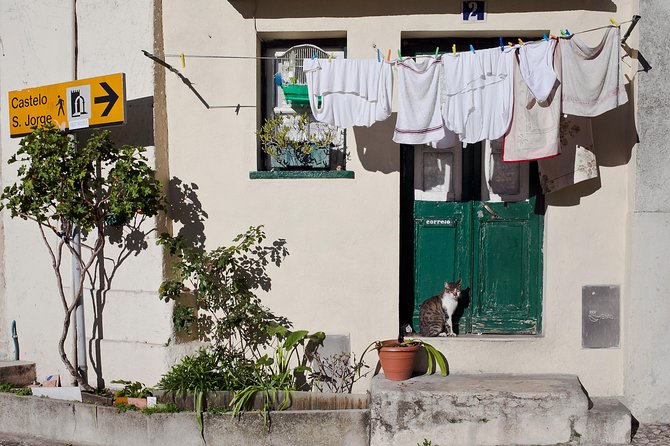
At Museu de Lisboa, Teatro Romano, you’ll see the remains of Lisbon’s first properly built monument under the rule of Caesar Augustus, dating to the end of the first century BC. It was expanded in AD 57 and dedicated to Nero.
The site was later buried and forgotten, then reopened to the public in 2015. That story alone makes the stop worthwhile. Modern Lisbon does not always advertise its Roman past, yet the ruins show how old the city’s public life really is.
The visit is scheduled for 10 minutes. That is brief, so expect an introduction rather than a long museum visit. The stop works best as a compact piece of the larger story: Roman theater, medieval city, earthquake damage, and later rebuilding all appear within a few blocks.
The tour details list admission as free at the stops. Food, drinks, and transportation are not included, so carry water and plan for your own snack if you need one during the walk.
Lisbon Cathedral is half church, half fortress
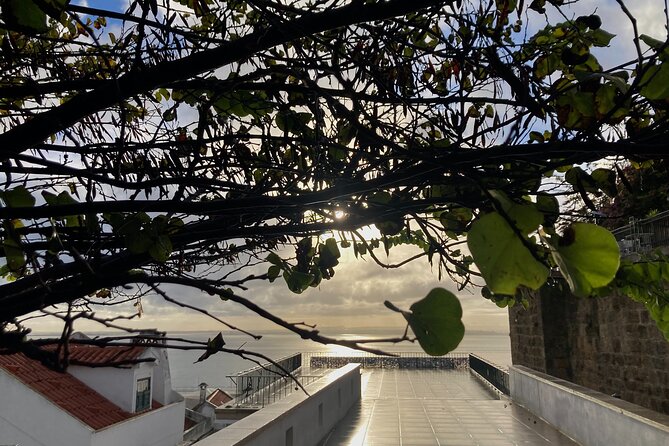
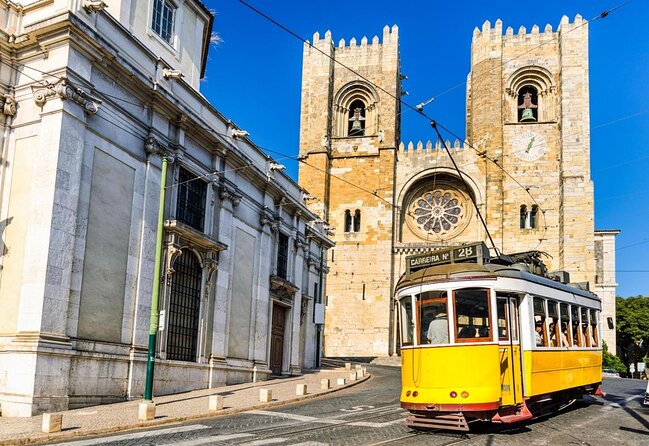
The Sé de Lisboa, or Lisbon Cathedral, is the city’s only remaining Romanesque monument. Its heavy form makes it look almost defensive, and that is part of its appeal. This is a church built in a city where religion and protection were closely linked.
You’ll have about 20 minutes here. The cathedral has been radically rebuilt, including major work in the 1930s, so it is not an untouched medieval building. That fact makes the stop more interesting, not less. You can consider what is original, what was repaired, and how later generations decided an old monument should look.
I would pay attention to the building’s character rather than expecting a perfect medieval interior. The cathedral is valuable as a survivor and a reconstruction, a place where Lisbon’s long past has been repeatedly repaired.
Saint Anthony and the question of Lisbon’s favorite saint
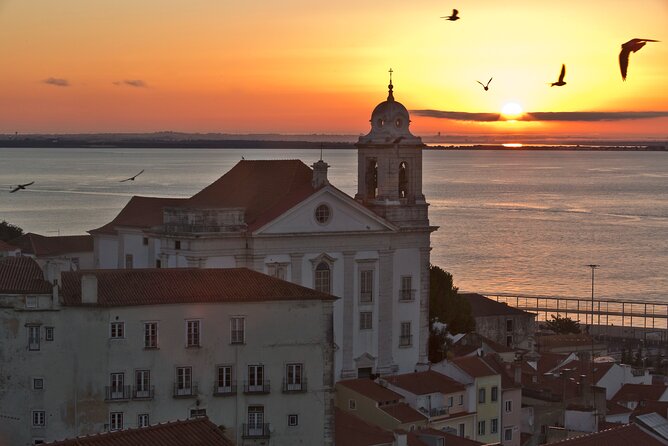
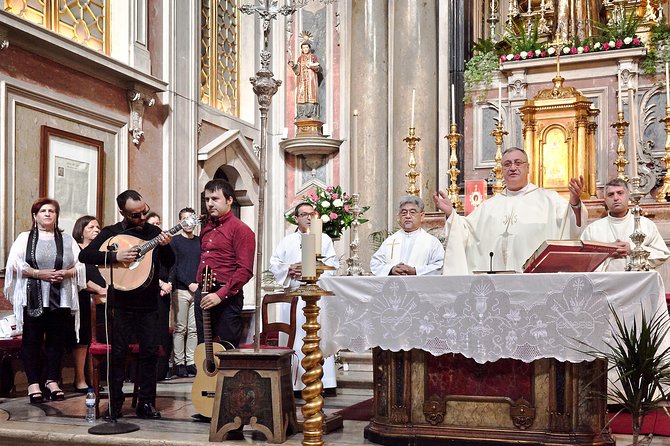
The next stop is the Church of St. Anthony, built over the place traditionally identified as the saint’s birthplace. The original room is now the church crypt.
The church was rebuilt after the 1755 tsunami and remains one of Lisbon’s most popular religious sites. You’ll spend around 15 minutes here, enough to hear the tradition and compare Saint Anthony with Saint Vincent, another major figure in Lisbon’s religious identity.
This is a good example of how the tour mixes fact and local belief without needing a grand monument. Saint Anthony is part of Lisbon’s public identity, and the small birthplace tradition gives the neighborhood a strong personal connection to him.
Roman tombstones in an unexpected wall

At Lapides das Pedras Negras, the ancient past appears in a less formal way. Roman tombstones are embedded in the walls of an 18th-century residential building.
The stop takes about 10 minutes. It is easy to miss something like this when walking alone, since it does not look like a large archaeological site with a grand entrance. Your guide’s role is important here: the point is not only to see the stones, but to understand how older pieces were reused in the later city.
This is one of the tour’s best small discoveries. It asks you to look at Lisbon’s walls with more care. After this, a plain facade may deserve a second glance.
Praça do Comércio opens Lisbon back to the river
The route finishes at Praça do Comércio, also called Terreiro do Paço. After the tight lanes and steep streets of Alfama, the open square feels almost theatrical.
The square was rebuilt after the 1755 tsunami and arranged as a grand setting facing the river. You’ll see the Column Pier, the statue of King José, and the monumental arch. Events take place here throughout the year, adding another layer to the square’s public role.
About 20 minutes are scheduled. This is a good place to pause, look back toward the Tagus, and understand the city’s change from hilltop lanes to ordered waterfront avenues. Since the tour ends at a different location from where it begins, you can continue exploring the Baixa area afterward rather than retracing the route.
The end point is listed as a separate location, but the supplied details do not give a precise final address. Confirm that detail when booking if you need to meet a taxi, catch a train, or fit the walk around another timed visit.
The final church facade and Lisbon’s decorative language
Before the tour ends, you’ll see Igreja de Nossa Senhora da Conceição Velha. Its late Portuguese Gothic facade is filled with royal symbols, grotesque figures, and esoteric suggestions.
This is a short 10-minute stop, but it rewards close attention. The facade is not plain medieval stonework. It mixes religious meaning, royal power, and decorative signs that invite questions. A guide can point out details that are easy to miss when you pass on your way to the riverfront.
The stop also brings the tour back to one of its main themes: Lisbon is a city of layers. Roman stones, medieval churches, Baroque decoration, royal rebuilding, and modern restoration all share the same streets.
What the private format is worth
The tour is offered in English and has morning or afternoon departure options. That flexibility helps you place it around a museum visit, a meal, or your arrival schedule.
A private walk is most useful if you have specific interests. You can ask about tiles, saints, Roman Lisbon, architecture, the 1755 disaster, or the difference between Alfama and Baixa. You are not dependent on the interests of a large mixed group.
The experience can also run longer than the advertised three hours if the pace allows. One account describes a walk with Luis that lasted close to four hours and included a coffee stop. That does not guarantee the same schedule for every booking, but it suggests that the guide may allow room for questions and a more relaxed pace.
At the same time, a private tour does not mean a private vehicle. Transportation is not included, and the route is on foot. Hotel pickup and drop-off are not included either. Meet at Largo Portas do Sol, near public transportation, and arrange your own way there.
Who should book this walk
I would choose this tour for a first or second day in Lisbon, especially if you want a clear introduction before exploring on your own. The route covers major sights while giving you enough lesser-known corners to avoid a purely postcard view of the city.
It suits couples, families, and small groups who want to ask questions freely. The maximum is 15 people, but the private arrangement means only your group participates. A larger party may find the price especially reasonable if a group discount is available.
I would think twice if you have trouble with hills, uneven surfaces, or walking in bad weather. The tour operates in all conditions, and Lisbon’s old quarters are not flat. You should also know that the advertised time is approximate. If you have a fixed lunch booking or another timed attraction, leave a cushion.
The tour does not include food or drinks, so bring water. Alcoholic drinks are also excluded. No air-conditioned vehicle is provided, because this is a walking experience.
Should you book Lisbon Off the Beaten Track and Main Sights?
Book it if you want Lisbon explained as a connected city rather than a string of isolated stops. The combination of Portas do Sol, Santa Luzia, Alfama lanes, Roman remains, the cathedral, Saint Anthony, and Praça do Comércio gives you a useful three-hour framework.
The strongest reasons to choose it are the private guide, the sensible route, and the mix of major sights with details you could easily miss. Luis has a reputation for careful explanations and flexibility, and the price is modest for a private English-language walk.
Skip it if you want a relaxed, flat route, extensive interior visits, or transportation between sights. For most active visitors, though, this is a practical way to meet Lisbon on foot, with the river at one end and the city’s oldest streets under your shoes.
FAQ
How long is the Lisbon walking tour?
The tour lasts approximately three hours. The timing can vary, and one walk with Luis lasted close to four hours with a coffee stop.
What language is the tour offered in?
The tour is offered in English.
How much does the tour cost?
The listed price is $48.06 per person. Group discounts are available.
Is this a private tour?
Yes. Only your group participates in the private activity.
How many people can join one booking?
A booking requires at least two people and allows a maximum of 15 people.
Where does the tour begin?
The meeting point is Largo Portas do Sol, 1100-411 Lisboa, Portugal.
Does the tour end where it starts?
No. The activity ends at a different location, with the final point listed separately from the starting point.
Are food, drinks, or transportation included?
No. Food, drinks, alcoholic beverages, hotel pickup and drop-off, and transportation to or from attractions are not included.
What happens if it rains?
The tour operates in all weather conditions. Dress appropriately for the forecast and wear sturdy shoes for Lisbon’s hills and old streets.
Fresh finds around Lisbon
- Lisbon: Tuk Tuk City Tour★ 3.6 · 7 reviews
- Fatima Full day Private Tour★ 5.0 · 7 reviews
- Lisbon: Highlights and Hidden Gems Tour★ 5.0 · 7 reviews
- Discover Sintra Beauty with a Guided Journey from Lisbon★ 5.0 · 7 reviews
- Private Tour to Evora and Monsaraz from Lisbon★ 5.0 · 7 reviews
- Private Half-Day Tour to Sintra★ 3.4 · 7 reviews
- Lisbon: Sunset and Wine Catamaran Tour★ 5.0 · 7 reviews
- Nazaré: Beaches of Nazaré Guided E-Bike Tour★ 4.9 · 7 reviews
Walking Tours, compared.
Lisbon: History, Stories and Lifestyle Walking Tour
Read our review →
Best of Lisbon Small-Group Guided Walking Tour
Read our review →
Lisbon: Food and Wine Small Group Walking Tour
Read our review →
Best of Lisbon Walking Tour: Rossio, Chiado & Alfama
Read our review →
Sintra & Cascais Day Tour with Pena Palace Entry and Gardens Walk
Read our review →
Lisbon Roots – Small group Food & Culture Walking Tour w/tastings
Read our review →
Lisbon: Starter Walking Tour to the highlights in German
Read our review →Browse the lists this tour appears in