
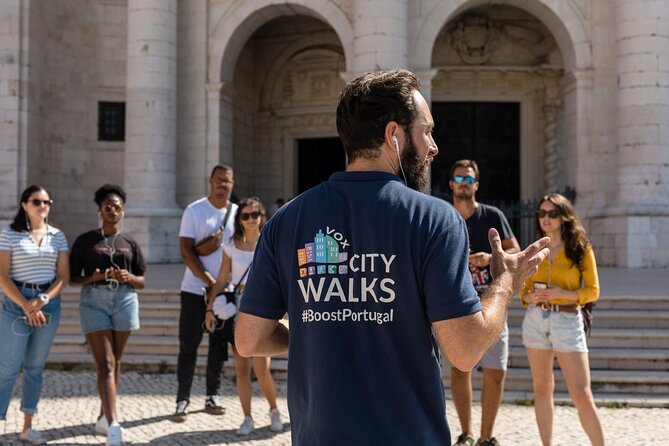
Reviewed · ALFAMA & OLD TOWN WALKS
Lisbon: Baixa Chiado Quarter Walking Tour
Lisbon’s downtown is best understood on foot, where grand squares, steep lanes, tiled sidewalks, old theaters, and famous elevators fit into one compact route. This Baixa-Chiado walking tour takes you from the riverfront through the rebuilt Baixa district and uphill toward Chiado and Bairro Alto, with plenty of stops for stories and photos.
I like the focus on Praça do Comércio and Rossio, Lisbon’s two great public squares, and I like that the walk adds places many visitors might otherwise rush past, such as Bertrand Bookstore, Carmo Convent, and the old theaters. The free Vox City app is also useful if you want to keep exploring after the guide leaves.
The main caution is its $107 price. Since the tour lasts about two hours and does not include attraction admissions, food, drinks, or public transportation, it offers the best value if you want an organized introduction rather than a long sightseeing day. One published account also described confusion when a two-hour route stretched toward three hours, so ask the guide early about timing.
In This Review
- Key points to know before booking
- Starting at Douradores and entering Baixa
- Praça do Comércio and the Augusta Street Arch
- City Hall and Lisbon’s rebuilt center
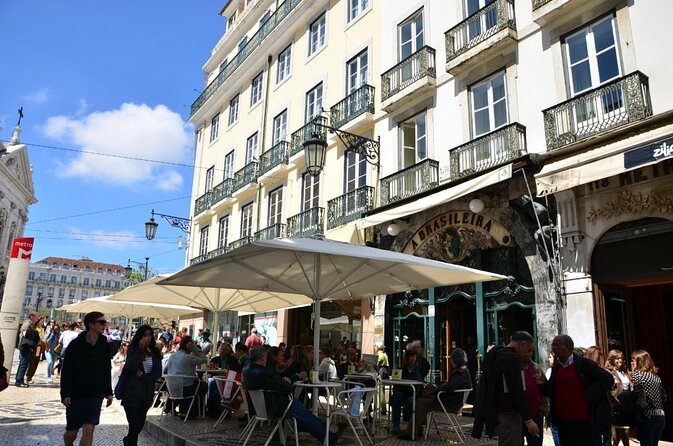
- Bertrand Bookstore and Café A Brasileira
- Luís de Camões Square and the climb toward Bairro Alto
- Bica and Gloria, Lisbon’s hillside transport
- Carmo Convent, the roofless church
- Rossio Square and the National Theatre
- Santa Justa Elevator and Lisbon from above
- The Jesuit church and Chiado’s cultural core
- What the $107 price really buys
- Timing, pace, and guide quality
- Who should book this Lisbon walk
- Should you book it?
- FAQ
- Where does the Baixa-Chiado walking tour begin?
- Where does the tour end?
- How long does the walking tour last?
- What attractions are included in the route?
- Are entrance tickets included?
- Is public transportation included?
- Is the Vox City app included?
- Can I cancel for a full refund?
Key points to know before booking
- Praça do Comércio opens the story: Begin beside the Tagus at Lisbon’s grand riverfront square and the symbolic Augusta Street Arch.
- The route covers several hills: Baixa is fairly orderly, but Carmo, Chiado, and Bairro Alto bring slopes and uneven Portuguese paving.
- Santa Justa is viewed, not included inside: The famous iron elevator is part of the sightseeing, but entry and transport tickets cost extra.
- The route mixes famous sights with local culture: Bertrand Bookstore, Café A Brasileira, old theaters, and family-run taverns give the walk more character than a monument-only circuit.
- Barbara received strong praise for her guiding: One account described her as pleasant and well informed, while another praised the guide’s professional delivery in Spanish. Guide assignments can vary.
- The app adds value after the walk: Your booking includes a Vox City map and several self-guided Lisbon routes.
Starting at Douradores and entering Baixa

The walk begins at Rua dos Douradores 16, a central meeting point in Lisbon’s Baixa quarter. You return to this same location at the end, which makes the tour easy to fit into a day of sightseeing. Confirmation arrives when you book, and the group can include up to 25 people.
Baixa is not old Lisbon in its original form. The 1755 earthquake destroyed much of the central city, and the district was rebuilt under the direction of the Marquês de Pombal. The result is a more orderly street plan than you will find in Alfama or Bairro Alto, with straight roads, broad squares, and a strong shopping and banking role.
That rebuilding is one of the most useful themes on this walk. You are not simply ticking off monuments. You are seeing how Lisbon responded to disaster with a planned center that runs from the riverfront toward Avenida da Liberdade.
The tour is conducted on foot, so wear shoes that handle slopes and traditional Portuguese pavement. Lisbon’s sidewalks can be smooth in some places and slippery or uneven in others. The hills are not a minor detail, especially once the route reaches Carmo and Bairro Alto.
More Walking Tours in Lisbon
- Lisbon: History, Stories and Lifestyle Walking Tour
★ 4.8 · 10,902 reviews - Best of Lisbon Small-Group Guided Walking Tour
★ 5.0 · 4,869 reviews - Lisbon: Food and Wine Small Group Walking Tour
★ 4.9 · 4,082 reviews
Praça do Comércio and the Augusta Street Arch
The route visits Praça do Comércio, one of Lisbon’s most impressive open spaces. Its large arcaded buildings face the river, creating a sense of scale that is hard to grasp from a narrow side street.
The Augusta Street Arch marks the entry toward the downtown grid. Its carvings and symbols celebrate Portugal’s past and cultural figures, while the arch itself works as a grand gateway from the square into Rua Augusta.
This is an excellent place for a guide to set the scene. The square links Lisbon’s river trade, royal history, earthquake recovery, and modern city life. It also gives you one of the tour’s clearest photo stops without requiring an admission ticket.
Look beyond the arch as you walk inland. The straight streets of Baixa show the logic of the Pombaline rebuild, while the hills ahead remind you that Lisbon’s tidy central grid quickly gives way to a more irregular city.
City Hall and Lisbon’s rebuilt center
Lisbon City Hall comes next, a Neoclassical building completed in 1880 after a 15-year construction period. It is still the seat of the municipal government, so this stop connects the city’s political life with the architecture around it.
The building is not likely to take long to see from outside, but it helps fill in the character of Baixa. This part of Lisbon is not only for shopping and sightseeing. It remains an active civic center.
A short explanation here can be more valuable than a quick photograph. The surrounding streets were built as part of a deliberate plan, and City Hall belongs to the later chapter of that central district’s development.
Bertrand Bookstore and Café A Brasileira
Chiado brings a different mood. It has long been associated with books, theater, cafés, and literary life, and the tour points out two of its best-known cultural addresses.
Bertrand Bookstore was founded in 1732 by French entrepreneur Pierre Bertrand. It has continued in its original Chiado location and is recognized as the world’s oldest operating bookstore. You should not expect a long browsing session unless the guide allows extra time, but even a brief stop gives the neighborhood a human scale.
The tour also discusses Café A Brasileira, often called the Café of the Brazilian Lady. It is one of Lisbon’s oldest and most respected cafés. Its importance is not just the coffee. The café belongs to the old Chiado habit of gathering around ideas, writing, politics, and city gossip.
These stops are a strong part of the route because they show Lisbon through everyday institutions rather than only grand buildings. If you want time to shop for books or sit down for coffee, plan to return after the organized walk. Food and drinks are not included.
More old-town wanders:
- Alfama Tour in Lisbon Old Town
★ 5.0 · 4,936 reviews - Private Lisbon Sightseeing Tuk-Tuk Tour: Alfama, Belém & More
★ 5.0 · 4,277 reviews - Lisbon: Hills, Alfama, and Mouraria Tour by Electric Bike
★ 4.8 · 3,438 reviews - Best of Lisbon Walking Tour: Rossio, Chiado & Alfama
★ 4.9 · 2,700 reviews
Luís de Camões Square and the climb toward Bairro Alto
Luís de Camões Square is a pleasant pause between Chiado and Bairro Alto. Trees, stone benches, and traditional Portuguese paving surround the bronze monument to the poet Luís de Camões.
The square also helps you understand Lisbon’s hills. From here, the city’s cultural districts begin to feel less like separate neighborhoods and more like connected terraces. You can reach famous sights quickly, but the route is rarely flat.
Bairro Alto is known for cultural activity, workshops, boutiques, street art, and narrow lanes. During the day, you see its creative side and old architecture. At night, the district changes character, with small tascas, or family-run taverns, filling the lanes.
The included evening walking tour is available only in high season. The supplied information does not give a fixed schedule, so confirm availability when booking if the night route matters to you.
Bica and Gloria, Lisbon’s hillside transport
Lisbon’s elevators are more than tourist curiosities. They solve a real city problem: moving between the lower streets and the steep upper neighborhoods.
The Bica elevator is an electrified funicular railway that climbs a sharply sloped route. Some sections reach an inclination of about 12 degrees, which explains why walking between Baixa and Bairro Alto can feel like exercise.
The Gloria elevator is another famous connection between downtown and Bairro Alto. Its route is closely tied to the city’s steep streets and is often photographed for its yellow cars and hillside setting. The tour lets you see the city’s famous elevation changes in a practical way.
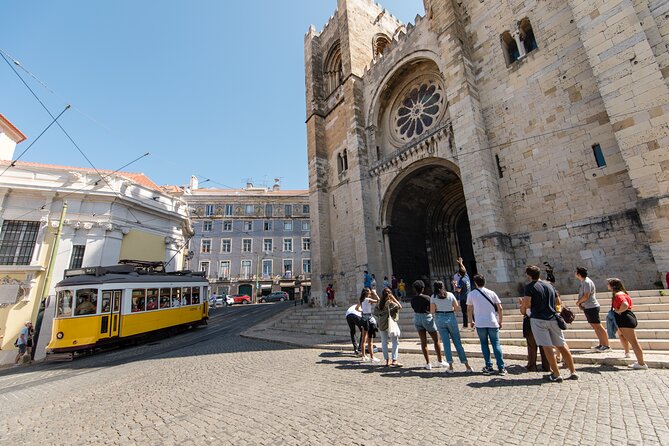
The iconic yellow tram 28 is also part of the sightseeing. The tour does not include public transportation tickets, so seeing the tram is not the same as riding it. If you want to use a funicular, elevator, or tram later, budget separately and check the current fare and operating details.
Carmo Convent, the roofless church

Carmo Convent is one of the route’s most striking places. The 1755 earthquake damaged the Carmelite convent and its great church, which was never fully rebuilt. Today, the open sky above the stone arches creates a powerful reminder of the disaster.
From a sightseeing point of view, Carmo is more than a ruined church. It is a physical break in the city’s story. Baixa shows the organized rebuilding that followed the earthquake, while Carmo shows what was lost.
The tour appears to treat the convent as an exterior stop or general visit point, and attraction entry is not included. If entering the site is important to you, ask whether your route includes admission or plan to return independently.
This is also where the walking becomes more demanding. The climb from Baixa toward Carmo is manageable for most people, but the route’s hills and paving can slow the group. That matters because the published duration is approximately two hours, not a guaranteed long-form historical tour.
Rossio Square and the National Theatre

Rossio reaches back to medieval Lisbon. Before and after the 1755 earthquake, it served as a central public gathering place for people of different social positions. Bullfights, public shows, royal declarations, and public executions during the Inquisition all took place in or around this broad square.
Today, Rossio is easier to enjoy as a place to watch city life. Its paving patterns, central monument, and busy surroundings make it one of the best points for understanding how Lisbon uses public space.
The Queen Maria II National Theatre sits at Rossio and is one of Portugal’s most important historical performance venues. Its site has an older and darker past, including connections to the Portuguese Inquisition and lodging for visiting foreign nobles. The building and square together show how entertainment, power, and public ceremony have shared the same address.
The route also identifies Lisbon’s other historic theater spaces. The Trinity Theatre, in Chiado, was built in the mid-19th century and remains one of the city’s oldest theaters still in operation. These stops are especially useful if you care about music, drama, and the cultural life of a capital, not just its viewpoints.
Santa Justa Elevator and Lisbon from above
Santa Justa Elevator is one of the city’s best-known structures. Its iron design recalls the engineering style associated with the Eiffel Tower, and it first operated with steam before later conversion to electric power.
The elevator connects the lower Baixa area with the Carmo hills. That practical purpose explains its lasting importance. It was built to handle Lisbon’s steep terrain, then became an attraction in its own right.
Your guide will point out the elevator and explain its role, but the tour price does not include entry. Lines and access can change, so do not assume the walking tour includes a ride or a viewpoint visit.
The route also includes the São Pedro de Alcântara viewpoint, one of Lisbon’s best city overlooks. From there, you can look across rooftops toward the central hills and see why the city’s elevators and funiculars matter. A viewpoint stop adds visual balance to the architectural and historical sections of the walk.
The Jesuit church and Chiado’s cultural core
The route includes an early Catholic church established in Portugal and run by the Jesuits, a powerful order known for its role in education. The supplied details do not identify the church by name, so confirm the exact stop with your guide if this is a priority.
Even without a long visit inside, the stop gives useful context for Lisbon’s religious institutions. The city’s churches were tied not only to worship but also to education, politics, art, and public life.
This part of the walk works best when your guide explains connections between the buildings rather than rushing from facade to facade. One published account praised the guide’s professional delivery and ability to keep the group interested, while another found the historical coverage too light. That contrast is worth keeping in mind: the quality of your experience may depend heavily on the assigned guide and the depth of questions you ask.
What the $107 price really buys
At $107, this is not a bargain-priced orientation walk. The fee covers the Baixa-Chiado tour, a local guide, the Vox City app with multiple self-guided Lisbon routes, and an evening walk in high season when available.
It does not cover public transportation, food, drinks, or entry to attractions. If you add Santa Justa, Carmo Convent, or another paid site, your total cost rises.
The price makes more sense for you if you value a planned route, historical commentary, and help connecting scattered sights. It makes less sense if you mainly want to see the outside of the monuments and are comfortable using a map.
The group limit of 25 is reasonable for a city walk, though it is not an intimate private tour. A 4.7 rating based on 15 published evaluations and a 93 percent recommendation rate suggest a generally positive experience, but the small sample means you should keep expectations measured.
Timing, pace, and guide quality
The advertised duration is approximately two hours. That is enough for an introduction to the main streets and landmarks, but not enough for lengthy visits inside several attractions.
One account praised Barbara for being pleasant and well informed, yet also described a route that became confusing when the guide warned about possible extra payment for a slower group and continued beyond the expected endpoint. The whole group eventually left after the damaged church stop.
That is a useful practical warning. At the beginning, confirm the expected finish time, whether any extra charge could apply, and which stops are included in the two-hour route. A clear answer protects your plans for lunch, a museum booking, or an evening reservation.
Another account found the historical coverage limited and felt the guide’s main experience was with cycling and scooter tours. So I would book this as a broad city introduction, not as a specialist history seminar.
Who should book this Lisbon walk
This tour suits you if you are visiting Lisbon for the first time and want the central districts explained in a logical order. It is also useful if you want to learn where Baixa, Chiado, Carmo, and Bairro Alto fit before exploring them alone.
You will get the most from it if you enjoy exterior architecture, city history, viewpoints, and neighborhood atmosphere. It is a good fit for someone who wants to see Bertrand Bookstore, Café A Brasileira, Rossio, and the elevators in one outing.
It may not suit you if you need a wheelchair-friendly route, although service animals are allowed and most people can participate according to the supplied information. The combination of hills, stairs, and paving deserves attention before booking.
The tour is also less suitable for anyone seeking deep detail at every stop. The route covers many places quickly, so use the Vox City app to continue learning afterward and return to the sights that catch your interest.
Should you book it?
Book this tour if you want a guided introduction to Lisbon’s central districts and value the convenience of seeing major squares, elevators, theaters, cafés, and ruins in one compact route. The route has a good mix of grand landmarks and ordinary city culture, and the app gives you something useful after the guide finishes.
Think twice about the $107 cost if you want attraction entry, transport, or a small private group. I would also confirm the two-hour finish time at the meeting point, especially after the account of a route that ran long.
My call: a useful orientation walk for first-time Lisbon visitors, provided you treat it as a highlights tour and confirm the scope before setting off. The strongest value comes from the guide’s city overview and the included self-guided routes, not from admission savings.
FAQ
Where does the Baixa-Chiado walking tour begin?
The tour begins at R. dos Douradores 16, 1100-161 Lisboa, Portugal.
Where does the tour end?
The activity ends back at the meeting point.
How long does the walking tour last?
The tour lasts approximately two hours.
What attractions are included in the route?
The route includes sights such as the Augusta Street Arch, Praça do Comércio, Lisbon City Hall, Bertrand Bookstore, Luís de Camões Square, Bica, Bairro Alto, Carmo Convent, Rossio, the Queen Maria II National Theatre, Santa Justa Elevator, São Pedro de Alcântara viewpoint, and historic theaters and churches.
Are entrance tickets included?
No. Entry to attractions is not included in the tour price.
Is public transportation included?
No. Public transportation tickets are not included.
Is the Vox City app included?
Yes. The price includes the Vox City sightseeing app, a Lisbon map, and multiple self-guided walking tours.
Can I cancel for a full refund?
Yes. You can cancel at least 24 hours before the local start time for a full refund. Cancellations or changes made within 24 hours are not refunded or accepted.
Fresh finds around Lisbon
- Lisbon: Tuk Tuk City Tour★ 3.6 · 7 reviews
- Fatima Full day Private Tour★ 5.0 · 7 reviews
- Lisbon: Highlights and Hidden Gems Tour★ 5.0 · 7 reviews
- Private Tour to Evora and Monsaraz from Lisbon★ 5.0 · 7 reviews
- Discover Sintra Beauty with a Guided Journey from Lisbon★ 5.0 · 7 reviews
- Private Half-Day Tour to Sintra★ 3.4 · 7 reviews
- Lisbon: Sunset and Wine Catamaran Tour★ 5.0 · 7 reviews
- Nazaré: Beaches of Nazaré Guided E-Bike Tour★ 4.9 · 7 reviews
Alfama & Old Town Walks, compared.

Private Lisbon Sightseeing Tuk-Tuk Tour: Alfama, Belém & More
Read our review →
Lisbon: Hills, Alfama, and Mouraria Tour by Electric Bike
Read our review →
Best of Lisbon Walking Tour: Rossio, Chiado & Alfama
Read our review →
Lisbon Small-Group Food Tour with 18 Tastings in Alfama District
Read our review →
Lisbon: Baixa District Food Tour with Dinner and Drinks
Read our review →
Lisbon E-Bike Tour Commerce Square, Mouraria and Alfama
Read our review →
Lisbon: Old Town TukTuk Tour and Scenic Viewpoints in Alfama
Read our review →Browse the lists this tour appears in