
Reviewed · LISBON FOOD TOURS
Tastes of Lisbon – Private food Tour
Lisbon’s food story is best understood one small bite at a time: a custard tart at an old pastry shop, a salty codfish cake, a glass of port, and a fierce little shot of cherry liqueur. This private walking tour links those tastes with the city’s streets, history, and fado traditions, led by Filipa or Ricardo.
I like two things right away. First, the tour uses food as a doorway into Portugal’s past rather than treating each snack as an isolated sample. Second, the private format lets the guide adjust the pace and menu, as Filipa did for a vegetarian guest. The main consideration is that this is not a nonstop market crawl. You may sit down at several restaurants, and the history and city sightseeing are nearly as important as the eating.
In This Review
- Key points to know before booking
- Lisbon through pastries, cod, and local drinks
- Praça da Figueira and one of Lisbon’s old pastry shops
- Largo de São Domingos and the sharp taste of ginjinha
- Cheese, ham, port, and the old grocery tradition
- Tinned fish and seafood at Miss Can
- Fado, romance, and the city behind the menu
- Why a private tour can be worth $139.99
- Filipa, Ricardo, and the value of a local host
- Walking, timing, and practical planning
- Who should book this Lisbon food tour?
- Should you book Tastes of Lisbon?
- FAQ
- Where does the tour start?
- Where does the tour end?
- How long does the experience last?
- What food is included?
- What drinks are included?
- Is the tour private?
- Is the tour offered in English?
- Can I cancel for a full refund?
Key points to know before booking
- The route runs from Rossio to Praça do Comércio: You walk through central Lisbon while eating and drinking along the way.
- The food is distinctly Portuguese: Expect pastel de nata, pastel de bacalhau, cod, cheese, ham, port, ginjinha, pastries, and tinned fish or seafood.
- Filipa and Ricardo lead the experience: Both are described as warm, engaging guides with strong knowledge of Portuguese food, history, and culture.
- The private setting changes the feel: Only your group participates, so you can ask questions, request adjustments, and set a comfortable pace.
- It is a cultural food tour, not simply a tasting route: Fado, politics, architecture, local businesses, and Portugal’s past all enter the conversation.
- Come hungry: The food can add up to a light meal or more, and one direct tip is not to eat breakfast beforehand if you want to sample everything.
Lisbon through pastries, cod, and local drinks
The tour begins at Lisboa Rossio, at Rua 1º de Dezembro near Rossio Station. That is a useful meeting point for a first day in Lisbon because it puts you in the middle of the historic center and close to public transportation.
From here, the experience sets out on foot. The stated duration is about three to four hours, although some tours have lasted longer when the conversation and sightseeing took over. I would plan on four hours rather than trying to squeeze in another fixed appointment immediately afterward.
The central idea is simple and effective: food gives you a reason to enter places you might otherwise pass by. A pastry shop becomes a lesson in Portuguese café life. A cheese tasting opens a conversation about regional products and trade. A glass of ginjinha leads to the story of Lisbon’s old drinking culture and the layers of history around Largo de São Domingos.
You are not just handed a plate and sent on your way. The guide explains what you are eating and how it fits into Portuguese life. That makes this a particularly useful introduction for a first visit, when every neighborhood, custom, and dish is still new.
More Lisbon food crawls:
- Lisbon: Pastel de Nata Baking Class
★ 4.9 · 2,106 reviews - Lisbon Small-Group Food Tour with 18 Tastings in Alfama District
★ 5.0 · 1,967 reviews - Lisbon: Baixa District Food Tour with Dinner and Drinks
★ 4.9 · 1,870 reviews
Praça da Figueira and one of Lisbon’s old pastry shops
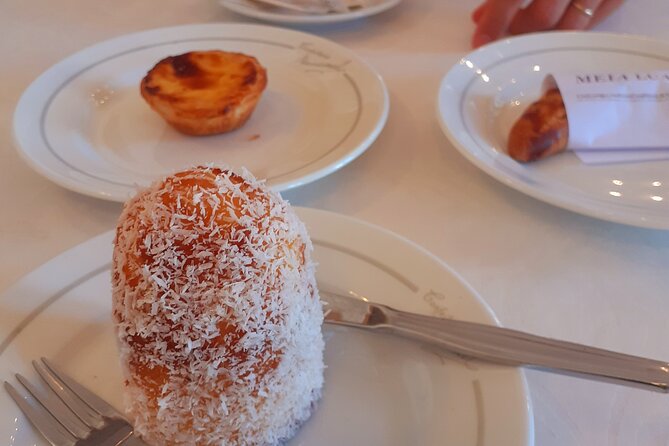
One of the first substantial stops is Praça da Figueira, where you visit one of Lisbon’s oldest pastry shops. The exact shop is not named in the supplied details, but the tasting list gives you a clear idea of what to expect.
The classic opening is coffee with pastel de nata, Lisbon’s famous custard tart. You may also try pastel de bacalhau, a fried codfish cake, and a light sponge cake. One account specifically describes a coconut sponge as unusually airy, while the general menu lists sponge cake. The combination gives you three different sides of Portuguese snack culture: coffee and pastry, salt cod, and a simple cake.
This stop is more than a sugar break. Pastry shops are part of the daily rhythm of Lisbon, where a quick coffee at the counter can be as ordinary as a morning newspaper. You get a sense of how Portuguese eating often favors small portions, strong flavors, and an unhurried pause.
The drawback is that this is not necessarily a hands-on pastry lesson. You will taste and hear the story, but the experience does not promise a cooking demonstration or time in the kitchen. If you booked because you want to make your own custard tarts, this is the wrong kind of food activity.
Largo de São Domingos and the sharp taste of ginjinha

The next named stop is Largo de São Domingos, a small square with an important place in Lisbon’s drinking culture. Here you try ginjinha, the sweet-sour cherry liqueur often served in a tiny glass. It is more forceful than its candy-like flavor suggests.
The square is also a good setting for the tour’s mix of food and history. The guide uses the drink as a starting point for explaining the area and its layers of Lisbon life. This is where the experience feels less like a restaurant itinerary and more like a walking lesson with refreshments.
The menu describes ginjinha as a soft drink, but the drink is a liquor, so do not treat it like juice. If you do not drink alcohol, ask about alternatives when booking or at the start. The available information confirms wine and liquor tastings, but it does not promise a specific nonalcoholic substitute.
This stop is short, about 25 minutes. That helps keep the walking route moving, though it also means you should not expect a long sit-down tasting with a formal lecture.
Cheese, ham, port, and the old grocery tradition
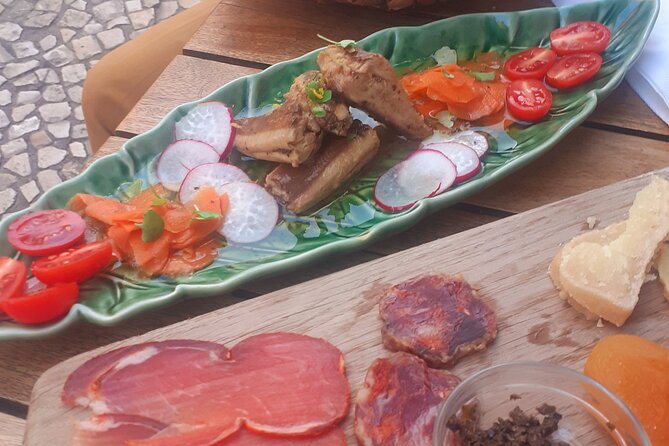
The tour also includes cheese and ham, paired in some accounts with port. You might taste both tawny and ruby port, though the listed menu does not guarantee every style on every departure. The point is to sample familiar Portuguese staples in a local setting and understand how they work together.
Salt cod is another important theme. Portugal’s relationship with bacalhau is central to its cooking, and the tour may show you displays of salted cod before or around the tasting stops. You can expect cod in more than one form, including the fried codfish cake and cod prepared with olive oil.
The pairing of cheese, cured ham, and port is especially useful for you as a visitor because these are easy products to find later in the trip. After tasting them with a guide, you have a better chance of ordering with confidence in a shop or restaurant.
A practical note: the menu includes several starters and desserts, but it does not list exact portion sizes. Some descriptions call the food plentiful, while another makes clear that the route includes two restaurants as well as the pastry shop and ginjinha stop. Think of the meal as a series of small plates and tastings that may replace lunch, not as a single formal meal.
A handful more Lisbon ideas to compare
- Lisbon City Center Tour – The Unmissable Lisbon
★ 5.0 · 22,234 reviews - Lisbon: Sintra, Pena, Regaleira, Cabo da Roca & Cascais
★ 4.7 · 19,656 reviews - Lisbon: Jerónimos Monastery Entrance Ticket
★ 4.1 · 14,164 reviews - Lisbon: History, Stories and Lifestyle Walking Tour
★ 4.8 · 10,902 reviews
Tinned fish and seafood at Miss Can
One of the more distinctive elements is a stop focused on Portuguese canned fish and seafood. This can sound modest on paper, but it is one of the tour’s more memorable ideas. Portugal has a long tradition of preserving fish in tins, and modern shops have helped turn the humble pantry staple into a popular food souvenir.
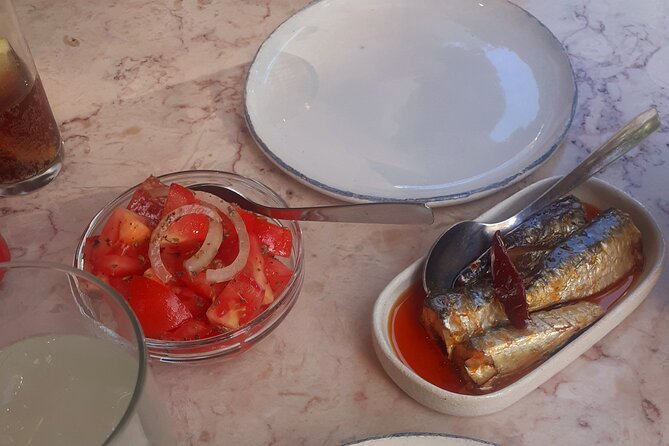
The tastings may include spicy sardines, cod in olive oil, cavala in mustard sauce, bread, and other seafood. The selection can make a strong impression if you have never regarded canned fish as something worth seeking out. You may also find yourself buying tins to take home, which is practical because they travel better than fresh food and give you an easy reminder of Lisbon after the trip.
This is a good example of the tour’s willingness to move beyond the standard pastel de nata checklist. The pastry is essential, but Portuguese food is also about preservation, fishing, salt, oil, and the sea. Tinned seafood gives the guide a way to talk about those subjects while you eat.
Still, this stop will not suit everyone. If you dislike fish, seafood, or strong salty flavors, ask how much of the menu can be adjusted. The private format helps, and a vegetarian version has been arranged before, but the tour’s identity remains tied to traditional Portuguese food.
Fado, romance, and the city behind the menu
Fado enters through the story of Lisbon’s romantic fado dinners. You hear about the origin of the music and how food, drink, and evening entertainment became linked in the city’s culture.
The tour does not appear to be a fado performance, so you should not book it expecting a concert. Instead, fado is part of the wider explanation of Lisbon and its social traditions. That distinction matters. If you want live music, choose a separate fado evening. If you want to understand why fado dinners matter before attending one, this tour gives you useful background.
The history can stretch well beyond food. Guides have discussed Portugal from Roman and Visigothic times through the Age of Exploration, the monarchy, dictatorship, the Enlightenment, and the country’s place in the European Union. They also answer questions about architecture, politics, and present-day life.
That broad range is one of the tour’s strongest features, but it can also be a weakness for someone seeking only food. The best match is a person who enjoys learning while eating. If you already know Lisbon well or have spent several days on historical tours, the background may feel repetitive, especially if you take this on your last day.
Why a private tour can be worth $139.99
At $139.99 per person, this is not a budget snack walk. The value depends on how much you want from the guide and how fully you use the private format.
You are paying for several things at once: an English-speaking guide, a walking route through central Lisbon, food and drink tastings, cultural explanation, and a visit limited to your own group. The private setting is important. Filipa has adjusted a route for vegetarian needs, and guides have also allowed detours for interests such as pottery galleries. Those changes are harder to arrange on a large group tour.
The price makes more sense if this is your first afternoon in Lisbon and you want a fast orientation through food. You can finish knowing what pastel de nata, bacalhau, ginjinha, port, Portuguese cheese, and tinned seafood taste like, while also learning where the main central neighborhoods fit together.
It is less compelling if you want a high-volume tasting tour with many brief samples from markets and shops. One account expected that style and instead found the experience centered partly on sitting down at three restaurants. That is a fair warning: the tour is a city and culture experience organized around food, not a pure grazing session.
The 98 percent recommendation rate and 4.9 rating from 56 reviews point to a very strong overall record, but the price still deserves a careful look. You should book it for the guide’s time and context as much as for the food itself.
Filipa, Ricardo, and the value of a local host
Filipa is the guide named most often in the feedback, and Ricardo also leads tours. You cannot assume which person will guide your departure unless the operator confirms it, but both are presented as personable, flexible, and well versed in Lisbon and Portuguese traditions.
Filipa’s strongest quality is her personal approach. Guests have described her as warm, enthusiastic, and willing to shape the route around tastes and interests. She has even walked a group back to its hotel after a tour that ran to about five hours, though that should not be treated as the standard ending.
Ricardo receives similar praise for explaining food alongside neighborhoods, architecture, politics, and national history. One particularly useful description presents him as a strong choice for someone with only one day in Lisbon, since the tour offers a quick orientation while you eat.
The guide can make or break a private experience. Here, the repeated praise focuses on friendliness, clear explanations, and pride in Lisbon. The occasional complaint is not about rude service or poor food. It comes from a mismatch between what one person expected and what the tour actually offers.
Walking, timing, and practical planning
The route starts at Rossio and ends at Praça do Comércio. It is a walking visit through central Lisbon, so wear shoes that handle uneven streets and a steady urban walk. The supplied information does not give a full distance or grade, but Lisbon’s central streets can include slopes, so ask the operator if you have mobility concerns.
The tour is offered in English and uses a mobile ticket. Confirmation arrives at booking, and the meeting point is near public transportation. Only your group participates, which makes it easier to pause, ask questions, or tell the guide that you need a slower pace.
Allow more time than the advertised three to four hours if your schedule is tight. Several accounts describe tours lasting longer than planned, often because the guide continued talking, added context, or offered extra help. That sounds pleasant, but it can affect a museum reservation or dinner booking afterward.
The tour has free cancellation up to 24 hours before the local start time. Changes or cancellations inside that window are not accepted for a refund. The simple rule is to decide by the previous day.
Who should book this Lisbon food tour?
I would recommend it most strongly to first-time visitors who want a friendly introduction to Lisbon and are happy to learn through eating. It also suits couples, families, and small friend groups who prefer a private guide over a fixed large-group route.
Food-focused visitors should book with the right expectations. You will taste many Portuguese staples, but you will also spend time walking, listening, and discussing history. The route is a good fit if you want to know why a food matters, not only whether you like it.
Vegetarians may be able to take part with adjustments, as a vegetarian menu has been arranged before. You should still state your needs clearly before booking because cod, seafood, ham, and other animal products are central to the standard menu.
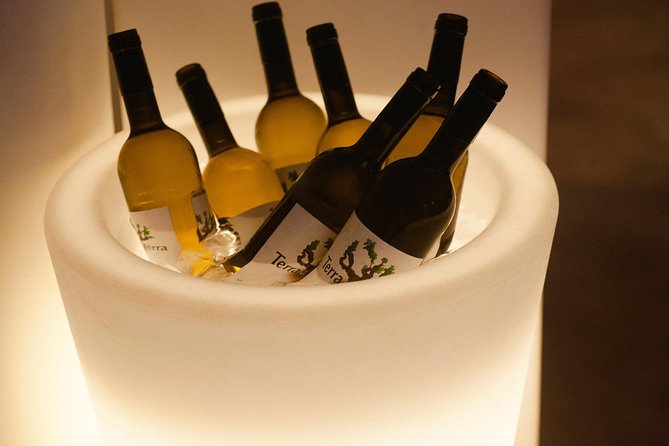
Drinkers will have more to explore, with local wines, port, and ginjinha included in the experience. If you avoid alcohol, confirm what can be changed before you pay.
Should you book Tastes of Lisbon?
Book this tour if you want Lisbon explained by someone who can connect pastries, cod, port, fado, old shops, and modern food businesses into one walk. The private format, flexible guides, and broad cultural conversation give it more substance than a basic tasting circuit.
Skip it if you want a cooking class, a market-only route, or constant small samples with almost no history. At $139.99 per person, it earns its price through personal guiding and context, not just the cost of the food.
For a first afternoon in Lisbon, I think it is a strong choice. Come hungry, leave room in your schedule, and tell Filipa or Ricardo what you eat, drink, and care about before the walking begins.
FAQ
Where does the tour start?
It starts at Lisboa Rossio, at Rua 1º de Dezembro 125, 1249-970 Lisboa, Portugal.
Where does the tour end?
The tour ends at Praça do Comércio, 1100-148, Lisbon.
How long does the experience last?
The stated duration is approximately three to four hours. Some tours have lasted longer, so allow extra time if you have plans afterward.
What food is included?
The menu includes coffee, pastel de nata, pastel de bacalhau, codfish, cheese, ham, tinned fish and seafood, and sponge cake.
What drinks are included?
You can expect local wines and liquors, including port and ginjinha. The menu also lists a ginjinha soft drink.
Is the tour private?
Yes. Only your group participates in the private tour or activity.
Is the tour offered in English?
Yes. English is the offered language.
Can I cancel for a full refund?
Yes, if you cancel at least 24 hours before the experience starts. Cancellations or changes made less than 24 hours in advance are not accepted for a refund.
Fresh finds around Lisbon
- Sanctuary of Fátima and Coimbra City Tour★ 4.5 · 51 reviews
- Sintra/Lisbon: Sintra & Quinta da Regaleira Tour with Ticket★ 4.4 · 51 reviews
- Jeronimos Monastery Guided Tour – Small Groups – Tickets Included★ 5.0 · 51 reviews
- Lisbon: Private Christmas Lights Tour by Eco Tuk Tuk★ 4.9 · 51 reviews
- Peniche: Berlengas Island Catamaran Tour – Round Trip★ 4.6 · 51 reviews
- Half day Spa Water Therapy experience at THE SPA at Corinthia Lisbon★ 4.5 · 51 reviews
- Premium Lisbon Airport Transfer to Lisbon★ 5.0 · 51 reviews
- Private Tour Romantic Sintra, Cabo da Roca & Cascais★ 5.0 · 51 reviews
Lisbon Food Tours, compared.
Lisbon Small-Group Food Tour with 18 Tastings in Alfama District
Read our review →
Lisbon: Baixa District Food Tour with Dinner and Drinks
Read our review →
Devour Lisbon: The Ultimate Portuguese Food Tour
Read our review →
Lisbon Food Tour with 10+ Tastings of Local Delicacies & Wines
Read our review →
Lisbon Private Food Tour – Taste 10+ Local Dishes & Wines
Read our review →
Lisbon: Segway Food Tour of Alfama and Old Town Lisbon
Read our review →
Lisbon Awakens: A Culinary Crossroads, Reborn.
Read our review →Browse the lists this tour appears in