
Reviewed · HISTORICAL TOURS
Lisbon Essential Walking Tour: History, Stories and Lifestyle
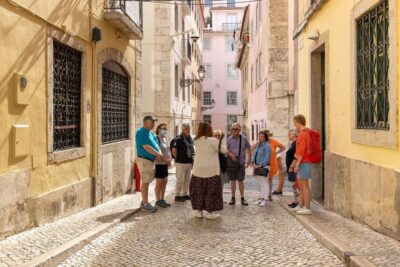
Lisbon’s story is written into its hills, ruins, churches, trams, and narrow lanes. This three-hour walking tour links the city’s essential sights from Bairro Alto to Alfama, giving you a useful first look before you explore on your own.
I like the mix of major landmarks and local stories, especially the stop at San Roque, the Carnation Revolution site at Carmo, and the walk through Alfama. I also like the practical touches: a coffee and pastry break, a Tram 28 ride, and guide recommendations for restaurants and fado.
The catch is the walking. Lisbon is steep, the route covers close to four miles according to one guest, and comfortable shoes and water are important. The group can include up to 15 people, so the experience may feel less personal than a private tour.
In This Review
- Key points to know before booking
- Why this route works as a first look at Lisbon
- Bairro Alto begins with Lisbon’s changing character
- São Pedro de Alcântara delivers the first big view
- San Roque hides its treasures behind a plain front
- Carmo connects Gothic ruins with the 1974 revolution
- Santa Justa gives you a choice, not an included ride
- Baixa brings a welcome coffee and pastry break
- Praça da Figueira leads into Lisbon’s tram experience
- Alfama is the tour’s most atmospheric neighborhood
- Lisbon Cathedral finishes the story at street level
- Guides make the biggest difference
- Who will enjoy this three-hour walk
- Is $30.25 a fair price?
- Should you book the Lisbon Essential Walking Tour?
- FAQ
- How long does the Lisbon Essential Walking Tour last?
- How much does the tour cost?
- What sights are included on the route?
- Is the Tram 28 ride included?
- Is the Santa Justa elevator ride included?
- Is food included?
- What language is the tour offered in?
- How large is the group?
- Can I cancel the tour for a full refund?
Key points to know before booking
- A strong first-day route: You see Bairro Alto, Baixa, Alfama, Lisbon Cathedral, San Roque, Carmo, and several major viewpoints in one morning or afternoon.
- Local guides shape the experience: Ricardo, Beatrice, Paulo, Ana, Sofia, Joao, Lucie, and others have led tours, with particular praise for clear history, humor, and practical advice.
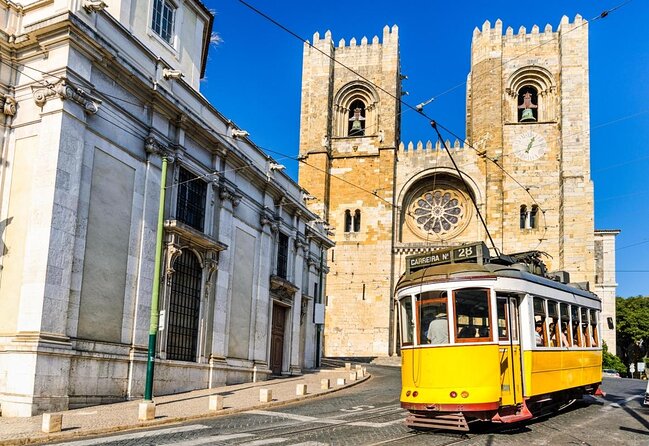
- The Tram 28 ride is included: This gives you a short taste of one of Lisbon’s best-known tram routes without paying for a separate sightseeing ride.
- Coffee and cake break included: The pause in Baixa adds a welcome rest and introduces you to a simple local café habit.
- Expect hills and uneven streets: This is an active walk, not a gentle city stroll. Wear supportive shoes and bring water.
- Good value at $30.25: With a professional guide, tram trip, snack break, and insurance included, the price is fair for a first orientation to Lisbon.
Why this route works as a first look at Lisbon
Lisbon can be confusing at first. The city is spread across several hills, and its neighborhoods each have a different feel and past. A walk that begins in Bairro Alto, drops toward Baixa, then climbs into Alfama gives you a basic mental map of the center.
That map is the real value here. You are not simply being driven past sights. You walk between them, see how the streets change, and hear how the earthquake of 1755, royal rebuilding, religion, dictatorship, and popular festivals shaped the city.
The tour is listed at $30.25 per person. For that price, you receive about three hours with a professional guide, a tram trip, coffee and cake, and liability and personal accident insurance. The Santa Justa elevator ride is not included, and transfers to or from the meeting point are also your responsibility.
I would book this early in a Lisbon stay, ideally on your first day. The route helps you decide where to return later, and guides such as Beatrice, Ricardo, Paulo, and Ana have been especially praised for linking dates and monuments to stories about Portuguese life.
More Walking Tours in Lisbon
- Lisbon: History, Stories and Lifestyle Walking Tour
★ 4.8 · 10,902 reviews - Best of Lisbon Small-Group Guided Walking Tour
★ 5.0 · 4,869 reviews - Lisbon: Food and Wine Small Group Walking Tour
★ 4.9 · 4,082 reviews
Bairro Alto begins with Lisbon’s changing character
The walk starts in Bairro Alto, a neighborhood about five centuries old. This is a smart starting point because the area helps explain how Lisbon grew and changed instead of presenting the city as a collection of isolated monuments.
The guide discusses the effect of the 1755 earthquake and the movement of families from Baixa and nearby districts into this part of town. That gives you an early lesson in how natural disaster and urban change affected ordinary residents.
The opening stop lasts about 15 minutes and has no admission charge. It is more of a street-level orientation than a formal attraction, so the quality depends on how well your guide tells the story. The tour’s strongest guides, including Ricardo, Paulo, and Beatrice, have been praised for making Portuguese history easy to follow and tying it to their own memories or local experience.
São Pedro de Alcântara delivers the first big view
From Bairro Alto, you pass through the garden at Miradouro de São Pedro de Alcântara. The viewpoint looks over Baixa and across to the south bank of the Tagus River.
This is one of the places where Lisbon’s hills make sense. From above, you can see the city’s layered position and understand why viewpoints are part of daily life here, not just photo stops. You get about 15 minutes, enough for pictures and a quick explanation.
The stop is free, but the route is not flat. The city’s slopes begin to matter almost immediately, and they continue throughout the tour. If you have trouble walking uphill or on uneven streets, this is the main issue to consider before booking.
San Roque hides its treasures behind a plain front
I find the Church and Museum of San Roque one of the most useful stops on this route. Its exterior is restrained, but the interior brings together gilding, tiles, and paintings in a compact display of Mannerist and Baroque art.
The church was built by the Jesuits and was among the first Jesuit churches in Portugal, as well as one of the earliest in the world. The contrast between the simple outside and elaborate inside makes the visit memorable.
You spend about 20 minutes here, with no admission charge listed for the tour. That time is enough for the guide to point out key details, but it is not a long museum visit. If you enjoy art and church interiors, you may wish to return independently for a slower look.
A good guide will help you see more than decoration. The stop gives context about religious orders, artistic style, and the role churches played in Lisbon’s public life. Several guides have been praised for making these historical explanations clear rather than turning them into a string of dates.
More history-first plans:
- Lisbon: Live Fado Show with Port Wine in Historic Center
★ 4.7 · 4,166 reviews - Lisbon: Fado Show with Wine in a Historic Venue
★ 4.8 · 1,294 reviews - Explore Lisbon by Tuk Tuk: History and Viewpoints
★ 5.0 · 840 reviews - Lisbon: Daytime or Sunset Boat Cruise with History and Wine
★ 4.9 · 819 reviews
Carmo connects Gothic ruins with the 1974 revolution
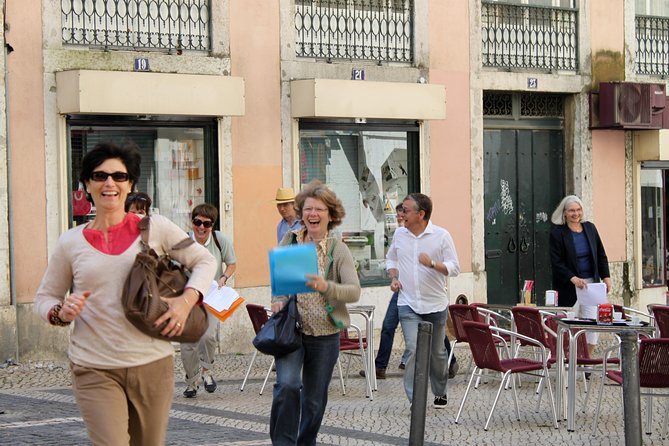
The next major stop is Igreja do Carmo, the church and convent on the slope above Baixa. Its Gothic architecture is important, but the site’s political story is just as striking.
The Carnation Revolution began here in 1974, ending nearly five decades of dictatorship in Portugal. That fact gives the stop a modern edge. Lisbon’s history is not only about kings, explorers, and earthquakes. It also includes the recent struggle that changed the country’s government.
You spend about 20 minutes at Carmo. The stop is free according to the tour details, though the separate Santa Justa elevator ride is not included later in the route. Your guide’s explanation is especially important here, since the site’s meaning can be easy to miss if you only see it as an old church.
This is also a good place to ask questions. Guides such as Ricardo and Beatrice have received strong praise for making Portuguese history personal and understandable, while still keeping the walk moving.
Santa Justa gives you a choice, not an included ride
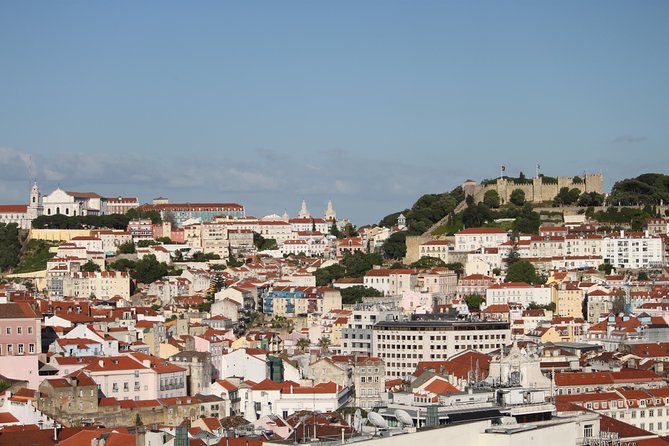
The Santa Justa elevator is a Gothic Revival monument and one of Lisbon’s best-known viewpoints. It is visually impressive from street level, and the structure makes a practical connection between different parts of the city.
The tour allows about 15 minutes here. The elevator admission is not included, so you should treat this as a viewing stop unless you decide to pay separately. That distinction matters because some people may expect the stop to include a ride.
The route continues downhill after Carmo and Santa Justa. This section helps you feel the transition from the older upper neighborhoods into Baixa, the central district rebuilt after the earthquake.
Baixa brings a welcome coffee and pastry break
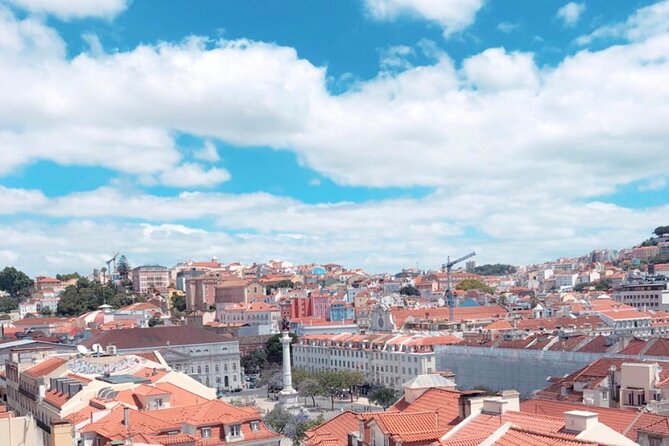
In Baixa, the tour pauses at a local café for coffee and a pastry. This is a small feature, but I think it improves the rhythm of the experience. Three hours of hills and city streets can be tiring, and a short sit-down gives you time to rest, ask questions, and absorb what you have seen.
The break lasts about 15 minutes, and coffee with pastry is included. Other food and drinks are not included. The stop has also been praised as a nice touch, with the pastel de nata often singled out as part of the experience.
This is not meant to be a full meal. If you need lunch, plan to eat before or after the tour. The break is best viewed as a sample and a pause, not a replacement for breakfast.
Baixa also gives you a practical sense of Lisbon’s rebuilt center. The streets here feel different from Bairro Alto and Alfama, and the guide can connect that change to the city’s reconstruction after 1755.
Praça da Figueira leads into Lisbon’s tram experience
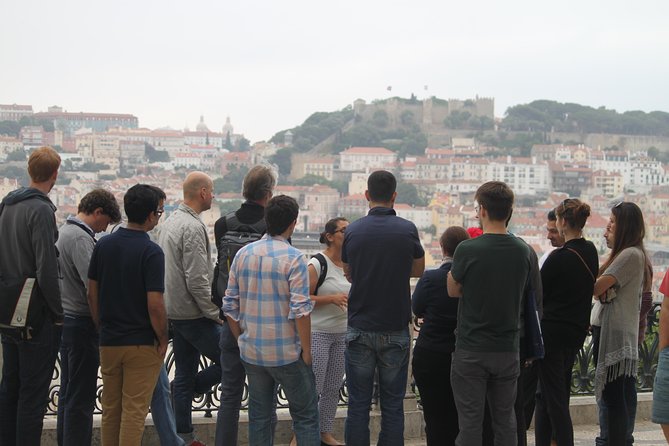
After the café break, the route continues through Baixa and Praça da Figueira. This puts you in the heart of central Lisbon before the included tram ride.
The tram section is one of the most appealing parts of the tour because it adds a local form of transport to the walking route. You ride uphill from the castle area toward Portas do Sol, joining the kind of route many visitors hope to experience in Lisbon.
The tour details identify this as a Tram 28 journey. The included ride is useful because you get the experience without arranging a separate ticket or working out the route yourself. It also gives your feet a short rest.
Keep your expectations realistic. The itinerary specifies a tram trip, not a long, private ride with reserved seats. The group may need to share the tram with other passengers, and the exact feel of the ride can depend on city conditions. Still, it is a worthwhile change of pace after the long downhill walk.
Alfama is the tour’s most atmospheric neighborhood
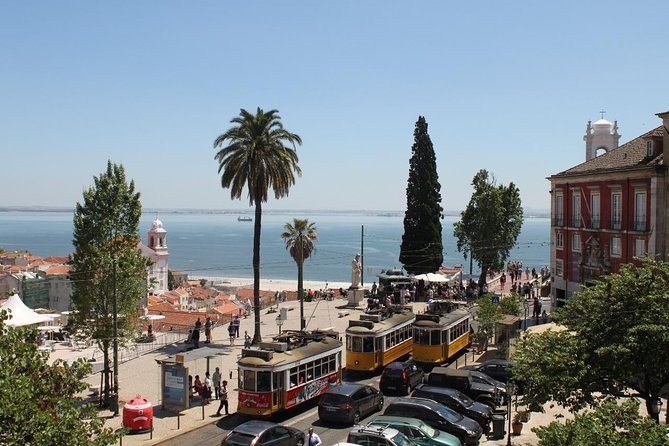
At Portas do Sol, you look toward the Monastery of São Vicente de Fora, the National Pantheon, and Alfama. The route then enters one of Lisbon’s oldest and most traditional districts.
Alfama spreads down toward the Tagus through narrow streets and lanes. The neighborhood is linked with fado houses and the festivals of popular saints, especially St. Anthony. This is where the tour shifts from grand monuments to everyday neighborhood character.
You spend about 20 minutes here, but the route through Alfama may feel like one of the most memorable sections because you are walking rather than simply looking from a viewpoint. Your guide can explain the origins of fado, point out local customs, and show how the neighborhood fits into Lisbon’s larger story.
The narrow lanes can be confusing if you are exploring alone. That makes a guide useful, particularly on a first visit. Ana has been praised for knowing the back alleys, while Beatrice has been praised for helping people understand how to navigate the city and for sharing fado suggestions.
Lisbon Cathedral finishes the story at street level
The tour ends at Lisbon Cathedral, built in 1150, three years after the city was taken back from the Moors. Its long history is visible in the building itself, which has been altered over time and now combines several architectural styles.
Ending here works well. The cathedral brings together the religious, military, and urban stories introduced earlier in the walk. You finish in the oldest part of the city after moving through Bairro Alto, Baixa, and Alfama.
The tour ends in Lisbon rather than returning you to a hotel or another neighborhood. That is convenient if you want to continue exploring the cathedral and Alfama, but you will need to arrange your own onward transport.
Guides make the biggest difference
The experience is led by local guides, and the individual guide matters. Ricardo is repeatedly praised for his clear explanations, strong command of Lisbon’s past, and ability to keep the walk interesting. Beatrice receives similar praise for warmth, humor, organization, and care for the group.
Paulo is described as friendly, funny, and especially good with families of different ages. Ana has been praised for her knowledge of side streets and for leading a walk of nearly four miles. Sofia, Joao, and Lucie have also received strong comments for making the tour engaging and easy to understand.
That said, one poor experience included unclear explanations, showing that the tour is not identical every time. The operator also has to manage group details, and one booking problem involved an incorrect meeting place and the guide not receiving the reservation. The guide handled the problem, but I would still check your confirmation carefully before setting out.
The tour is offered in multiple languages, with English listed as an option. Select your language when booking rather than assuming it will be available on the day.
Who will enjoy this three-hour walk
This tour suits first-time visitors who want a clear introduction before tackling Lisbon independently. It is also useful if you have only a short stay and want to cover several central districts without arranging separate visits.
Families can enjoy it, including those with older children and teenagers, provided everyone is comfortable walking uphill. The stories, tram ride, church interiors, and pastry break keep the pace varied.
You should think twice if you dislike hills, need frequent rest, or want long visits inside each church and monument. The schedule gives you an overview, not an in-depth museum tour. The route is active, and the close to four-mile estimate from one participant gives a better sense of the effort than the three-hour duration alone.
Service animals are allowed, the route is near public transportation, and most people can participate. Transfers to the meeting point are not included, so plan that part yourself.
Is $30.25 a fair price?
Yes, for most first-time visitors. The price includes a professional guide, Tram 28 trip, coffee and cake, and insurance. You also get a route that joins several districts and viewpoints, which would take more planning to reproduce alone.
The value is strongest if you want context. A free map can show you where San Roque, Carmo, Santa Justa, Alfama, and the cathedral are, but it will not explain how the earthquake changed Baixa or why Carmo matters to modern Portugal.
The price is less attractive if you mainly want independent sightseeing or long interior visits. You will still need to pay separately for the Santa Justa elevator if you choose to ride it, and you must cover any extra food and drinks.
The tour is often booked about 29 days ahead. That suggests planning early is sensible, especially if your Lisbon dates are fixed. Free cancellation is available up to 24 hours before the start time for a full refund. Changes or cancellations inside that window are not accepted or refunded.
Should you book the Lisbon Essential Walking Tour?
Book it if you want to get your bearings fast, learn the main chapters of Lisbon’s story, and enjoy a guided walk through neighborhoods you might otherwise struggle to connect. The included tram ride and pastry break add real variety, while guides such as Ricardo, Beatrice, and Paulo can turn the route into a lively introduction.
Skip it if steep streets are a serious problem, if you prefer private touring, or if you want to spend an hour inside each monument. For most first visits, though, the 4.8 rating from 316 reviews and 95 percent recommendation rate match the tour’s clear strengths: strong guides, a smart route, useful local advice, and a fair price.
FAQ
How long does the Lisbon Essential Walking Tour last?
The tour lasts approximately three hours.
How much does the tour cost?
The listed price is $30.25 per person.
What sights are included on the route?
The route includes Bairro Alto, São Pedro de Alcântara viewpoint, San Roque church and museum, Carmo church and convent, Santa Justa elevator, Baixa, Praça da Figueira, Alfama, and Lisbon Cathedral.
Is the Tram 28 ride included?
Yes. A tram trip is included in the tour.
Is the Santa Justa elevator ride included?
No. Admission to the Santa Justa elevator is not included.
Is food included?
Coffee and a pastry are included during the Baixa stop. Other food and beverages are not included.
What language is the tour offered in?
English is listed as an available language. The tour is also offered in multiple languages, which you select when booking.
How large is the group?
The tour has a maximum of 15 participants.
Can I cancel the tour for a full refund?
Yes. You can cancel up to 24 hours before the experience start time for a full refund. Cancellations and changes made less than 24 hours before the start time are not accepted or refunded.
Fresh finds around Lisbon
- Sanctuary of Fátima and Coimbra City Tour★ 4.5 · 51 reviews
- Sintra/Lisbon: Sintra & Quinta da Regaleira Tour with Ticket★ 4.4 · 51 reviews
- Jeronimos Monastery Guided Tour – Small Groups – Tickets Included★ 5.0 · 51 reviews
- Half day Spa Water Therapy experience at THE SPA at Corinthia Lisbon★ 4.5 · 51 reviews
- Lisbon: Private Christmas Lights Tour by Eco Tuk Tuk★ 4.9 · 51 reviews
- Peniche: Berlengas Island Catamaran Tour – Round Trip★ 4.6 · 51 reviews
- Lisbon: Private Tuk-Tuk Tour for 2 hours★ 4.7 · 51 reviews
- Premium Lisbon Airport Transfer to Lisbon★ 5.0 · 51 reviews
Historical Tours, compared.
Lisbon: History, Stories and Lifestyle Walking Tour
Read our review →
Lisbon: Live Fado Show with Port Wine in Historic Center
Read our review →
Lisbon: Fado Show with Wine in a Historic Venue
Read our review →
Explore Lisbon by Tuk Tuk: History and Viewpoints
Read our review →
Lisbon: Daytime or Sunset Boat Cruise with History and Wine
Read our review →
Private Tuk Tuk Tour Through Lisbon’s Historical Streets
Read our review →
Lisbon Sunset Sailing with Portuguese Wine and History
Read our review →
Lisbon: Guided Tuk-Tuk Tour Along the Historic Tram Line 28
Read our review →Browse the lists this tour appears in