
Reviewed · STREET ART
Lisbon 3-Hour Street Art Tour
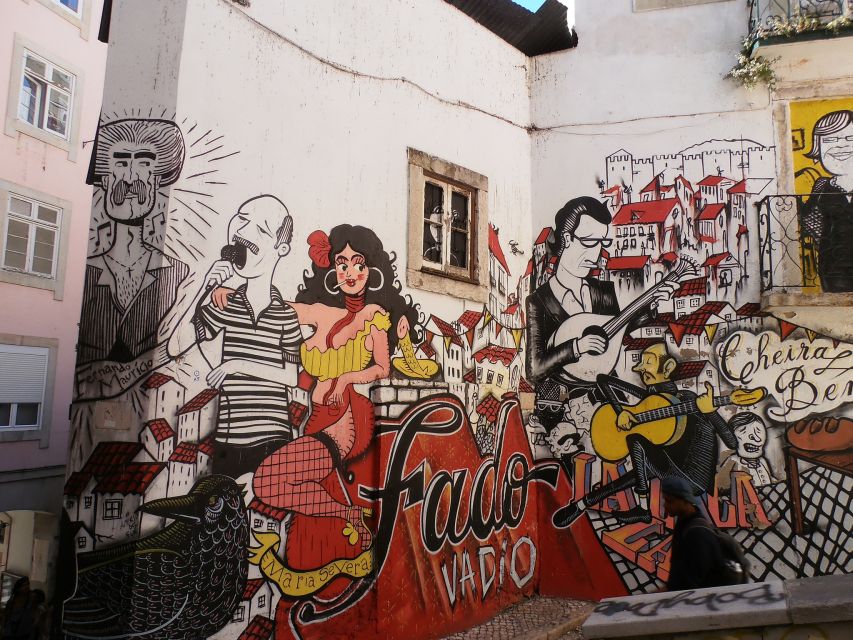
Lisbon’s street art is not confined to one gallery or polished avenue. It appears on worn walls, stairways, old facades, and neighborhood corners, often carrying a social or political point. This three-hour walk takes you through Mouraria and Graça, where art is tied closely to the renewal of older parts of the city.
I like two things right away: you hear the stories behind the images, and you see work by both Portuguese and international artists. The tour also ends at a mural by Vhils, one of Portugal’s best-known street artists. The catch is simple: Lisbon is hilly, the pace can be brisk, and three hours on foot under the summer sun takes some stamina.
In This Review
- Key points at a glance
- Why Lisbon street art works best on foot
- Starting at Martim Moniz
- Mouraria: art among Lisbon’s older streets
- Graça and the city views
- A route filled with different styles
- The Vhils mural finale
- What the guides add
- Price, pace, and practical value
- Who should book this walk?
- Should you book the Lisbon Street Art Tour?
- FAQ
- Where does the Lisbon Street Art Tour meet?
- How long does the tour last?
- What language is the tour in?
- Which Lisbon neighborhoods does the tour visit?
- What should I bring?
- Is the tour suitable for wheelchairs or strollers?
Key points at a glance
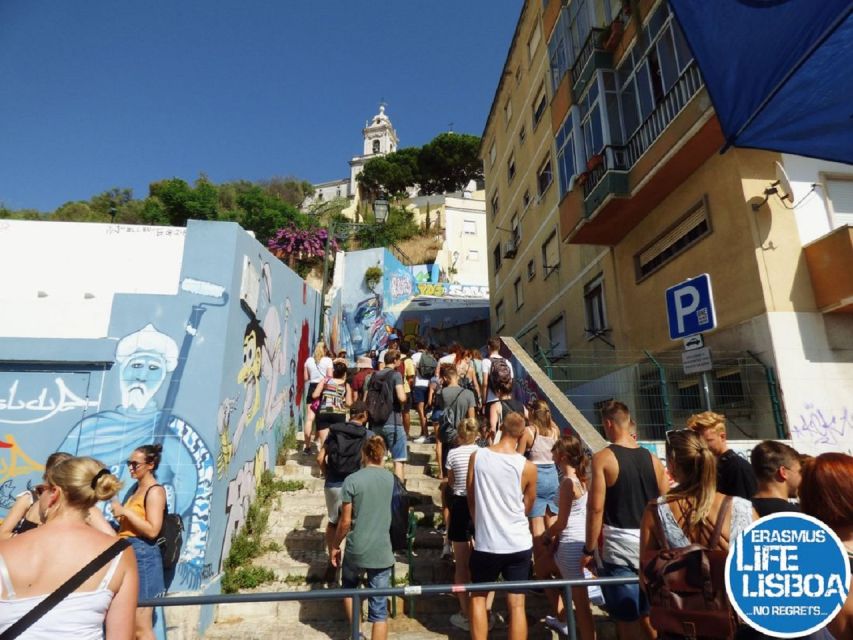
- Mouraria and Graça provide the setting: You see murals and smaller works among old streets, stairs, and neighborhood projects.
- The art comes with context: Your guide explains artists, techniques, local events, and the social or political meaning behind selected pieces.
- The route covers many styles: Expect tags, posters, stencils, large murals, and works by artists from Portugal and abroad.
- Vhils provides the finale: The walk ends at a mural by the Portuguese artist famous for carving images into walls.
- The guide shapes the experience: Véro is listed as the guide, while past tours have also featured Diogo, Diana, Ninetta, Margarida, and others.
- Good shoes matter: Hills, stairs, heat, and a fairly quick tempo make this a poor fit for anyone seeking an easy stroll.
Why Lisbon street art works best on foot
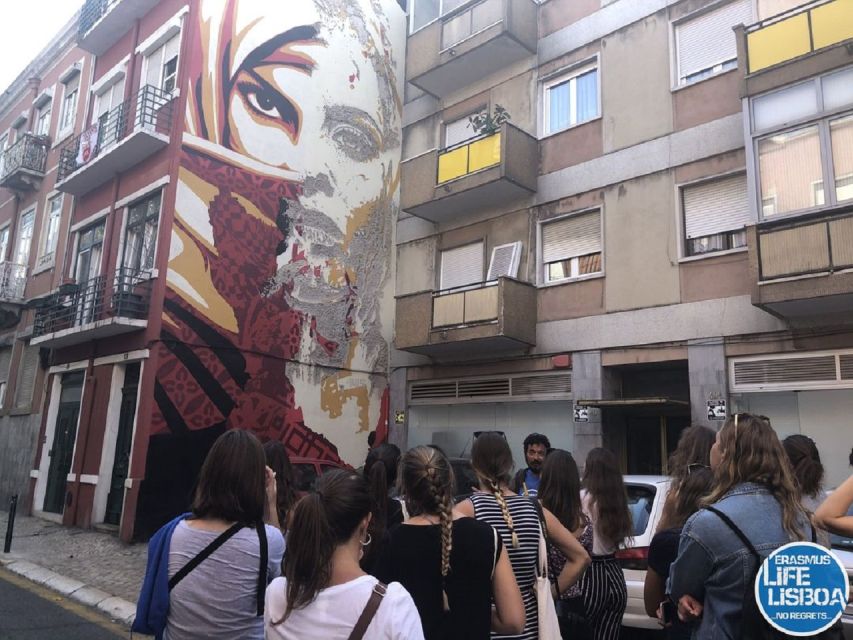
You can spot street art on your own in Lisbon, but the city does not always explain what you are seeing. A painted wall may look like decoration until someone points out the artist’s method, the neighborhood issue behind it, or the reason a Portuguese public figure was remembered there.
That is the real value of this tour. You are not just collecting colorful photographs. You are learning how the city uses walls as public space. Some works are playful. Others comment on politics, inequality, memory, or urban change. A guide helps you read the difference.
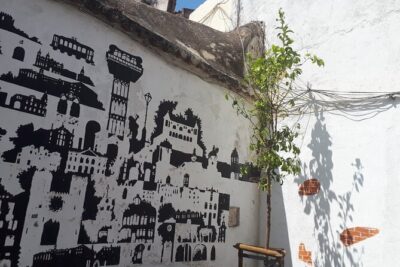
The tour focuses on Mouraria and Graça, two older areas where steep streets and aging buildings create a natural setting for large-scale work. Art projects here can form part of wider efforts to refresh the neighborhoods. That does not mean every wall is a formal public project. You may see careful murals beside quick tags, paper posters, and stencils.
I like that mix. It gives you a more honest look at street art than a route made only of large commissioned murals. You see how artists work with the city as it is, including rough walls, narrow passages, and buildings that have seen better days.
A handful more Lisbon ideas to compare
- Lisbon: Street Art Tour
★ 4.9 · 1,324 reviews - Lisbon: Kickstart Street Art Walking Tour
★ 4.9 · 717 reviews - Lisbon: Street Art Tuk Tuk Tour
★ 4.9 · 372 reviews
Starting at Martim Moniz
The meeting point is in Martim Moniz Square, near the monument with soldier heads, bullets, and helmets, surrounded by water. It is opposite Hotel Mundial, and the tour team holds a board marked Lisbon Street Art Tour.
This detail matters because Martim Moniz is a broad open square with several visual landmarks. The meeting point can be hard to identify from a map alone, so use the monument and Hotel Mundial as your main reference points. The square is served by the green metro line, making it a practical place to reach before the walk begins.
Arrive with your bearings sorted out. One person had trouble finding the precise meeting point because the map did not mark the spot clearly enough. The staff holding the sign should make the final step easier, but do not wait until the last second if you are unfamiliar with the square.
The first moments also help set the tone. This is a walking tour, not a sightseeing bus with occasional stops. You should expect to move through the city at a steady pace and pause when the guide has a work to explain.
Mouraria: art among Lisbon’s older streets
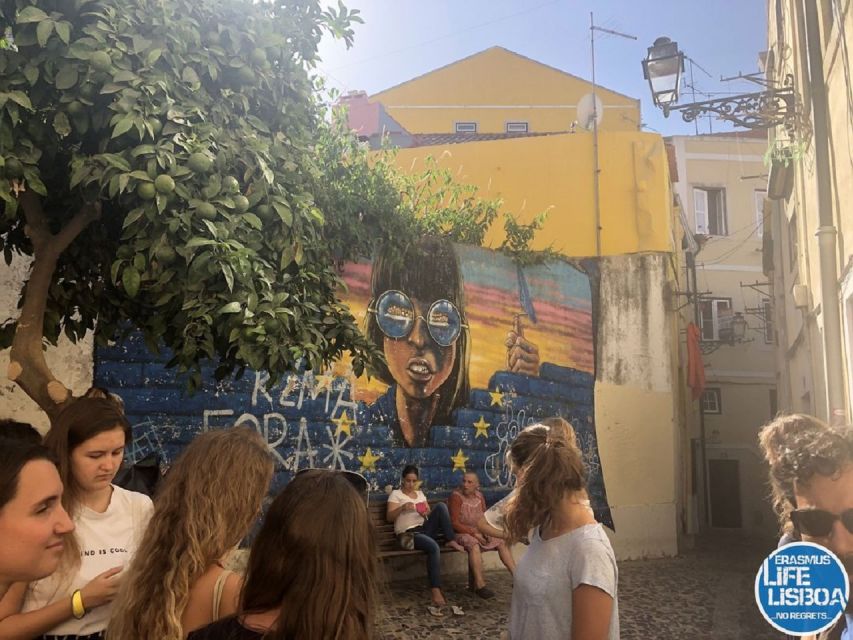
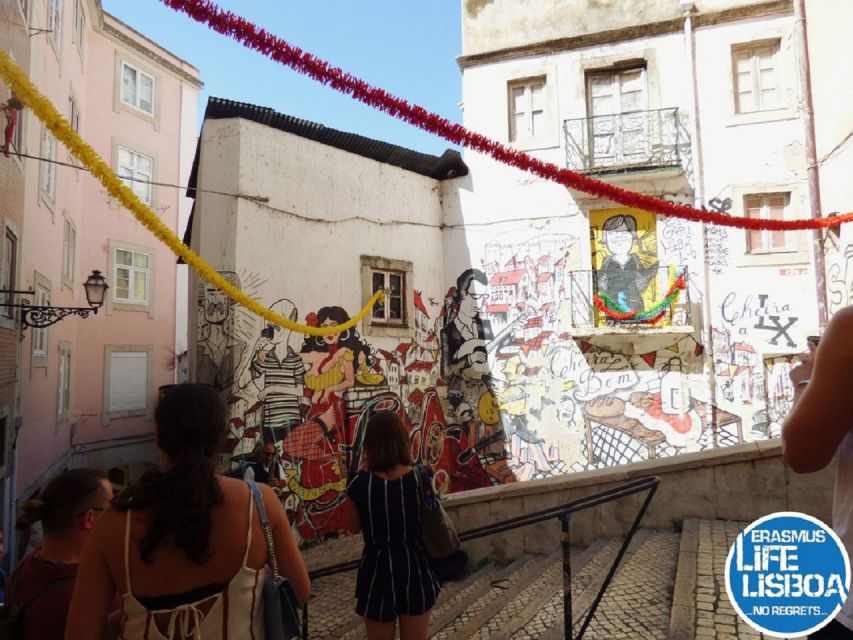
From Martim Moniz, the route heads toward Mouraria. This part of Lisbon is especially useful for understanding how street art interacts with everyday life. Murals may appear on larger walls, while smaller pieces hide on doors, corners, or surfaces you might pass without noticing.
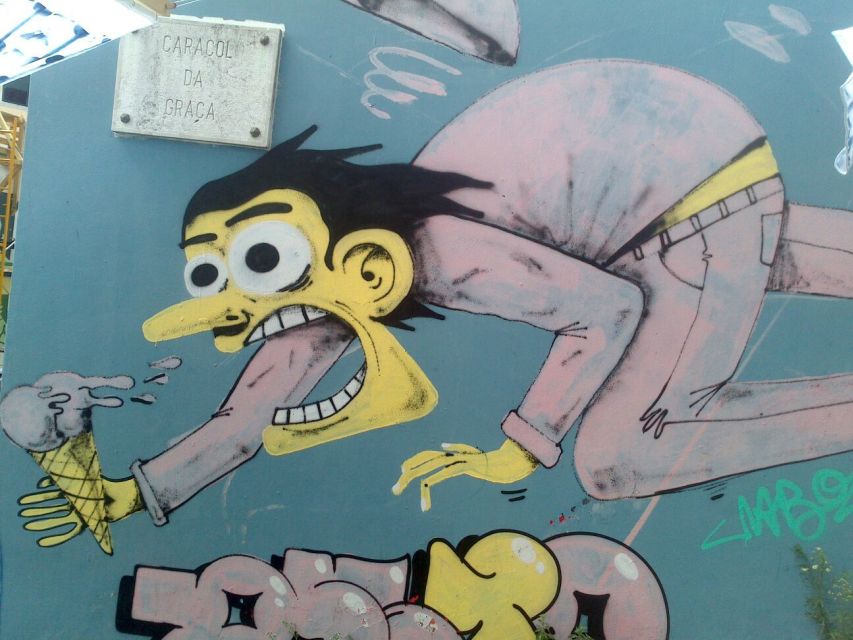
The guide points out different formats, including tags, posters, and stencils. These are not interchangeable. A stencil allows an image to be repeated quickly. A poster can make a sharp statement with little time on the street. A tag may be a name, a signature, or part of a larger local visual culture.
You also hear about artists and techniques. That gives you a better way to look at the work after the tour ends. Instead of seeing only a subject or color scheme, you can start asking how the artist built the image and why that wall was chosen.
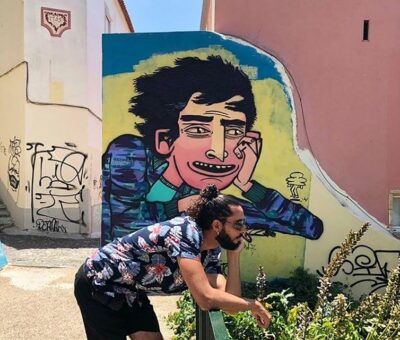
Mouraria is also where the social side of the tour becomes important. Some works have political messages. Others memorialize important Portuguese personalities. Your guide puts those images into local context, helping you understand why a particular figure or idea matters in Lisbon.
The route is not a museum visit with neat labels and controlled lighting. Light changes, surfaces age, and some work may be partly covered over time. That is part of the medium, but it also means the exact selection can change.
Graça and the city views
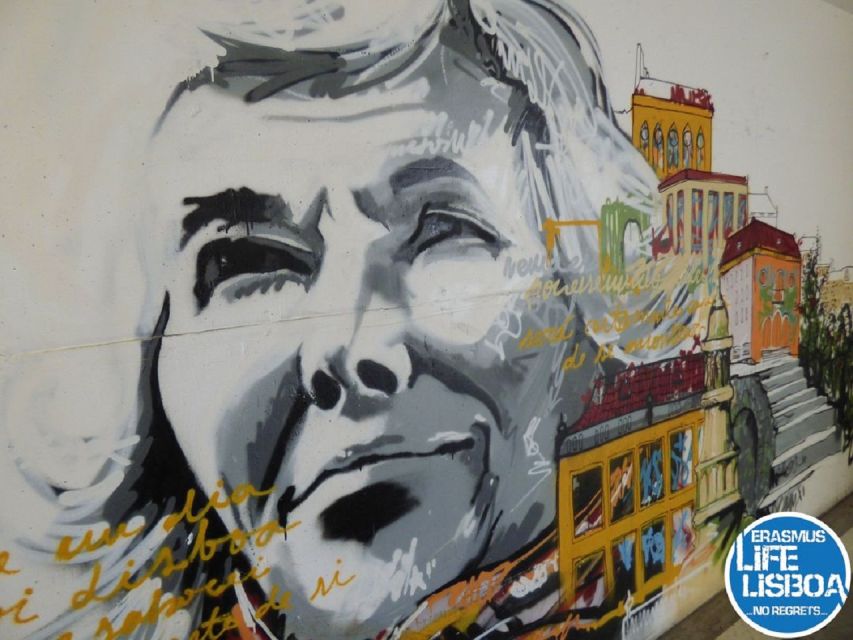
The walk continues into Graça, where the climb becomes more noticeable. Lisbon’s hills are part of the pleasure here, since you can gain attractive views over the city as you move through the neighborhood. They are also the main physical challenge.
The route includes hilly paths and stairs. A past participant found the three hours tiring in hot weather, even while recommending the experience. That is useful advice. You should carry water, wear comfortable shoes, and avoid treating this as a casual flat walk.
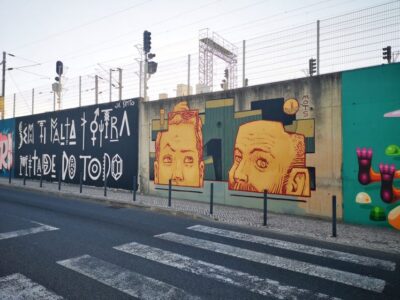
Graça gives the tour room to show a broader range of work. You may see large murals connected to neighborhood renewal, as well as smaller pieces by artists who use a wall for a more personal statement. The setting makes the art easier to understand because you can compare formal public projects with more spontaneous work nearby.
I especially like the way the guide connects art to place. A mural is not presented as an isolated image. You hear how it relates to the building, the street, or the area around it. That approach adds substance without turning the walk into a long academic lecture.
The pace can be fairly quick. One participant praised the speed because it allowed the group to see a lot, while another made clear that the walk can be demanding in heat. If you stop often to take photographs, you may need to rejoin the group promptly.
Nearby in Lisbon, a different day entirely:
- Lisbon City Center Tour – The Unmissable Lisbon
★ 5.0 · 22,234 reviews - Lisbon: Sintra, Pena, Regaleira, Cabo da Roca & Cascais
★ 4.7 · 19,656 reviews - Sintra: Pena Palace and Park Entrance Ticket
★ 4.2 · 17,410 reviews - Lisbon: Jerónimos Monastery Entrance Ticket
★ 4.1 · 14,164 reviews
A route filled with different styles

This is not a tour limited to one school of street art. The route includes:
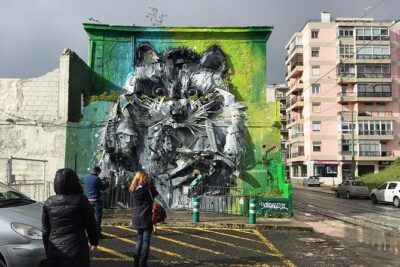
- Large murals
- Stencils
- Posters
- Tags
- Work by Portuguese artists
- Pieces by artists from other countries
- Art with social or political themes
- Memorial works connected to Portuguese personalities
That range is one of the strongest reasons to book. You get a working vocabulary for Lisbon’s public art rather than a parade of similar walls.
A guide can also explain why a piece deserves attention even when it is not the largest or brightest work. Street art often rewards close looking. A small stencil may communicate more directly than a huge mural, while a faded poster may show how quickly public art can change.
The tour also gives you a sense of the city’s current culture. Art in public space can be temporary, disputed, commissioned, or quietly tolerated. The guide’s role is to explain what can be known about the artists and their work, while helping you see the neighborhood as more than a backdrop.
The Vhils mural finale
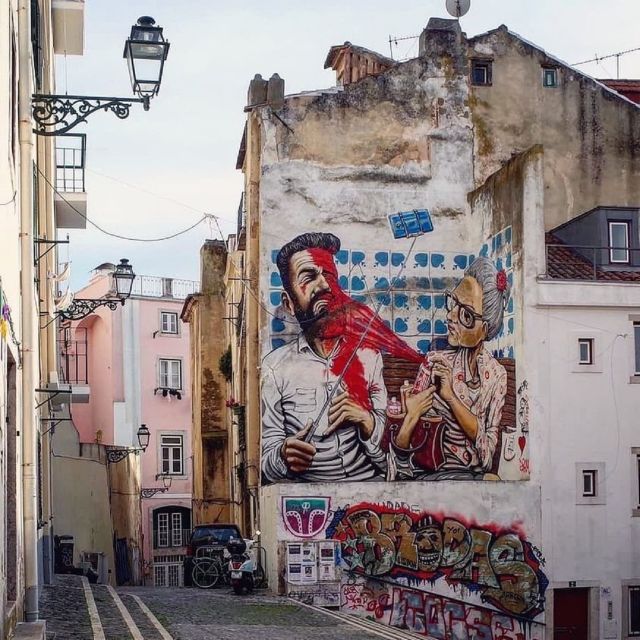
The walk ends at a mural by Vhils, the national artist named in the tour details. Vhils is known for working into walls rather than simply painting across them, so this final stop gives the route a clear visual payoff.
Ending at a major piece is smart. It gives you a final point of focus after seeing many smaller works and helps tie together the discussion of technique. You also finish somewhere different from where you began, so plan your onward route rather than assuming you will return to Martim Moniz.
That ending is worth noting when you arrange your day. A participant specifically wished the group had been told at the start that the walk would not finish at the meeting point. Keep your phone map ready, and do not schedule a tight appointment immediately afterward.
What the guides add

The listed guide is Véro, and the guide’s personality can shape the walk. Past tours have also been led by Diogo, Diana, Ninetta, Margarida, and others. The strongest guide feedback centers on enthusiasm, clear explanations, care with the group, and the ability to connect art with local and cultural history.
One particularly useful detail is that Diogo has led the walk with his dog, Billy. The dog is not a guaranteed part of every departure, but Billy has been a welcome extra on some tours.
The guides also offer more than facts about paint and walls. They can point you toward restaurants and other places to visit, which is handy if this is your first day in Lisbon. Several guides have been praised for making the group feel sociable, not just for delivering information.
Rain does not necessarily end the experience. One guide kept the mood upbeat during a downpour and took care of the group. Still, weather can affect how comfortable you are, so a light rain layer is sensible even though only comfortable shoes and water are specifically required.
Price, pace, and practical value
At $33 per person, the tour is fairly priced if you want more than a self-guided search. You are paying for three hours of local interpretation, route planning, and access to works you might miss while wandering alone.
The value is strongest for a first visit to Lisbon. The guide helps you get oriented in Mouraria and Graça, introduces artists you can look up later, and shows how public art fits into the city’s changing neighborhoods.
It is less compelling if you already know Lisbon’s street art well or prefer to walk slowly and stop whenever you wish. You may see a large number of pieces, but the schedule does not leave unlimited time at every wall.
Food and drinks are not included. Bring your own water, especially in warm weather. Large bags and luggage are not allowed, so this is not a good activity to schedule between hotel checkout and an onward departure unless you have somewhere secure to leave your belongings.
The tour is offered in English and lasts three hours. You can cancel up to 24 hours before the start for a full refund, and the reserve now, pay later option keeps your plans flexible.
Who should book this walk?
I would recommend it to you if you enjoy art, local stories, urban change, and walking through real neighborhoods rather than moving between major sights by vehicle. It is also a good choice early in a Lisbon stay, when the guide’s restaurant and sightseeing suggestions can help shape the rest of your visit.
It suits people who are curious about both famous artists and less formal work. You do not need to know street art in advance. The guide explains the main ideas and gives you enough context to look with more confidence.
Families with young children should think about the hills, stairs, heat, and walking time. Non-folding strollers are not allowed, and prams should be avoided if possible. The activity is not suitable for people with mobility impairments, and non-folding wheelchairs are not permitted.
Comfortable shoes are essential. Sandals with poor support or new shoes are a bad gamble on Lisbon’s slopes.
Should you book the Lisbon Street Art Tour?
Book it if you want to understand why Lisbon’s walls look the way they do, not simply photograph them. The combination of Mouraria, Graça, social themes, varied techniques, city views, and a final Vhils mural gives the three hours a clear purpose.
Skip it if steep streets, stairs, heat, or a brisk walking pace would spoil your day. For everyone else, $33 buys a useful introduction to an art scene that is easy to miss when you explore without local help. Just meet by the correct Martim Moniz monument, bring water, and remember that the finish is somewhere other than the start.
FAQ
Where does the Lisbon Street Art Tour meet?
Meet in Martim Moniz Square by the monument or sculpture with soldier heads, bullets, and helmets, surrounded by water. It is opposite Hotel Mundial, and the team holds a board mentioning the Lisbon Street Art Tour.
How long does the tour last?
The walking tour lasts three hours. Starting times depend on availability.
What language is the tour in?
The live guide conducts the tour in English.
Which Lisbon neighborhoods does the tour visit?
The route heads through Mouraria and Graça, with street art and neighborhood projects along the way.
What should I bring?
Bring comfortable shoes and water. The route includes hills and stairs, so supportive footwear is important.
Is the tour suitable for wheelchairs or strollers?
The tour is not suitable for people with mobility impairments. Non-folding wheelchairs and non-folding strollers are not allowed, and prams should be avoided if possible because of the hills and stairs.
Fresh finds around Lisbon
- Sanctuary of Fátima and Coimbra City Tour★ 4.5 · 51 reviews
- Sintra/Lisbon: Sintra & Quinta da Regaleira Tour with Ticket★ 4.4 · 51 reviews
- Jeronimos Monastery Guided Tour – Small Groups – Tickets Included★ 5.0 · 51 reviews
- Peniche: Berlengas Island Catamaran Tour – Round Trip★ 4.6 · 51 reviews
- Half day Spa Water Therapy experience at THE SPA at Corinthia Lisbon★ 4.5 · 51 reviews
- Lisbon: Private Christmas Lights Tour by Eco Tuk Tuk★ 4.9 · 51 reviews
- Lisbon: Private Tuk-Tuk Tour for 2 hours★ 4.7 · 51 reviews
- Premium Lisbon Airport Transfer to Lisbon★ 5.0 · 51 reviews
Street Art, compared.
3-Hour Guided Street Art Walking Tour of Lisbon
Read our review →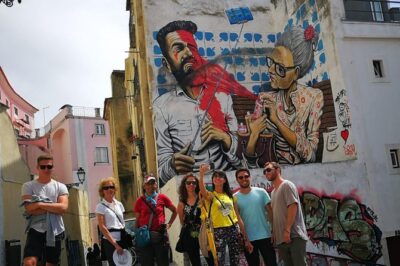

Browse the lists this tour appears in