
Reviewed · HISTORICAL TOURS
History-mistery of Lisbon (secrets societies and black arts)
Lisbon’s old center has more than pretty tiles and steep lanes. This evening walk uses gardens, fountains, lodges, ruins, and viewpoints to explore Knights Templar legends, Freemasonry, royal power, and political upheaval. Guide Slava connects visible details in the city to stories about secret groups and the forces that shaped Portugal.
I like the way the tour gets you away from the standard sightseeing script, especially at the underground reservoir near Principe Real and the Masonic lodge in Bairro Alto. I also like that Slava leaves room for questions and does not rush the hills, a useful touch on a walk that can last about two and a half hours.
The main consideration is the tour’s subject matter. Some stories are historical fact, while others involve myths, symbols, and interpretation. If you want a strictly academic account, this may feel loose. If you enjoy puzzles, unusual connections, and a guide who encourages you to think, it should be a good fit.
In This Review
- Key points to know before you book
- Why this Lisbon walk feels different
- Alfredo Keil Garden and Lisbon before Portugal
- Principe Real, the aqueduct, and the underground reservoir
- The fountain near the birthplace of Marques de Pombal
- Bairro Alto and the Masonic lodge
- Sao Pedro de Alcantara and Lisbon’s foundation myths
- Rossio Station and the pull of Sintra
- Dom Pedro IV Square and the royal family
- Largo do Carmo, ruins, and the 1974 revolution
- How much value do you get for $44.58?
- Who should book this experience?
- Should you book the Lisbon mystery walk?
- FAQ
- How long does the History-mistery of Lisbon tour last?
- What time does the tour start?
- Where does the tour begin?
- Where does the tour end?
- Is the tour private?
- Is the tour offered in English?
- How much walking and climbing should I expect?
Key points to know before you book
- Secret societies take center stage: Expect extended discussion of the Knights Templar, Freemasons, symbols, and their claimed influence on Lisbon and Portugal.
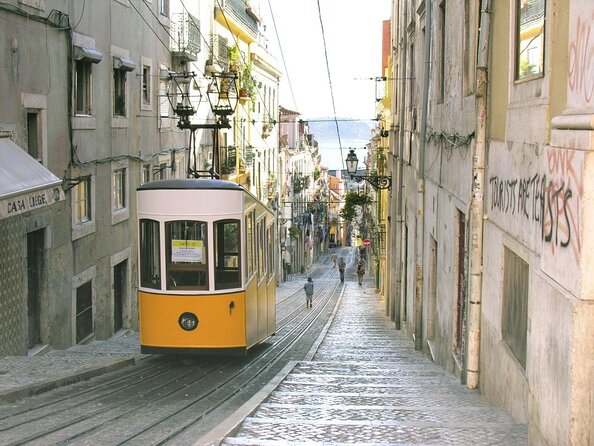
- The route uses real city landmarks: Gardens, an old aqueduct system, a fountain, a Masonic lodge, Rossio, Carmo, and Lisbon viewpoints all serve as the backdrop.
- Slava is the guide: His warm, engaged style and willingness to answer questions are central to the experience.
- It is a private English-language walk: Only your group takes part, with group discounts available.
- Lisbon’s hills are part of the deal: You will climb at points, though the guide allows time for breaks and discussion.
- The price rewards a small group: At $44.58 per person, value improves when the cost is shared by several people who enjoy the theme.
Why this Lisbon walk feels different
Most first walks through Lisbon focus on tiled facades, viewpoints, pastries, and famous monuments. This one asks you to look again at places you might otherwise pass without a thought. A garden becomes a starting point for pre-Portuguese beliefs. A fountain becomes a prompt for discussing power and colonial connections. A train station opens a conversation about Sintra and the people drawn to it.
That approach is the real appeal. You are not simply moving from one attraction to the next. You are following a chain of ideas through central Lisbon, with Slava pointing out symbols and historical links that may not be obvious at street level.
The theme also calls for a sensible amount of skepticism. Secret-society tours can slide into grand claims if the guide treats every coincidence as proof. Here, you should listen for the difference between established events, local legend, and the guide’s interpretation. The experience is most rewarding when you treat it as a guided investigation rather than a final answer to every mystery.
The walk begins at 6:00 pm on Avenida da Liberdade, at number 89. That timing gives the tour a late-day feel without making it a nighttime ghost walk. The route is in English, lasts roughly two to three hours, and includes free admission at every listed stop.
More history-first plans:
- Lisbon: History, Stories and Lifestyle Walking Tour
★ 4.8 · 10,902 reviews - Lisbon: Live Fado Show with Port Wine in Historic Center
★ 4.7 · 4,166 reviews - Lisbon: Fado Show with Wine in a Historic Venue
★ 4.8 · 1,294 reviews
Alfredo Keil Garden and Lisbon before Portugal
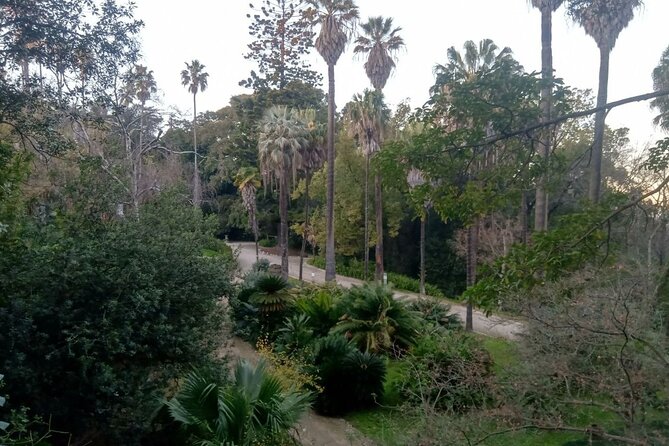
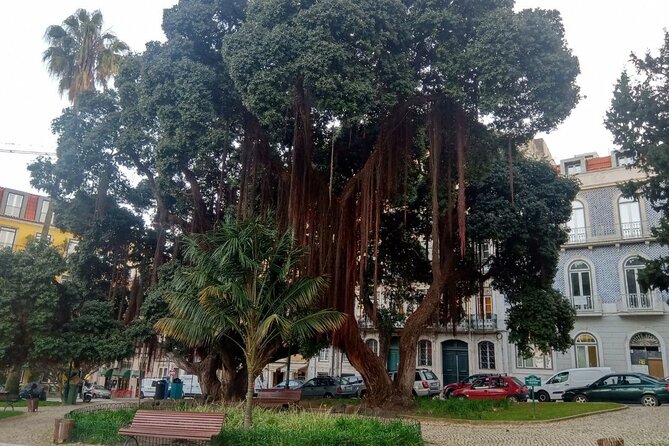
The first stop is Alfredo Keil Garden, beneath large ceiba trees. This is not just a place to gather the group. Slava uses it to set up the oldest layer of the story: who lived in the region before Portugal took shape, and what those earlier people believed.
That opening gives the tour a wider frame than a narrow account of kings and battles. You begin with origin stories and belief systems, then follow their echoes into later Portuguese symbols and institutions. It is also a calm way to start, since the first stop lasts about 20 minutes and has no admission charge.
You should expect discussion rather than a formal monument visit here. The value comes from the guide’s explanation and the questions it raises. If you like archaeology, folklore, and competing foundation stories, this section should catch your attention. If you prefer a long list of dates and confirmed documents, the interpretive approach may require some patience.
Principe Real, the aqueduct, and the underground reservoir
The walk continues to Jardim do Principe Real, an English-style garden known for its old cedar and an underground reservoir. This is one of the most distinctive stops because it ties an attractive public square to Lisbon’s water system.
Slava explains the aqueduct, which predates the earthquake of 1755, and the branching network of underground passageways connected with it. The word mystery fits naturally here: water infrastructure is practical, but its hidden routes can feel secretive when you picture them beneath the city.
You spend about 20 minutes in the garden, again without an admission charge. This is a good place to pay attention to how the tour works. The subject is not simply the aqueduct itself. It is the contrast between Lisbon’s open public spaces and the systems concealed below them.
The stop may also appeal to anyone who has already seen the main monuments and wants a fresh reason to look at the city’s foundations. You will not be taking a specialist engineering tour, so expect history, symbolism, and connections rather than a technical survey of the waterworks.
The fountain near the birthplace of Marques de Pombal
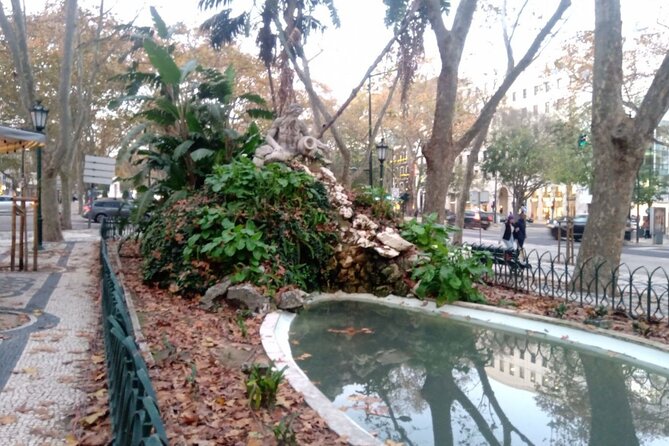
At Chafariz da Rua do Seculo, the group pauses at a mysterious fountain in front of the house where the Marquis of Pombal was born. The stop lasts about 15 minutes, but the subject reaches well beyond one Lisbon street.
Here the tour asks how secret societies relate to indigenous peoples and to Pombal, the political figure associated with the rebuilding and reshaping of Lisbon. It also brings South America into the discussion, linking Portuguese power to a wider Atlantic story.
This is likely to be one of the more provocative sections. Pombal’s role in Portugal gives the guide a solid historical figure to work with, while the secret-society angle invites broader interpretation. I would listen closely and keep your own judgment switched on. The best use of this stop is to consider how political power, empire, religion, and symbolism can overlap without assuming every suggested link is proven.
A handful more Lisbon ideas to compare
- Lisbon City Center Tour – The Unmissable Lisbon
★ 5.0 · 22,234 reviews - Lisbon: Sintra, Pena, Regaleira, Cabo da Roca & Cascais
★ 4.7 · 19,656 reviews - Lisbon: Jerónimos Monastery Entrance Ticket
★ 4.1 · 14,164 reviews - Lisbon: Sunset Boat Party Cruise with DJ and Open Bar
★ 4.5 · 10,378 reviews
Bairro Alto and the Masonic lodge
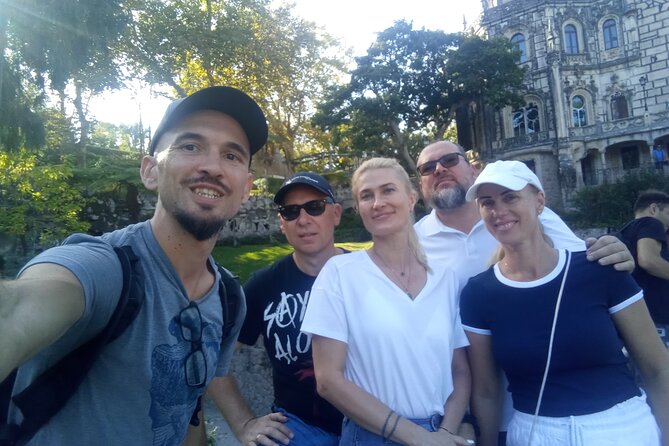
Bairro Alto is often reduced to its bars and nightlife. This walk uses the neighborhood for a different purpose, stopping in front of a Masonic lodge for about 15 minutes.
The lodge provides a concrete setting for a discussion of Freemasonry in Portugal, both in the past and the present. That is more effective than talking about secret groups in the abstract. You have a real building in front of you, a historic district around you, and a guide explaining how organized ideas and symbols may have influenced national life.
You do not need prior knowledge of Masonic history to follow this part. Slava’s job is to explain the background and point out details you might otherwise miss. The walk is private, so you can ask for clarification or spend more time on the subjects that interest your group.
This stop also shows the tour’s balance of famous and less obvious Lisbon. Bairro Alto is familiar to many visitors, but the lodge shifts your attention from nightlife to institutions and power. If your group wants only classic sightseeing, the discussion may feel like a detour. If you enjoy political history and coded imagery, it is one of the stronger moments.
Sao Pedro de Alcantara and Lisbon’s foundation myths
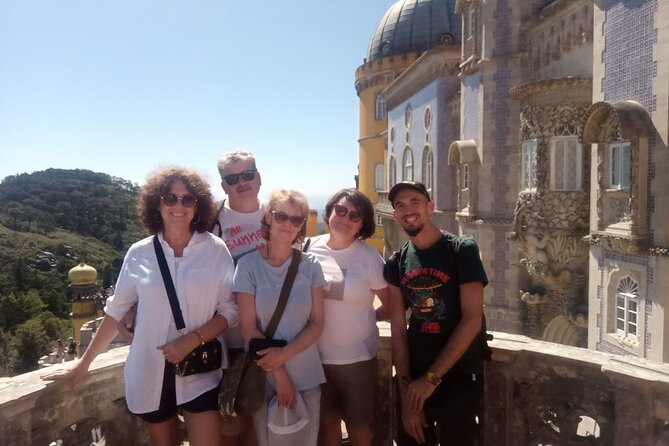
At Miradouro de Sao Pedro de Alcantara, you get a broad view over Avenida da Liberdade and Restauradores Square. The stop lasts about 10 minutes, making it brief but useful.
A viewpoint gives the guide room to explain Lisbon’s coat of arms and the myths surrounding the city’s foundation. It also helps you see the physical layout that has shaped so much of the discussion. Rather than looking at one doorway or symbol, you can take in the center as a whole.
This is a good point to catch your breath. The route includes uphill walking, and the city’s slopes are not decorative. You should wear shoes with a firm grip and avoid treating this as a flat stroll. Slava has been described as allowing time for people to climb at their own pace, but you should still arrive ready for exertion.
Rossio Station and the pull of Sintra
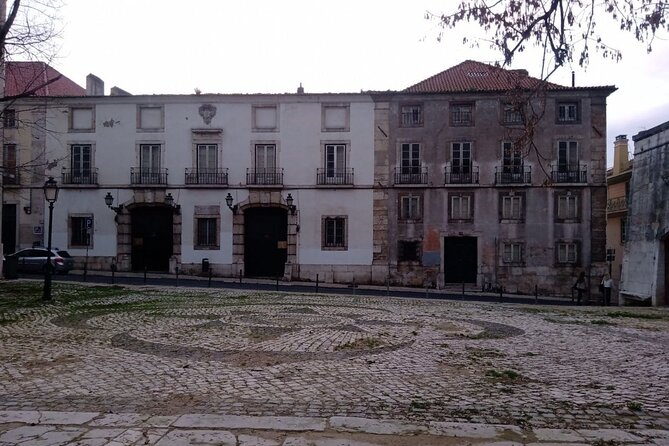
Estacao do Rossio is a highlight for architecture lovers. The station’s Manueline-style facade makes it one of central Lisbon’s most memorable buildings, and it also serves as the departure point for trains to Sintra.
The stop takes about 10 minutes and shifts the focus from Lisbon’s secret groups to Sintra’s unusual appeal. Slava discusses why famous people from different countries have wanted to own land there. That question opens the door to Sintra’s reputation as a place of estates, symbolism, and personal reinvention.
You will not be touring Sintra on this experience, so do not book it as a substitute for a day trip. Instead, think of this as a compact introduction to the town and the people drawn to it. The station is also a practical landmark, especially if you plan to visit Sintra later.
Dom Pedro IV Square and the royal family
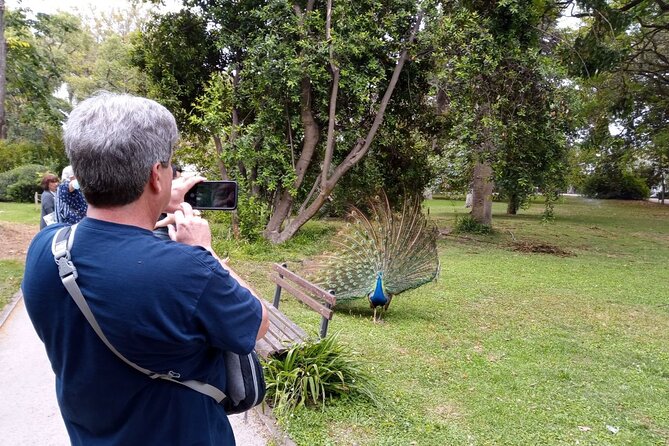
The route reaches Praca Dom Pedro IV, commonly known as Rossio Square, where the tour examines buildings on the southern side and develops a psychological portrait of the royal family during the reign of Dom Pedro IV.
This is an interesting change of scale. Earlier stops focus on hidden networks and symbolic clues. Here, the guide turns to personalities, family relationships, monarchy, and the connection between Portugal and Rio de Janeiro.
That Atlantic link matters because Portuguese royal power was tied closely to Brazil. The discussion helps explain why Lisbon’s political story cannot be read only within the city’s streets. The royal family’s choices affected both sides of the ocean, and the square becomes a place to consider how personal motives and national events can collide.
The published route information also lists Largo do Carmo as a stop and gives Praca Dom Pedro IV as the ending point. Since those details appear in a slightly different order, confirm the exact final meeting point when you book. The listed start time is 6:00 pm, and the stated end point is Praça Dom Pedro IV 72.
Largo do Carmo, ruins, and the 1974 revolution
Largo do Carmo brings together architecture and modern political history. The Carmo monastery ruins now frame a museum and a National Guard building, including a museum connected with the 1975 revolution.
The guide asks whether the revolution should be understood as a romantic revolution or a coup d’état. That question gives you a chance to look past simple slogans and consider who held power, how the change unfolded, and how the public remembers it.
The comparison with Salazar’s Portugal and life in the Soviet Union adds another political layer. This is not a standard monument explanation. It is a discussion of authoritarian systems, public life, and the way political memory is shaped after a regime changes.
You should expect about 15 minutes here. The ruins give the conversation a strong setting, but the subject is serious and may take the tour in a more analytical direction than the earlier legends. If you want a purely supernatural experience, this section may surprise you. If you like political history, it adds welcome substance.
How much value do you get for $44.58?
The price is $44.58 per person. Since this is a private activity, only your group participates, which makes the cost easier to justify for couples, families, or friends who share an interest in the subject. Group discounts are also available.
You are not paying for entrance tickets, since every listed stop has free admission. You are paying for the guide’s time, the route design, interpretation, and the ability to ask questions without being part of a large public group.
The value depends on your expectations. For a simple orientation walk, the price may seem high because the experience does not include paid monuments or transport. For a focused private tour lasting up to three hours, with a specialist theme and a guide who adjusts the pace, it is more reasonable.
I would book it when the subject matters to you. The strongest parts are the connections between places, not a collection of major indoor attractions. A larger group can also benefit from the discount, but the private format is especially useful when your party wants to discuss specific topics in detail.
Who should book this experience?
I would recommend it to you if you enjoy:
- Knights Templar and Freemason stories
- Political history and contested interpretations
- Lisbon’s symbols, foundation myths, and unusual buildings
- Walking routes that go beyond the main postcard sights
- Small private tours where questions are welcome
- A guide who brings personal enthusiasm to a specialized subject
You should think twice if you want a flat route, a conventional history lesson, or a tour built around entering major monuments. The hills are real, the route is discussion-heavy, and some claims are best treated as theories or legends rather than settled fact.
The walk can work well early in a Lisbon visit because it gives you new ways to read the city afterward. It can also be a good choice later in your stay, when you have already seen the main squares and want a more unusual angle.
The experience is offered in English, confirmation is provided at booking, and the route is near public transportation. Most people can participate, but you should be comfortable with uphill walking. Free cancellation is available up to 24 hours before the start time. Bad weather or failure to meet the minimum number of participants can lead to a new date or a full refund.
Should you book the Lisbon mystery walk?
Book this tour if you want Lisbon presented as a puzzle of symbols, political choices, underground systems, and old beliefs. Slava’s friendly, engaged manner is a major part of the experience, and the private format gives you room to ask questions and control the depth of the discussion.
Skip it if you want firm historical consensus at every stop or a short, easy walk with little climbing. For the right audience, $44.58 buys a thoughtful and unusual way to see central Lisbon, with enough architecture, politics, and legend to keep the conversation going long after the tour ends.
FAQ
How long does the History-mistery of Lisbon tour last?
The tour lasts approximately two to three hours. Some sections are brief, while other stops allow time for detailed discussion and questions.
What time does the tour start?
The listed start time is 6:00 pm.
Where does the tour begin?
The tour begins at Av. da Liberdade 89, 1250-096 Lisboa, Portugal.
Where does the tour end?
The listed ending point is Praça Dom Pedro IV 72, 1100-202 Lisboa, Portugal. Largo do Carmo also appears as a stop, so confirm the exact route order when booking.
Is the tour private?
Yes. Only your group participates in this private activity. Group discounts are available.
Is the tour offered in English?
Yes. The experience is offered in English.
How much walking and climbing should I expect?
The route is a walking tour through central Lisbon and includes hills to climb. Most people can participate, but you should be prepared for uphill sections and wear suitable walking shoes.
Fresh finds around Lisbon
- Lisbon: Tuk Tuk City Tour★ 3.6 · 7 reviews
- Fatima Full day Private Tour★ 5.0 · 7 reviews
- Lisbon: Highlights and Hidden Gems Tour★ 5.0 · 7 reviews
- Private Tour to Evora and Monsaraz from Lisbon★ 5.0 · 7 reviews
- Discover Sintra Beauty with a Guided Journey from Lisbon★ 5.0 · 7 reviews
- Private Half-Day Tour to Sintra★ 3.4 · 7 reviews
- Lisbon: Sunset and Wine Catamaran Tour★ 5.0 · 7 reviews
- Nazaré: Beaches of Nazaré Guided E-Bike Tour★ 4.9 · 7 reviews
Historical Tours, compared.
Lisbon: History, Stories and Lifestyle Walking Tour
Read our review →
Lisbon: Live Fado Show with Port Wine in Historic Center
Read our review →
Lisbon: Fado Show with Wine in a Historic Venue
Read our review →
Explore Lisbon by Tuk Tuk: History and Viewpoints
Read our review →
Lisbon: Daytime or Sunset Boat Cruise with History and Wine
Read our review →
Private Tuk Tuk Tour Through Lisbon’s Historical Streets
Read our review →
Lisbon Sunset Sailing with Portuguese Wine and History
Read our review →
Lisbon: Guided Tuk-Tuk Tour Along the Historic Tram Line 28
Read our review →Browse the lists this tour appears in