Reviewed · PRIVATE
Tour of Lisbon in a Private Tour
Lisbon is a city of hills, tight lanes, grand squares, and far-reaching views. This private tour gives you a practical way to connect the pieces in one day, from the medieval Alfama to the riverside monuments of Belém, with a crossing to Christ the King for a superb look back at the city.
I like the private vehicle and flexible pace, especially because Lisbon’s sights are spread across steep neighborhoods and the riverfront. I also like the chance to get local advice from guides such as João, Anastasia, Jorge, Ana, and John, who have tailored routes to guest interests and offered tips for the rest of a Lisbon stay. The main drawback is that this is an overview day: several stops are short, and some major sights are viewed from outside rather than explored in full.
In This Review
- Key points to know before booking
- Why this private Lisbon tour works well
- Santa Justa puts Lisbon’s hills in perspective
- Portas do Sol and Alfama reveal Lisbon’s old side
- Senhora do Monte gives you the high view
- Santo António and the Cathedral anchor old Lisbon
- Baixa explains the city rebuilt after disaster
- Commerce Square opens the city to the Tagus
- Christ the King delivers the big city view
- Belém brings Portugal’s seafaring story to the river
- What the $118.56 price means in practice
- Guides, comfort, and the pace of the day
- Who should book this Lisbon day tour?
- Should you book it?
- FAQ
- How long is the private Lisbon tour?
- What time does the tour begin?
- Where can pickup and drop-off take place?
- Is the tour private?
- Is the tour offered in English?
- Is transportation included?
- Is lunch included?
- Which attractions include admission?
- Can I cancel for a full refund?
Key points to know before booking
- A full-city route in about eight hours: Cover central Lisbon, Alfama, Belém, and Almada without piecing together several buses, trams, and taxis.
- Private pickup and drop-off: Begin at your hotel, apartment, or cruise port, then return there at the end.
- Strong viewpoint lineup: Santa Justa, Portas do Sol, Senhora do Monte, and Christ the King each show Lisbon from a different angle.
- A blend of driving and walking: Use the air-conditioned vehicle for distance, then walk through places such as Alfama and the historic center.
- Best for a first visit or short stay: You can see the main sights quickly and collect useful suggestions for later exploring.
- A flexible experience for mixed abilities: The guide can adjust the pace, though steep streets, steps, and uneven cobblestones remain part of Lisbon.
Why this private Lisbon tour works well
The strength of this experience is its range. Lisbon is not a city where every major sight sits around one compact plaza. The old center lies among hills, Belém is west along the Tagus, and Christ the King is across the river in Almada. Covering those areas independently in one day takes planning and patience.
Here, you have a private driver and guide, an air-conditioned vehicle, private transportation, WiFi on board, and hotel, apartment, or cruise-port pickup and drop-off. That saves time and lets you focus on the city instead of figuring out transfers.
The tour is offered in English and begins at 8:30 a.m. Starting early is useful. Downtown sights can become crowded later, and an early departure gives you a better chance to see central areas before the day reaches full speed.
The format also suits people who dislike fixed group schedules. You can ask for more time at a viewpoint, move faster through a stop that interests you less, or ask for additional attention to food, architecture, local life, or Portuguese history. The route is broad enough to give you an overview, but the private setting makes it more personal than a standard coach tour.
A handful more Lisbon ideas to compare
- Lisbon City Center Tour – The Unmissable Lisbon
★ 5.0 · 22,234 reviews - Lisbon: Sintra, Pena, Regaleira, Cabo da Roca & Cascais
★ 4.7 · 19,656 reviews - Lisbon: Jerónimos Monastery Entrance Ticket
★ 4.1 · 14,164 reviews
Santa Justa puts Lisbon’s hills in perspective
The Elevador de Santa Justa is a fitting first stop because it introduces Lisbon’s vertical character. The neo-Gothic iron elevator connects Rua do Ouro with Largo do Carmo, linking the lower Baixa district with the higher streets around Carmo.
The wooden cabins, decorated with brass, give the ride an old-fashioned feel. At the top, you get views over Baixa, the Castle, the Tagus, and the ruins of the Carmo Convent. The scheduled visit lasts about 20 minutes, and admission is included.
This is more than a transport curiosity. From above, you can see how the city’s streets spread toward the river and how sharply the upper neighborhoods rise behind the flat central grid. If you are taking photographs, this is an efficient first stop.
The tradeoff is time. Twenty minutes allows for the elevator and viewpoint, not a long stay around Carmo or a full visit to the convent ruins. If you want to explore the area at length, ask your guide if the schedule allows it.
Portas do Sol and Alfama reveal Lisbon’s old side
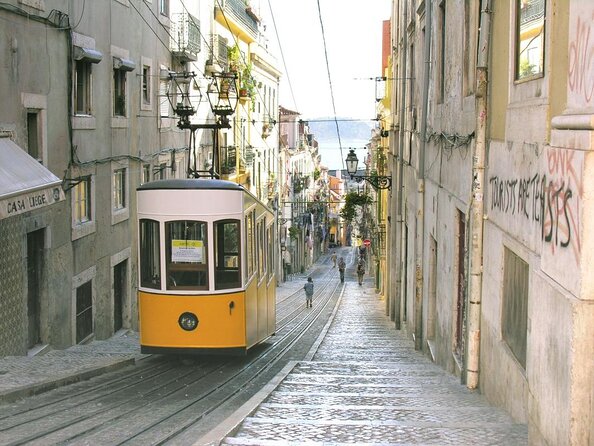
The Portas do Sol viewpoint looks over the eastern side of Alfama and the Tagus. From here, the district appears as a maze of lanes, stairways, tiled roofs, church domes, and balconies. The kiosk offers a place for a quick Portuguese coffee, while Tram 28 regularly passes nearby.
The stop itself is brief, about five minutes, so treat it as a photo and orientation point rather than a long break. The statue of Saint Vincent, Lisbon’s patron, adds a small piece of local identity to the scene.
The real time comes in Alfama, where you spend about an hour. This is the oldest part of Lisbon and one of the few areas to retain its pre-1755 earthquake street pattern. It was once a Jewish quarter and fishing community, and today its narrow alleys still feel more like a small village than part of a capital city.
This is the most walk-focused part of the day. You might pass clotheslines hanging from balconies, hear Fado from a restaurant, smell fish grilling, or stop to examine traditional tilework. Your guide can explain how the district survived the earthquake because of its position on the city’s higher ground.
Alfama is also where the private format matters most. A large group can clog a narrow lane, while a small private party can pause when something catches your eye. Still, bring sensible shoes. The district has steep slopes, stairs, and uneven paving, and the listed visit does not include admission to a specific attraction.
Senhora do Monte gives you the high view
The Miradouro da Senhora do Monte is one of Lisbon’s highest viewpoints. It looks across the city toward the Castle, central districts, and the Tagus, with a tile panel helping identify the main monuments.
A small image of the Virgin Mary gives the viewpoint its name, and behind it sits an eighteenth-century chapel that is usually closed. There is also a local legend about a stone chair and easier childbirth, a detail your guide may use to add a little character to the stop.
You have about 15 minutes here. That is enough for the panorama and photographs, but not for a relaxed sunset visit beneath the olive trees, cypresses, and stone pines. The private vehicle makes reaching this high point easier than tackling the climb on foot, though getting out and walking around still requires care on sloped surfaces.
Nearby in Lisbon, a different day entirely:
- Sintra: Pena Palace and Park Entrance Ticket
★ 4.2 · 17,410 reviews - Lisbon: History, Stories and Lifestyle Walking Tour
★ 4.8 · 10,902 reviews - Lisbon: Sunset Boat Party Cruise with DJ and Open Bar
★ 4.5 · 10,378 reviews - Lisbon: Pena Palace, Sintra, Cabo da Roca, & Cascais Daytrip
★ 4.7 · 9,981 reviews
Santo António and the Cathedral anchor old Lisbon
The Church of Santo António is linked by tradition to the house where Saint Anthony was born. The church sits beside the former Porta do Mar, part of the medieval defensive wall, and a small museum next door is dedicated to the saint.
The stop lasts around 15 minutes and admission is free. It is a compact visit, but useful if you want religious history tied to a real place rather than just another church on a checklist.
The Lisbon Cathedral follows, with about ten minutes outside or inside the cathedral area and no listed admission charge. Construction began in the second half of the twelfth century after Lisbon was taken from the Moors by Afonso Henriques. Its mixture of architectural styles reflects centuries of rebuilding and change.
Ten minutes is a short look. You can appreciate the cathedral’s importance and ask questions, but you should not expect a full examination of every chapel or treasury area. If church interiors are central to your interests, tell the guide early so the day can be adjusted where possible.
Baixa explains the city rebuilt after disaster
The Baixa district gives the tour its clearest lesson in urban planning. The 1755 earthquake destroyed much of central Lisbon, and Baixa was rebuilt with orderly streets, planned blocks, and broad squares. Many streets were named for the trades once practiced there, including shoemaking, saddlery, gilding, and gold and silver work.
This planned center contrasts with Alfama’s winding lanes. Walk through Baixa and you can see the practical response to disaster in the regular street layout and neoclassical buildings. The district later lost many residents to newer parts of the city, but its shops, cafés, offices, and pedestrian streets have brought it back to life.
The tour also passes along Lisbon’s grand tree-lined avenue between Restauradores and Marquês de Pombal. This is the city’s major luxury shopping and theater corridor, paved with the black-and-white Portuguese cobbles that give Lisbon so much of its visual character.
The private vehicle helps you see this area without spending much of your day walking its full length. If you want shopping time, though, that would need to be arranged around the sightseeing schedule.
Commerce Square opens the city to the Tagus

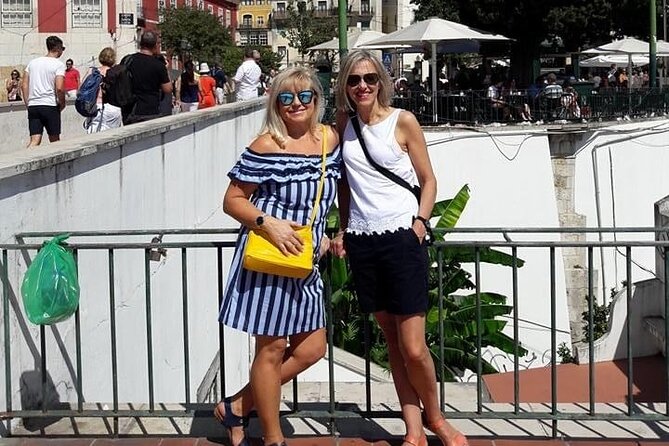
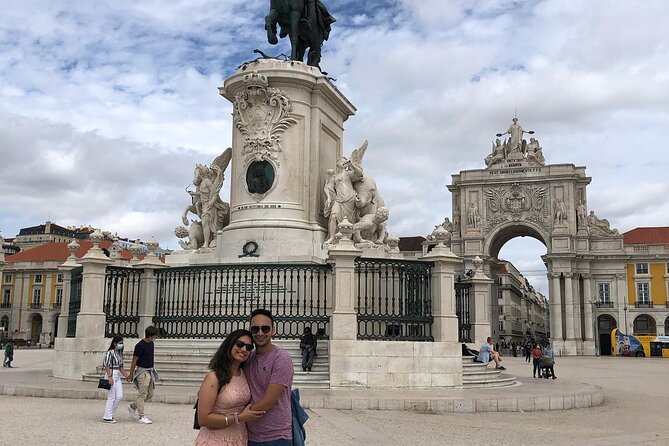
Praça do Comércio is Lisbon’s great riverfront square. It occupies the site of the former Royal Palace, destroyed in the 1755 earthquake, and its yellow buildings form three sides of a grand open space. The fourth side faces the Tagus.
The square once served as Lisbon’s commercial doorway. Ships unloaded goods directly here, and the arcades and riverfront position made the square a working center as well as a ceremonial one.
You spend about 15 minutes here, which gives you time to understand the setting and take photographs. I like this stop because it ties together Lisbon’s royal past, trading history, earthquake rebuilding, and relationship with the river.
It is also a good place to pause after the hill districts. The day includes lunch, but lunch is not included in the price, so plan to pay separately. Several tour comments describe a midday lunch break, and the private setup should make it easier to discuss timing and food preferences with the guide.
Christ the King delivers the big city view
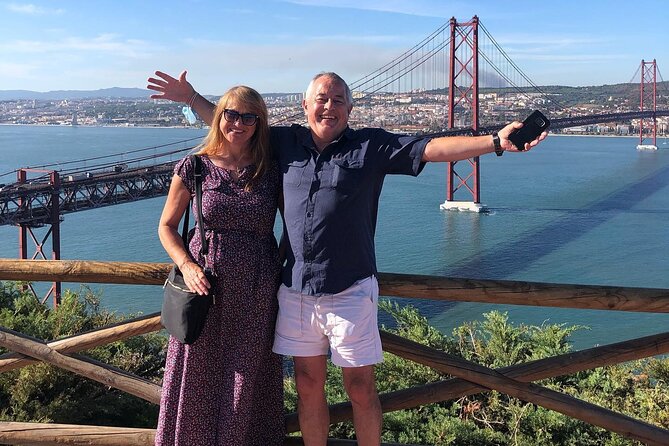
The route then crosses the Tagus to the National Sanctuary of Christ the King in Almada. The monument rises above the river on a 133-meter site and consists of a tall portico topped by the 28-meter figure of Christ with open arms facing Lisbon.
From here, the view takes in the capital, the Tagus, and the 25 de Abril Bridge. After spending the morning among narrow streets and close-set buildings, this broad outlook gives you a useful sense of Lisbon’s size and position beside the water.
The stop lasts about 30 minutes and admission is listed as free. It is one of the longer pauses on the route, which makes sense because the view needs time. Your guide can point out districts you have already visited and help you connect them from across the river.
The crossing also shows why private transportation has value. Reaching Almada and returning to the Belém area by public transport would add planning and waiting time, particularly during a one-day sightseeing plan.
Belém brings Portugal’s seafaring story to the river
The Monument to the Discoveries is a 15-minute panoramic stop. Its stylized caravel carries Prince Henry the Navigator at the front, followed by navigators, cartographers, soldiers, religious figures, writers, and artists linked to Portugal’s overseas expansion.
The monument presents a proud national story, but it is worth asking your guide about the wider human cost and political setting of that expansion. A private guide gives you room for those questions instead of limiting the discussion to dates and names.
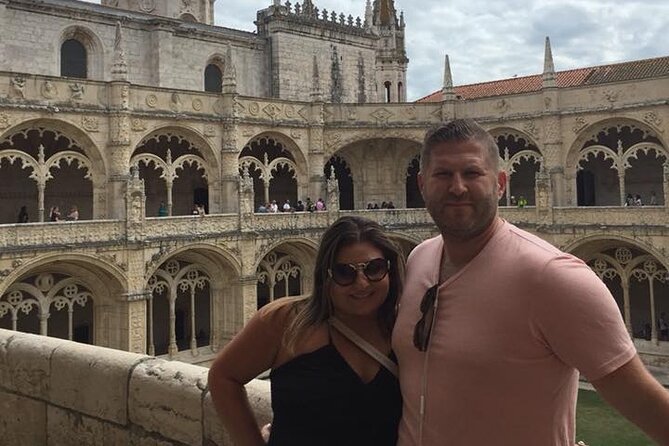
Next comes the Jerónimos Monastery, where the visit is limited to the monastery church. The church is known for its ornate stonework and for the tomb of Vasco da Gama, the navigator associated with the sea route to India. The scheduled time is about 20 minutes, and the information specifies the church rather than the cloisters.
That distinction matters. The cloisters are among the most famous parts of the monastery, but they are not included in this visit as described. If you have your heart set on seeing them, ask before booking or confirm if additional time and admission can be arranged.
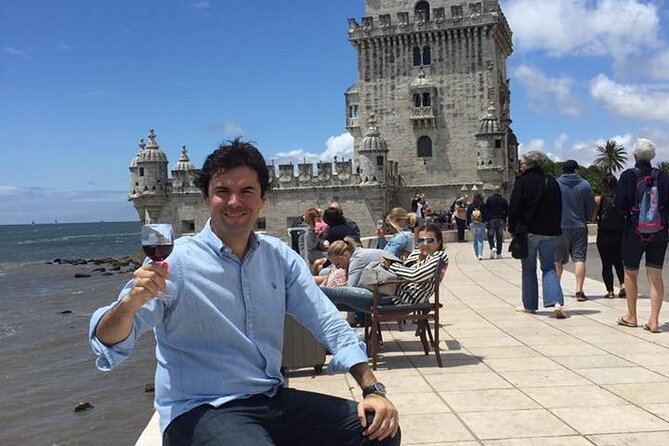
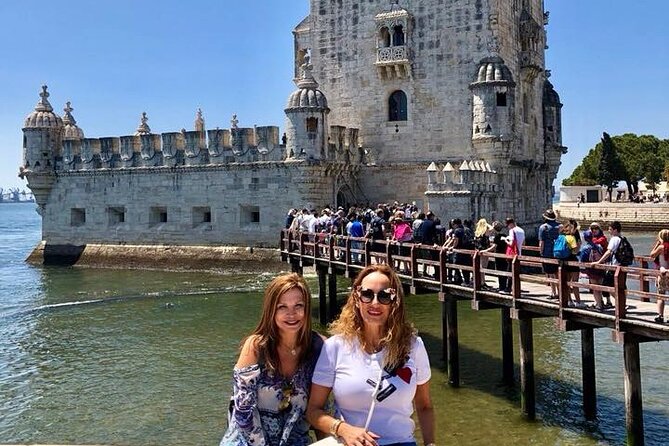
The final stop is Belém Tower, visited panoramically for about 15 minutes. Built during Portugal’s Age of Discoveries, the tower looks like a small fortified castle at the water’s edge and is recognized as a UNESCO World Heritage site.
Again, this is an outside viewing rather than a full interior tour. You get the setting, architecture, and photographs, but not an extended visit inside the tower.
What the $118.56 price means in practice
At $118.56 per person, the value depends heavily on the size of your party. A solo visitor or couple pays more per head than a larger private group, but the price includes a full day of private guiding, an air-conditioned vehicle, transportation, hotel or cruise-port pickup and drop-off, WiFi, and required insurance. Group discounts are available.
For a first visit, I see the price as paying for time and logistics as much as sightseeing. You avoid arranging transport between hills, central Lisbon, Belém, and Almada. You also get a guide who can explain what you are seeing and give practical suggestions for the rest of your stay.
The price does not include lunch, and admission details vary by stop. Santa Justa includes admission, while several other stops are free or panoramic. The Jerónimos visit is limited to the church, so do not assume that every major monument includes full entry.
The tour is often booked well ahead, with an average booking lead time of 86 days. That suggests planning early is sensible, especially if your Lisbon dates are fixed.
Guides, comfort, and the pace of the day
The guides named in the available information include João, Anastasia, Jorge, Ana, and John. Their roles can include both driving and guiding, so you should expect a mix of spoken explanation from the vehicle and short walks at the sights.
The strongest pattern is personal care. One guide adjusted the day for a guest with a bad back, another provided umbrellas during changing weather, and one helped carry purchases. Those details matter because a long Lisbon day can be tiring, especially in hot weather or on steep streets.
The day is described as roughly eight hours, though one account says it lasted nearly nine hours. That may happen when the route is adjusted or when the group wants more time. Road closures can also require changes, and the guide is expected to modify the route rather than let a blocked street spoil the day.
You can participate in English, and most people can take part. Still, do not confuse private transportation with a completely step-free experience. Alfama, the viewpoints, and historic areas involve slopes and cobblestones. Tell the operator about mobility or back concerns in advance so the route can be handled sensibly.
Free cancellation is available up to 24 hours before the start time for a full refund. Changes or cancellations inside that window are not accepted for a refund, and the tour requires a minimum number of participants.
Who should book this Lisbon day tour?
I would choose this for a first visit, a short stay, or a cruise stop when you want to see a large share of Lisbon without losing time to transport planning. It is also a good match for families or small groups with different interests, since the route can be adjusted more easily than a fixed group excursion.
It suits you if you value context, personal attention, and a broad introduction. Guides have covered history, architecture, neighborhoods, local customs, food, and practical advice, and the private setting lets you ask questions as the day unfolds.
I would hesitate if you want long, detailed visits inside museums and monuments. The itinerary moves quickly, and several stops are panoramic or brief. Independent travelers who prefer lingering in one neighborhood, shopping for hours, or spending an entire afternoon inside Jerónimos may get more from a slower custom plan.
Should you book it?
Book this tour if your priority is to see Lisbon’s major districts in one day while riding between them in comfort. The mix of Alfama lanes, Baixa planning, hilltop viewpoints, Christ the King, and Belém gives you a strong first look at the city.
Before confirming, ask which guide will lead your date, how much walking is expected, and if the church and monument visits match your interests. Also budget for lunch and remember that the Jerónimos cloisters and Belém Tower are not part of the described full-entry program.
For a short Lisbon stay, the private format and broad route make the $118.56 per-person price easier to justify, especially for a small group sharing the day.
FAQ
How long is the private Lisbon tour?
The tour lasts approximately eight hours. Some days may run longer if the route is adjusted or the group spends additional time at the sights.
What time does the tour begin?
The scheduled start time is 8:30 a.m.
Where can pickup and drop-off take place?
Pickup and drop-off are offered at your hotel, apartment, or cruise port.
Is the tour private?
Yes. Only your group participates in the private activity.
Is the tour offered in English?
Yes. English is one of the offered languages.
Is transportation included?
Yes. The experience includes private transportation, an air-conditioned vehicle, hotel or port pickup and drop-off, and WiFi on board.
Is lunch included?
No. Lunch is not included in the tour price.
Which attractions include admission?
Admission to the Elevador de Santa Justa is included. Several other stops are free, panoramic, or viewed from outside. The Jerónimos visit is limited to the monastery church.
Can I cancel for a full refund?
You can cancel at least 24 hours before the local start time for a full refund. Cancellations or changes made less than 24 hours before the start are not accepted for a refund.
Fresh finds around Lisbon
- Sanctuary of Fátima and Coimbra City Tour★ 4.5 · 51 reviews
- Sintra/Lisbon: Sintra & Quinta da Regaleira Tour with Ticket★ 4.4 · 51 reviews
- Jeronimos Monastery Guided Tour – Small Groups – Tickets Included★ 5.0 · 51 reviews
- Lisbon: Private Christmas Lights Tour by Eco Tuk Tuk★ 4.9 · 51 reviews
- Peniche: Berlengas Island Catamaran Tour – Round Trip★ 4.6 · 51 reviews
- Half day Spa Water Therapy experience at THE SPA at Corinthia Lisbon★ 4.5 · 51 reviews
- Lisbon: Private Tuk-Tuk Tour for 2 hours★ 4.7 · 51 reviews
- Premium Lisbon Airport Transfer to Lisbon★ 5.0 · 51 reviews
Private, compared.

True 4Hour Private Tuk Tuk Tour: Discover Lisbon with a Local!
Read our review →

Private Lisbon Sightseeing Tuk-Tuk Tour: Alfama, Belém & More
Read our review →
Lisbon Highlights: Private Tuk Tuk Tour Adventure Sightseeing
Read our review →
Welcome Lisbon Tour with Local Guide in Private Eco Tuk Tuk
Read our review →
Sintra Full-Day Private Tour – A Journey through Wonderland
Read our review →
Sintra Private Trip from Lisbon Customizable Dreamlike Experience
Read our review →