Reviewed · PRIVATE
Private Tour: Best of Lisbon by Sidecar
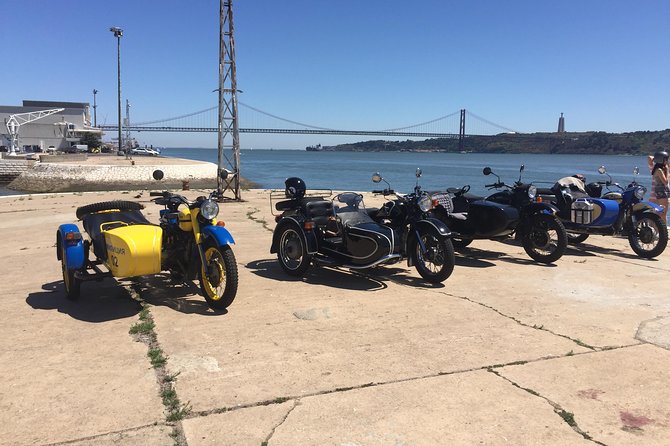
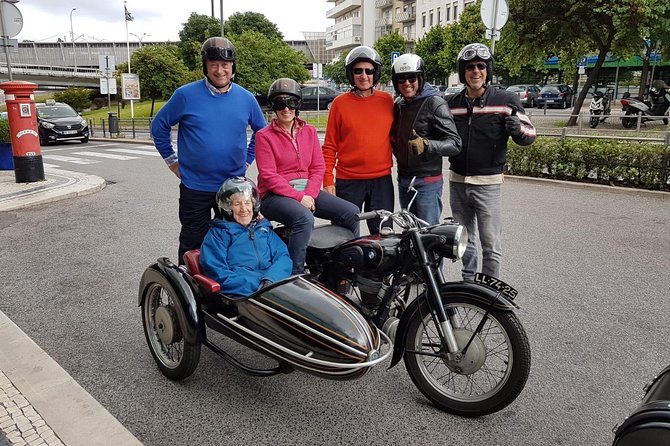
Lisbon is made for a sidecar. You slip through narrow lanes, climb steep hills, and cross busy avenues without being boxed inside a bus. The motorcycle also turns you into part of the show. People wave, children point, and that bright sidecar draws plenty of attention as you pass.
I love the fast city orientation and the personal guiding. In about three hours, you can connect Belem, Alfama, Chiado, Bairro Alto, Baixa and the major viewpoints, then return later to the places that catch your eye. I also like the small touches: hotel pickup, rain gear, gloves, photo stops, and local tips from guides such as Daniel, David, Luis and Jorge.
The main drawback is physical rather than cultural. Lisbon’s hills and cobbled streets can make the ride bumpy, especially for the passenger behind the driver. You also need to accept an open-air ride, so weather matters, and the sidecar has a combined passenger weight limit of 190 kilograms.
In This Review
- Key points to know before you book
- Why a sidecar works so well in Lisbon
- Meeting your guide and choosing your seat
- Belem: Lisbon’s river-facing monuments
- Alfama and Mouraria, where Lisbon feels oldest
- Chiado and Bairro Alto after the old quarters
- Viewpoints, Baixa and the grand avenues
- Evening rides and the taste of ginjinha
- What the $362.95 price really buys
- Safety, comfort and weather
- Who will get the most from this ride
- Should you book the Lisbon sidecar tour?
- FAQ
- How long is the Lisbon sidecar tour?
- How many people can ride in one sidecar?
- Is hotel pickup available?
- What age can children be to join?
- Is the tour offered in English?
- What equipment is included?
- Are food and drinks included?
- What happens if the weather is poor?
Key points to know before you book
- A private sidecar carries two people: One passenger rides in the sidecar while the other sits behind the driver on the motorcycle.
- The route covers a lot of ground: You can see Belem, Alfama, Mouraria, Chiado, Bairro Alto, Baixa, Rossio, Avenida da Liberdade and several viewpoints.
- Book it early in your stay: The tour gives you a useful feel for Lisbon’s hills, neighborhoods and layout before you plan the rest of your visit.
- Guides make the difference: Daniel, David, Luis, Jorge and Claudio are among the named guides praised for clear stories, local pride and safe driving.
- The ride is open to the weather: Helmets, gloves and rain gear are supplied, but poor weather can lead to a rescheduled tour or refund.
- Food and drinks cost extra: A pastel de nata is available at a local pastry shop on morning and afternoon tours, while ginjinha is an option on evening departures.
Why a sidecar works so well in Lisbon
Lisbon is spread across hills above the Tagus River, with old quarters that are awkward for large vehicles. A sidecar gets closer to the city than a coach and covers more ground than walking. That makes it a good first-day choice if you want a clear sense of direction before spending time inside museums, churches and neighborhoods.
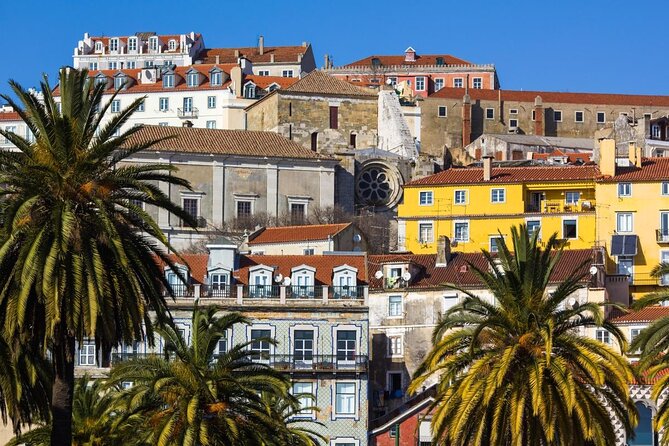
You are not simply driven from one monument to the next. The route connects parts of Lisbon that feel quite different. Alfama gives you old lanes and Moorish traces. Chiado brings shops, theaters and cafés. Belem opens onto grand monuments and the river. Between them, your guide can point out viewpoints, streets and districts you might otherwise miss.
I would think of this as a moving introduction rather than a substitute for a full sightseeing day. Stops are short, often around five minutes at the listed points, though the actual experience can include brief walks, photo opportunities and customized pauses. You get the city’s broad shape first, then choose where to return on foot.
A handful more Lisbon ideas to compare
- Lisbon City Center Tour – The Unmissable Lisbon
★ 5.0 · 22,234 reviews - Lisbon: Sintra, Pena, Regaleira, Cabo da Roca & Cascais
★ 4.7 · 19,656 reviews - Lisbon: Jerónimos Monastery Entrance Ticket
★ 4.1 · 14,164 reviews
Meeting your guide and choosing your seat
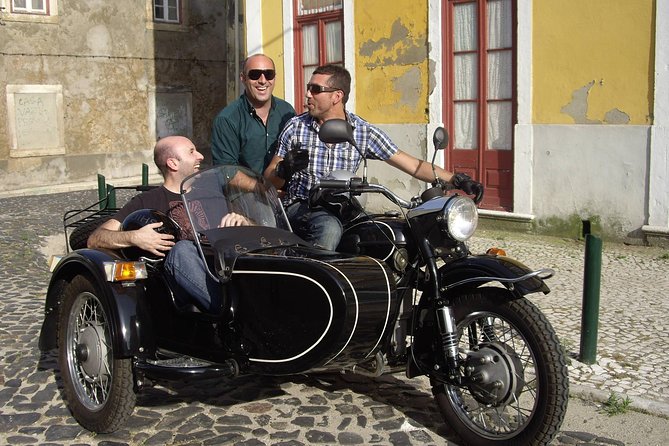
Pickup is offered from centrally located Lisbon hotels and the cruise ship terminal. That is useful if you have luggage, are arriving by ship, or simply want to avoid finding a starting point in an unfamiliar part of town. The tour is private, so only your party rides with the guide.
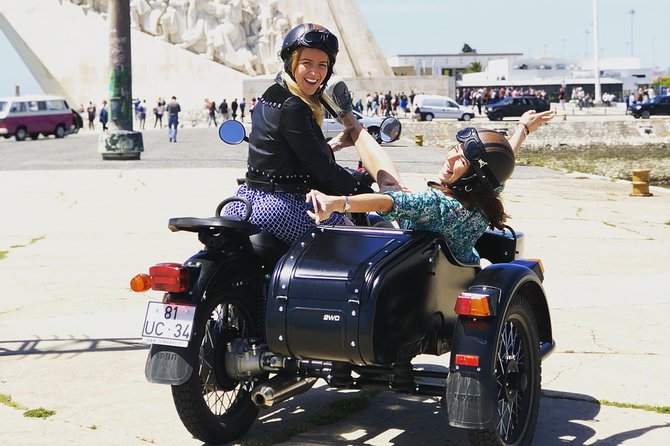
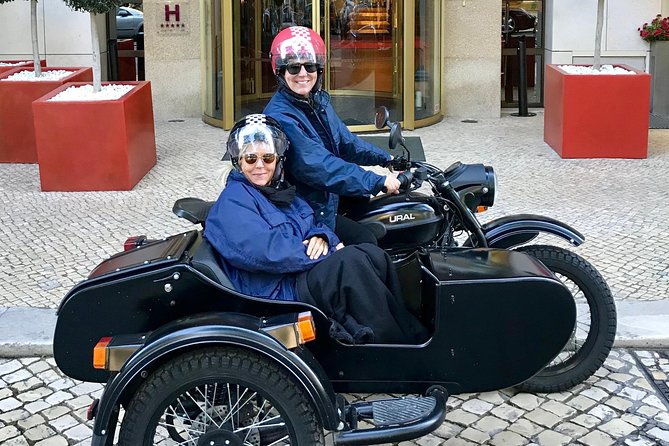
Each sidecar holds two passengers. One sits in the sidecar and the other rides on the motorcycle behind the driver. You should decide in advance who wants which position, then consider swapping if the guide allows and the ride pattern suits you.
The sidecar is usually the more open and photogenic seat. You have a broad view and can take in the streets without sitting directly behind the driver. The rear motorcycle seat may feel more secure to some people, but it also means dealing with Lisbon’s hills and turns from the bike itself.
The minimum age is eight. The combined weight limit for two passengers is 190 kilograms. Helmets, gloves and rain gear are included, and the tour is offered in English. Most people can take part, but this is not the right outing if you need a fully enclosed vehicle or have trouble with a motorcycle seat.
Belem: Lisbon’s river-facing monuments
Belem is the most famous outlying section of the standard route. It sits along the Tagus and carries the grand maritime character that many people associate with Lisbon.
The Tower of Belem is the headline sight. Built in the 16th century, it is a fine example of Manueline art, with carved stone details tied to Portugal’s seafaring era. From the sidecar, you see it as part of the riverfront setting rather than only as an indoor monument.
The Jerónimos Monastery gives the Belem section a second major landmark. Its scale and ornate stonework make it one of the city’s essential stops. The tour takes you there, but the experience described here is primarily an outside overview and drive-by visit, not a guaranteed interior visit or reserved admission.
That distinction matters. If you want to study the monastery cloisters or climb inside the tower, set aside separate time and check opening arrangements. The sidecar tour gives you context and a good first look, while your later visit can be slower and more focused.
On morning and afternoon tours, the route can include a stop at a Portuguese pastry shop for a pastel de nata. The custard tart is not included in the price, so bring a little spending money. This is a simple but worthwhile pause, since the pastry gives you a taste of everyday Lisbon rather than another monument.
Alfama and Mouraria, where Lisbon feels oldest

Alfama is the part of Lisbon where the sidecar earns its keep. Its narrow cobbled lanes climb from the Tagus toward the Castelo de São Jorge, with old houses packed closely along the slopes. A large tour vehicle would struggle here, while a motorcycle can work through the maze with much less fuss.
You may pass near important sights such as Lisbon Cathedral, Castelo de São Jorge, the National Pantheon and the Church of Saint Anthony. The tour does not promise admission to these buildings, so plan to return if you want interiors. The real value here is the introduction to the district’s shape, steep streets and Moorish influence.
Your guide adds short historical stories as you ride. The best part is not a long lecture. It is hearing why a lane, wall or neighborhood matters while you are looking directly at it. Guides named in the tour feedback, including David, Daniel and Luis, were especially praised for turning the ride into a lively history lesson without losing the fun of the road.
Mouraria adds another layer. The district began as the area where Moors were allowed to live after the Christian reconquest of Lisbon in 1147. Little of that original period remains beyond traces of the medieval wall, but the neighborhood is still one of the city’s most multiethnic areas.
That makes Mouraria a useful counterpoint to the polished monument zones. You see a part of Lisbon shaped by migration, older street patterns and daily life. Details on the exact length of the stop are not fixed, so expect a passing introduction rather than a long walking tour.
Nearby in Lisbon, a different day entirely:
- Sintra: Pena Palace and Park Entrance Ticket
★ 4.2 · 17,410 reviews - Lisbon: History, Stories and Lifestyle Walking Tour
★ 4.8 · 10,902 reviews - Lisbon: Sunset Boat Party Cruise with DJ and Open Bar
★ 4.5 · 10,378 reviews - Lisbon: Pena Palace, Sintra, Cabo da Roca, & Cascais Daytrip
★ 4.7 · 9,981 reviews
Chiado and Bairro Alto after the old quarters
Chiado changes the mood. This traditional shopping district mixes old and modern businesses along Carmo and Garrett streets. It is also one of Lisbon’s cultural centers, with museums and theaters close by.
You will probably notice the contrast after Alfama’s tight lanes. Chiado feels more open, commercial and polished, though it still carries plenty of old Lisbon character. A sidecar lets you see the district without giving up valuable walking time during a short visit.
Bairro Alto sits nearby but feels different again. It is known for its hilltop streets and viewpoints, and the tour treats it as both a neighborhood and a place to look out over the city. The listed stop is brief, around five minutes, so use it for orientation and photos rather than expecting time to explore every lane.
I like this sequence because it shows Lisbon as a city of distinct quarters, not one continuous old town. Your guide can explain how the neighborhoods relate to each other, then suggest where to return for an evening meal, music or a longer walk. Specific restaurant advice may vary by guide, but several guides have offered local suggestions at the end of the ride.
Viewpoints, Baixa and the grand avenues
Parque Eduardo VII provides one of the city’s broad viewpoints. From here, Lisbon’s long central axis and the Tagus direction become easier to understand. It is a useful stop if you want photographs that show the city’s scale rather than just a close-up of tiled facades.
The route then moves toward Baixa and Rossio, the central downtown area. These are practical landmarks for finding your way around later. Rossio is a good reference point for public transportation, central streets and the evening flow of the city.
A ride along Avenida da Liberdade and past Marquês de Pombal finishes the standard circuit with a dose of wide boulevards and formal city planning. It is a change from the medieval lanes of Alfama and the hilltop streets of Bairro Alto.
The precise route can vary. Some descriptions include additional monuments and a stop at LX Factory, a former industrial site now filled with design offices, artists’ studios, shops, restaurants and colorful street art. Mouraria is also included in the broader route description. Ask your guide at the start how much time is available for each area, especially if one particular district matters most to you.
Evening rides and the taste of ginjinha
An evening departure gives the experience a different tone. Lisbon’s streets and viewpoints take on a softer feel, and the sidecar becomes a memorable way to see the city after daylight sightseeing ends.
At the end of the evening tour, you can stop to try ginjinha, Lisbon’s well-known sour-cherry liqueur. It is not included, so you pay for your own drink. This is optional, but it gives the tour a distinctly local finish.
The evening option is best for you if you care more about atmosphere and neighborhood views than a pastry stop. Morning and afternoon departures include the chance to stop for pastel de nata instead. Both food stops are extras, not part of the $362.95 group price.
What the $362.95 price really buys

The listed price is $362.95 per sidecar for up to two people, not per passenger. Split between two, that works out to about $181.48 each. It is not a budget way to get from place to place, but it is a private experience with a driver-guide, hotel or cruise-terminal pickup, helmets, gloves, rain gear and all taxes and handling charges included.
The value depends on how you use the three hours. If you want slow museum visits and long meals, this is not the best use of your money. If you have limited time, are arriving from a cruise, or want a private overview without joining a large group, the cost becomes easier to justify.
You are also paying for access to a vehicle that can handle narrow streets and steep routes. A taxi could move you around, but it would not provide the same running commentary or sight-by-sight orientation. A walking tour could offer more detail at each stop, but it would cover less of Lisbon and require more effort on the hills.
The experience is often booked well ahead, with an average lead time of about 63 days. If your dates are fixed, I would reserve early, especially if you want a particular guide or a morning departure.
Safety, comfort and weather
The equipment included is basic but important: helmet, gloves and rain gear. The motorcycles are described as well maintained, and safe driving is a major part of the experience. Still, you are on an open motorcycle in city traffic, so you should choose this only if you feel comfortable with that type of transport.
The ride is described as surprisingly smooth for much of the route, but Lisbon’s cobbles and hills remain real. Hold on firmly, particularly in the rear seat and on steep streets. The sidecar passenger may have a more exposed ride, with less control over the motorcycle’s movement.
Good weather is required. If conditions make the tour unsafe or impractical, the operator offers another date or a full refund. You can also cancel for a full refund up to 24 hours before the start time. Food, drinks, lunch, the pastel de nata and ginjinha are not included.
Who will get the most from this ride
I would book this for a first day in Lisbon. You get a map in your head quickly, and you can mark places to revisit. It is especially useful for a couple with only a short stay, cruise passengers with limited time ashore, and anyone who wants a private guide rather than a large coach.
It also suits repeat visitors. One guide can tailor the route toward less familiar areas, and the sidecar offers a new view of streets you may have already walked.
Families can take part if children are at least eight years old and the combined weight limit is respected. The private format is helpful for families because the guide can adjust the pace and explain things directly to your group.
I would hesitate if you dislike motorcycles, need a quiet enclosed cabin, or want extensive time inside monuments. The short stops are useful for orientation, but you will need a separate visit for the Tower of Belem, Jerónimos Monastery, Castelo de São Jorge or other interiors.
Should you book the Lisbon sidecar tour?
Book it if you want a lively first look at Lisbon, enjoy personal guiding, and are comfortable riding outdoors on a motorcycle. The combination of Belem, Alfama, Mouraria, Chiado, Bairro Alto, Baixa and the viewpoints gives you a lot of city in a short time.
The strongest reason to choose it is the guide. Names such as Daniel, David, Luis, Jorge and Claudio come up repeatedly in the experience, with praise for their stories, local pride, friendly manner and careful driving. You cannot guarantee a particular guide unless the operator confirms one, so ask when booking.
Skip it if your main goal is museum access, a slow food tour or the lowest possible price. For everyone else, especially couples and short-stay visitors, this is a smart way to get your bearings fast and add a genuinely unusual ride to your Lisbon plans.
FAQ
How long is the Lisbon sidecar tour?
The standard tour lasts approximately three hours. Some descriptions and past experiences indicate a longer outing of close to four hours, so allow flexibility in your schedule.
How many people can ride in one sidecar?
One sidecar carries up to two passengers. One person rides in the sidecar and the other sits on the motorcycle behind the driver.
Is hotel pickup available?
Yes. Pickup is offered from centrally located hotels in Lisbon and from the Lisbon cruise ship terminal.
What age can children be to join?
The minimum age is eight years.
Is the tour offered in English?
Yes. English is the listed tour language.
What equipment is included?
Helmets, gloves and rain gear are included, along with the driver-guide and all taxes, fees and handling charges.
Are food and drinks included?
No. Food and drinks are not included unless specifically stated. Pastel de nata, lunch and ginjinha are paid separately.
What happens if the weather is poor?
The experience requires good weather. If the operator cancels because of poor conditions, you can choose another date or receive a full refund. You can also cancel at least 24 hours before the start time for a full refund.
Fresh finds around Lisbon
- Sanctuary of Fátima and Coimbra City Tour★ 4.5 · 51 reviews
- Sintra/Lisbon: Sintra & Quinta da Regaleira Tour with Ticket★ 4.4 · 51 reviews
- Jeronimos Monastery Guided Tour – Small Groups – Tickets Included★ 5.0 · 51 reviews
- Lisbon: Private Christmas Lights Tour by Eco Tuk Tuk★ 4.9 · 51 reviews
- Peniche: Berlengas Island Catamaran Tour – Round Trip★ 4.6 · 51 reviews
- Half day Spa Water Therapy experience at THE SPA at Corinthia Lisbon★ 4.5 · 51 reviews
- Lisbon: Private Tuk-Tuk Tour for 2 hours★ 4.7 · 51 reviews
- Premium Lisbon Airport Transfer to Lisbon★ 5.0 · 51 reviews
Private, compared.

True 4Hour Private Tuk Tuk Tour: Discover Lisbon with a Local!
Read our review →

Private Lisbon Sightseeing Tuk-Tuk Tour: Alfama, Belém & More
Read our review →
Lisbon Highlights: Private Tuk Tuk Tour Adventure Sightseeing
Read our review →
Welcome Lisbon Tour with Local Guide in Private Eco Tuk Tuk
Read our review →
Sintra Full-Day Private Tour – A Journey through Wonderland
Read our review →
Sintra Private Trip from Lisbon Customizable Dreamlike Experience
Read our review →