
Reviewed · BELéM TOURS
Lisbon: Belem Walking Tour with Jeronimos Monastery Tks Included
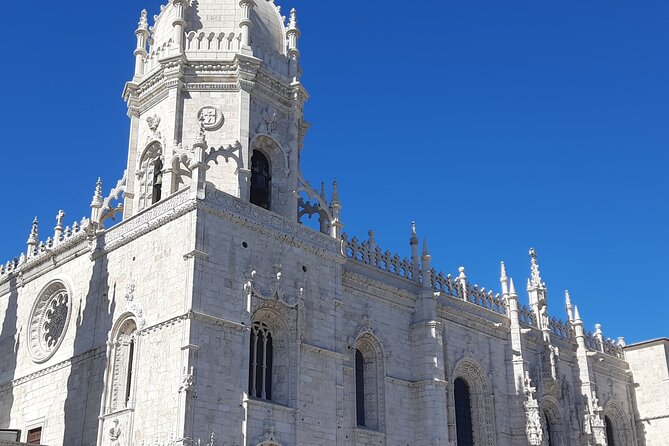
The best part of this Belém walking tour is the way it links beautiful stonework with Portugal’s seafaring age. You enter Jerónimos Monastery early, then walk past the pastry shop, gardens, monuments, and riverfront tower with the story still fresh in your mind.
I like two things here: the included monastery ticket can help you avoid the long individual-ticket line, and the guide turns a string of sights into one clear story about religion, monarchy, exploration, and empire. The warm custard tart at Pastéis de Belém is a fine bonus.
The main caution is timing. You must arrive before the 9:30 a.m. entry, and the tour runs outdoors in sun, rain, and sometimes little shade. On Sundays, the church visit is not included because it opens at 2 p.m. Also, Belém Tower is currently closed for restoration, so you see it from outside.
In This Review
- Key points to know before booking
- Why this Belém walk works so well
- Jerónimos Monastery, where Portugal tells its story in stone
- The church visit and the Sunday limitation
- Pastéis de Belém and the pastry stop
- Praça do Império and the symbols of empire
- The Discoveries Monument and Portugal’s public memory
- Belém Tower, viewed from the riverfront
- Guides, pace, and the feel of the group
- Timing, weather, and practical value
- Who should book this morning in Belém?
- Should you book the Jerónimos and Belém walking tour?
- FAQ
- Where does the tour begin?
- Where does the tour end?
- Is admission to Jerónimos Monastery included?
- Is the Belém Tower ticket included?
- Is the custard tart included?
- Does the church visit happen on Sundays?
- What happens if I need to cancel?
Key points to know before booking
- Early Jerónimos entry: The tour begins at 9:30 a.m., when joining the group line can save substantial waiting time.
- History with a human voice: Guides including Federico, Luis, Leo, Daniel, and Ruben have been praised for clear English, lively storytelling, and careful answers to questions.
- Pastel de Belém included: You receive an original custard tart at the historic shop, with some tours also offering a look toward the pastry-making area.
- A proper half-day walk: The route covers Jerónimos Monastery, the pastry shop, Praça do Império, the Discoveries Monument, and Belém Tower in about three and a half hours.
- Belém Tower is exterior only: Restoration work currently prevents entry, and the tower ticket is not included.
- Small enough to hear: The group limit is 20 people, and an earpiece may be supplied when the group is larger.
Why this Belém walk works so well
Belém is where Lisbon’s grandest national story is put on display. The district connects the monastery built during the age of Portuguese voyages with later monuments that celebrate those voyages. If you visit alone, the buildings can feel like separate stops. A good guide gives you the thread tying them together.
I especially like the order. You start indoors at Jerónimos Monastery, before the day gets hot and before the lines grow long. Then the walk moves outward, from religious power to Portugal’s imperial image, ending by the Tagus River at Belém Tower.
The tour is listed at $72.56 per person and lasts about three hours and 30 minutes. That is not the cheapest way to see Belém, but it bundles the monastery admission, an English-speaking guide, and a Pastel de Belém. The real value is the early entry and the explanation. If you would only buy a monastery ticket and stroll past the other sights, the price may feel high. If you want the district explained in one morning, it makes better sense.
The group can reach 20 people. That is not a private walk, but it is still far more manageable than a huge coach outing. Some groups have used supplied earpieces, which helps when you are walking and the guide is speaking near a busy street.
More Walking Tours in Lisbon
- Lisbon: History, Stories and Lifestyle Walking Tour
★ 4.8 · 10,902 reviews - Best of Lisbon Small-Group Guided Walking Tour
★ 5.0 · 4,869 reviews - Lisbon: Food and Wine Small Group Walking Tour
★ 4.9 · 4,082 reviews
Jerónimos Monastery, where Portugal tells its story in stone
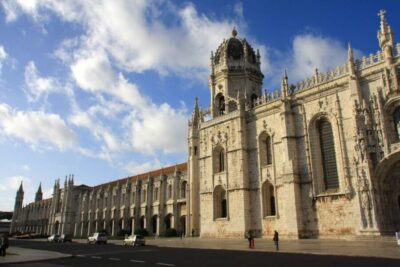
The tour begins at Mosteiro dos Jerónimos at 9:30 a.m. sharp. Do not treat this as a flexible suggestion. The group enters at a set time, and arriving late can mean missing the opening portion or creating a problem for everyone else.
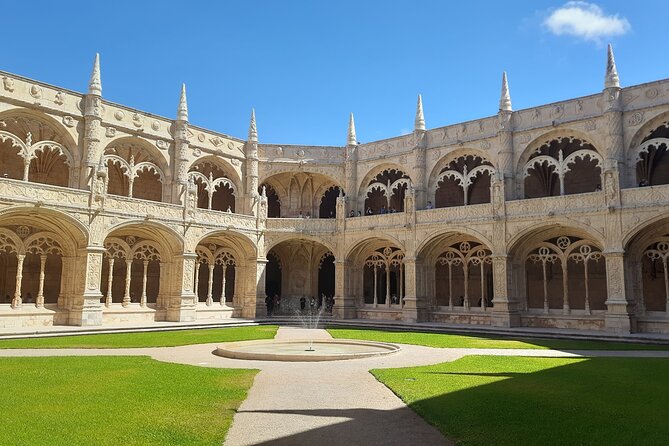
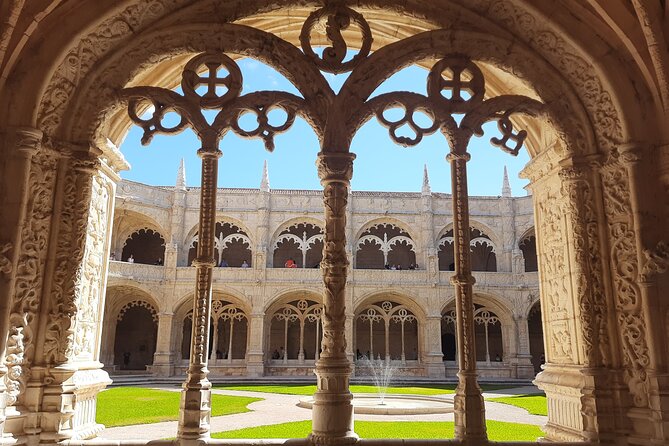
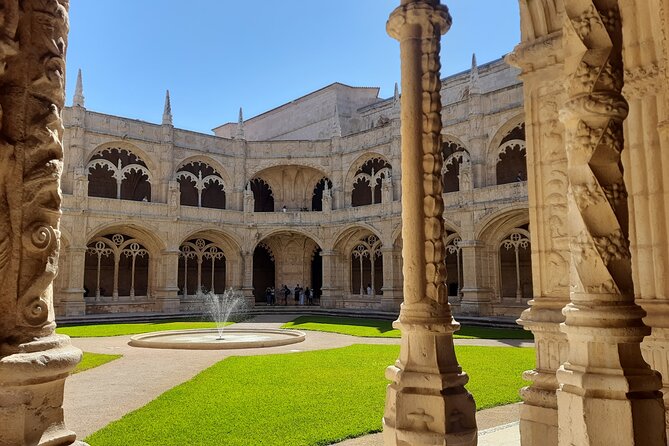
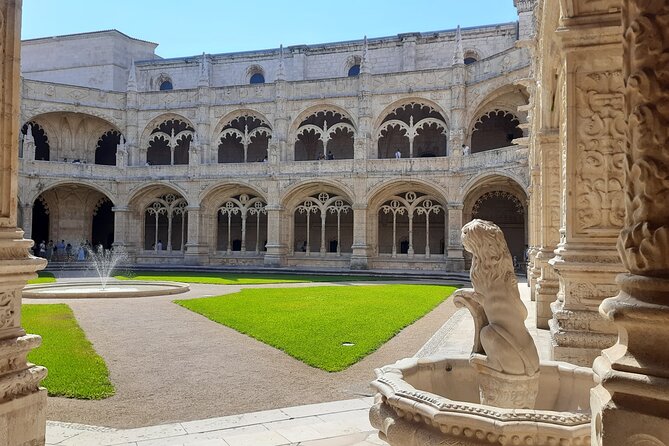
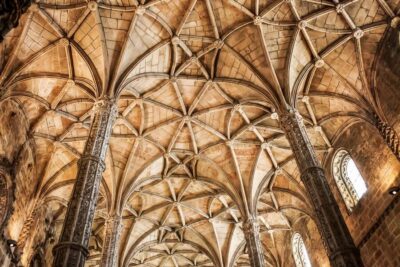
The visit starts in the upper cloister. This is the monastery’s great visual moment: pale carved stone, repeating arches, detailed columns, and views down into the central courtyard. The Manueline style combines late Gothic forms with Renaissance ideas, but the label alone does not explain why the place feels so distinctive. Your guide points out the symbols and connects the decoration to the wealth and confidence created by Portugal’s overseas voyages.
This is where the tour earns its keep. The monastery is not simply an ornate church complex. It reflects the role of religious institutions, the ambitions of the Portuguese crown, and the money tied to navigation during the 15th and 16th centuries. Guides such as Federico and Luis have been praised for explaining those links in a lively way instead of leaving you with a list of dates.
You then move through the lower cloister and several important rooms. The Chapter Room, old Refectory, and other spaces give you a better sense of daily monastic life. The cloister is the star, but these quieter rooms keep the visit from becoming only a photography stop.
The tomb of Fernando Pessoa is also part of the visit. Pessoa was moved here in the first half of the 20th century, bringing a major Portuguese literary figure into a site otherwise tied so closely to monarchy, religion, and exploration. It is a small but memorable detail, and it broadens the story beyond the Age of Discovery.
The church visit and the Sunday limitation
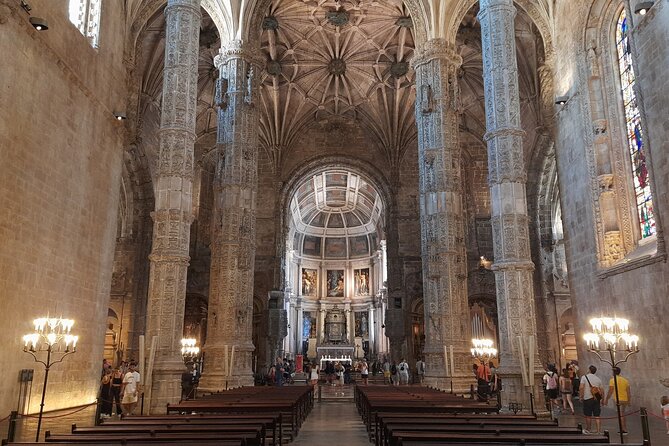
The church within the monastery complex is meant to be part of the route. It is a majestic Manueline interior, and its structure helps you see how Portugal’s decorative style worked in a sacred setting rather than only around a courtyard.
The church also gives the guide room to explain the relationship between religious belief and Portuguese navigation. The overseas voyages were not presented simply as commercial ventures. They were tied to royal power, religious purpose, national identity, and the expansion of Portuguese influence.
There is one firm exception. On Sundays, the church opens only from 2 p.m., so the morning tour does not include it. The rest of the monastery visit still goes ahead, but you should not book this version expecting to see every interior space described in the usual route.
The monastery and church can also be affected by strikes or opening changes. One tour continued when the monastery was open but the church was not, with the guide providing extra explanation outside that part of the visit. This is worth keeping in mind if seeing the church is your main reason for booking.
Pastéis de Belém and the pastry stop
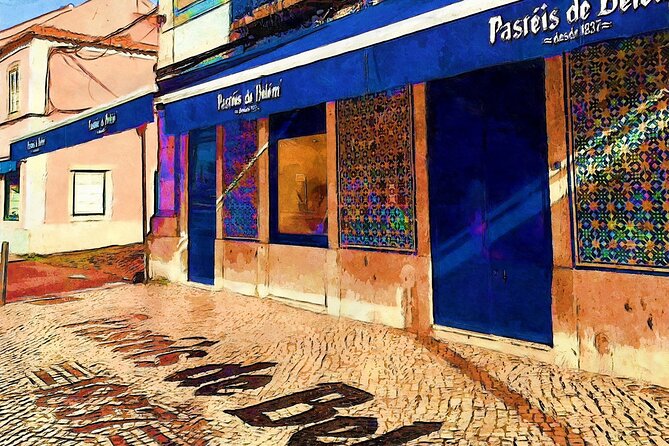
After the monastery, the group walks to Pastéis de Belém. The shop is tied to the monastery’s own pastry tradition, and the original custard tart is included in the tour.
You receive a snack, not a full meal. That distinction matters. The pastry gives you a taste of one of Lisbon’s best-known foods, but you will still need lunch later. The stop lasts about 20 minutes, so this is not designed as a long café break.
Some guides have also arranged a look toward the back of the pastry shop, where you can see something of how the treats are made. That adds a useful bit of texture to the stop. You are not merely handed a tart and sent onward. You get a brief connection between the monastery’s old recipe and the business that has sold it since the mid-19th century.
Food needs can sometimes be handled with care. One guide obtained a gluten-free treat for members of a group. Still, the included item is specifically the original custard tart, so you should raise dietary needs when booking or with the guide rather than assume every request can be met.
I would use this stop as a quick reset. Have the tart, use the restroom if needed, and keep moving. The tour covers a lot of ground, and the more important experience is the connection between the pastry, the monastery, and Belém’s long public memory.
More Belém mornings:
- Lisbon: Jerónimos Monastery Entrance Ticket
★ 4.1 · 14,164 reviews - Private Lisbon Sightseeing Tuk-Tuk Tour: Alfama, Belém & More
★ 5.0 · 4,277 reviews - Age of Discoveries Walking Tour in Belém
★ 5.0 · 1,513 reviews - Bike Tours Lisbon – Center of Lisbon to Belém
★ 5.0 · 686 reviews
Praça do Império and the symbols of empire
The walk continues to Jardim da Praça do Império. The garden was created for the Portuguese World Exhibition in 1940 and includes 32 coats of arms connected with former provinces of the Portuguese Empire.
This stop lasts only about 10 minutes, but it is useful because it brings the story into the 20th century. The garden was not created during the voyages themselves. It reflects a later period when Portugal was presenting and preserving an imperial identity.
Your guide can help you read the garden as more than decoration. The coats of arms point to how Portugal organized its memory of overseas rule. I appreciate that the strongest guides do not limit the story to heroic navigators. Federico, in particular, has been praised for including less comfortable parts of the past as well as the proud ones.
Because the visit is short and outdoors, you will want sun protection here. There can be limited shade along the route, especially on a clear late-summer morning. Bring sunscreen, water, and an umbrella if rain is possible.
The Discoveries Monument and Portugal’s public memory
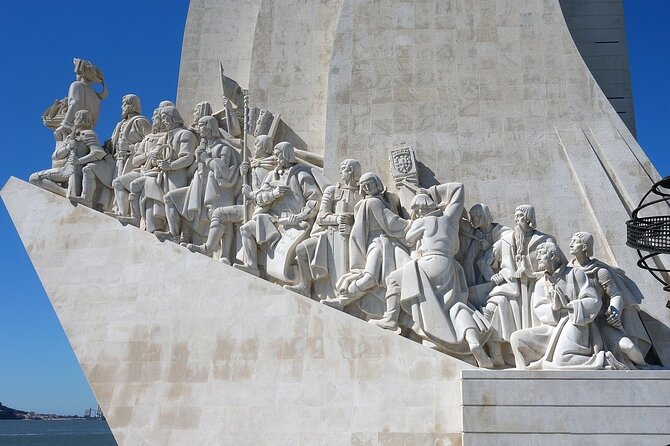
The Padrão dos Descobrimentos is one of Belém’s most recognizable landmarks. Built in 1960 to mark the 500th anniversary of the death of Infante D. Henrique, it shows important figures connected with Portuguese navigation.
The monument faces the river and works best when understood in relation to the other stops. At Jerónimos, you saw the religious and royal setting connected with navigation. Here, you see a 20th-century monument presenting the navigators and their supporters in a dramatic public image.
The tour allows about 20 minutes at the monument. That is enough for exterior viewing and explanation, but not a long museum visit. Admission to the monument is not included in the tour details, so you should not expect an interior visit as part of the standard route.
This is one of the places where a guide’s framing matters. The monument can look like a simple row of famous Portuguese figures. With context, it becomes part of a larger question: how did Portugal choose to remember its voyages centuries later? The best commentary connects the monument to national pride while also acknowledging that exploration brought major changes, conflict, and empire.
Belém Tower, viewed from the riverfront
The final stop is Torre de Belém, a Manueline tower built as a defensive point against vessels approaching Lisbon. UNESCO lists it as a World Heritage Site, and its position beside the Tagus makes it one of the city’s most striking exterior sights.
The tower is currently undergoing restoration, so you cannot visit inside. The admission ticket is also not included. This is the clearest limitation of the tour, especially if you expected to climb the tower or inspect its interior rooms.
Still, the exterior stop has real value. The tower’s setting helps you understand its original purpose better than a photograph does. It was part of Lisbon’s river defenses, not just a decorative landmark. Your guide finishes the formal tour here and gives directions for getting around the city afterward.
The route ends at Avenida Brasília by the tower. From there, you are on your own, so plan your next move before the tour starts. You might continue along the waterfront, return toward central Lisbon, or stay in Belém for lunch and another pastry.
Guides, pace, and the feel of the group
The guide is the heart of this experience. Federico has been praised for his enthusiasm, polished English, humor, and detailed accounts of the monastery, its architects, financiers, clergy, and Portugal’s naval past. Luis has also been singled out for a clear pace, strong historical detail, and a willingness to answer questions.
Leo, Daniel, and Ruben have led tours as well. The exact guide depends on the date, but the experience is designed around an English-speaking local guide rather than an audio recording or a self-guided handout.
The pace appears steady rather than rushed. You move through the monastery, stop for the pastry, then continue on foot between the major monuments. A guide has used an earpiece for a group of 12, which made it easier to follow commentary while walking.
This tour suits you if you like asking questions and want help placing architecture in context. It also works well for a first morning in Lisbon, since Belém can otherwise take some planning to organize. It is less suitable if you want long, unstructured time at each monument, a private guide, or a late start.
The tour is near public transportation, but no air-conditioned vehicle is included. That is not a problem for a walking route, but it matters on a hot day. Wear comfortable shoes and be ready for outdoor stretches with limited shade.
Timing, weather, and practical value
Starting at 9:30 a.m. is one of the smartest features. It gives you a chance to enter Jerónimos before the individual-ticket lines become especially long. You may still wait briefly, but the group entry can be a major time saver.
The listed duration is approximately three hours and 30 minutes, though some experiences have finished closer to three hours. Leave room in your schedule rather than booking a tight connection immediately afterward.
The tour runs rain or shine. Bring sunscreen and an umbrella, and dress for changing conditions. Restroom opportunities are available during the walk, including around the pastry stop.
Free cancellation is available up to 24 hours before the local start time. Changes or cancellations inside that window are not refundable. The tour also requires a minimum number of participants, so if that minimum is not reached, you will be offered another date or experience, or a full refund.
The experience is usually booked well ahead, with an average booking time of 46 days in advance. That suggests planning ahead is sensible, especially if your Lisbon dates are fixed.
Who should book this morning in Belém?
I would recommend it to first-time visitors who want a clear introduction to Belém without spending hours researching ticket systems and historical connections. Families and mixed-age groups may also appreciate the short stops, snack break, and steady route.
It is a good fit for anyone interested in architecture, Portuguese monarchy, religion, literature, and navigation. You do not need prior knowledge. The guide supplies the structure, and the sites provide the visual rewards.
I would hesitate if the inside of Belém Tower is essential to your plans. It is closed for restoration, and the tour cannot change that. I would also think twice if your visit falls on Sunday and the church is a must-see.
Should you book the Jerónimos and Belém walking tour?
Book this tour if you want an efficient morning with serious historical explanation, an included Jerónimos ticket, and a taste of the original Pastel de Belém. The 9:30 a.m. start and group entry can save time, while guides such as Federico and Luis have shown the kind of warmth and command that make old stone buildings easier to understand.
Skip it if you prefer to wander alone, need a late start, or mainly want to enter Belém Tower. For most visitors, though, the combination of monastery, pastry shop, navigation monuments, and riverfront history offers good value at $72.56, particularly when you treat it as a guided half-day rather than just a ticket-and-snack package.
FAQ
Where does the tour begin?
The tour begins at Mosteiro dos Jerónimos, 1400-206 Lisbon, Portugal.
Where does the tour end?
It ends at Belém Tower on Avenida Brasília, 1400-038 Lisboa. The guide provides instructions for getting around the city from there.
Is admission to Jerónimos Monastery included?
Yes. The entrance ticket to Jerónimos Monastery is included.
Is the Belém Tower ticket included?
No. The tower ticket is not included, and the tower is currently undergoing restoration work and cannot be visited inside.
Is the custard tart included?
Yes. The tour includes an original custard tart at the Pastéis de Belém shop. Lunch is not included.
Does the church visit happen on Sundays?
No. On Sundays, the church opens at 2 p.m., so the morning tour does not include the church visit.
What happens if I need to cancel?
You can cancel up to 24 hours before the experience start time for a full refund. Cancellations or changes made less than 24 hours before the start time are not accepted for a refund.
Fresh finds around Lisbon
- Sanctuary of Fátima and Coimbra City Tour★ 4.5 · 51 reviews
- Sintra/Lisbon: Sintra & Quinta da Regaleira Tour with Ticket★ 4.4 · 51 reviews
- Jeronimos Monastery Guided Tour – Small Groups – Tickets Included★ 5.0 · 51 reviews
- Lisbon: Private Christmas Lights Tour by Eco Tuk Tuk★ 4.9 · 51 reviews
- Peniche: Berlengas Island Catamaran Tour – Round Trip★ 4.6 · 51 reviews
- Half day Spa Water Therapy experience at THE SPA at Corinthia Lisbon★ 4.5 · 51 reviews
- Lisbon: Private Tuk-Tuk Tour for 2 hours★ 4.7 · 51 reviews
- Premium Lisbon Airport Transfer to Lisbon★ 5.0 · 51 reviews
Belém Tours, compared.

Private Lisbon Sightseeing Tuk-Tuk Tour: Alfama, Belém & More
Read our review →

Lisbon: Jerónimos Monastery E-Ticket and Audio Guide
Read our review →
Lisbon Bike Tour: Downhill Downtown Lisbon to Belém
Read our review →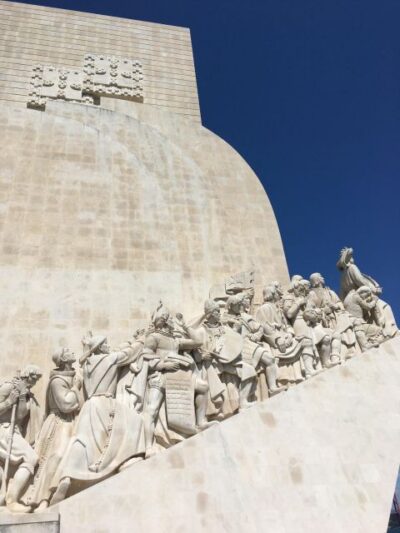
Lisbon: Belem Walking Tour with Jeronimos Monastery Ticket
Read our review →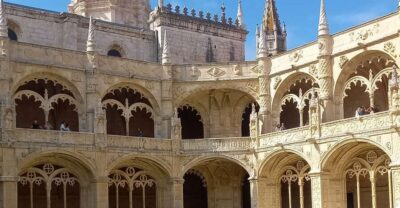
Lisbon: Belem, Jeronimos Monastery, and Coach Museum Tour
Read our review →Browse the lists this tour appears in