
Reviewed · HISTORICAL TOURS
Full day Small Group Tour of Historical Lisbon
Lisbon’s old center makes the most sense on foot, and this eight-hour walking tour links together the city’s steep lanes, tiled churches, grand squares, and river views in one long day. You begin at Saint Roch Church and finish at Praça do Comércio, passing through Bairro Alto, Chiado, Baixa, Mouraria, and Alfama along the way.
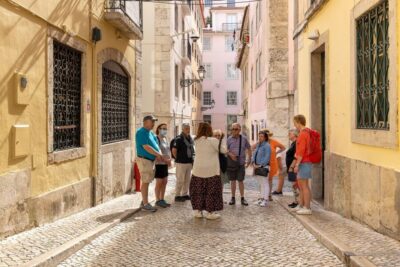
I like the small maximum of eight people, which gives guides such as Rui and Andriy room to answer questions and adjust the pace. I also like the mix of famous sights and less obvious stories, including the 1506 Jewish massacre, Salazar-era political repression, Fado, freemasonry, and the earthquake of 1755.
The main drawback is the length. Seven to eight hours of uphill streets, steps, and hard pavement can feel tiring, especially on a hot summer day. This is a full walking day, not a gentle introduction from a vehicle.
In This Review
- Key points to know before you book
- What this Lisbon tour really covers
- Saint Roch Church opens the day with ornate Baroque art
- Bairro Alto and Trindade reveal Lisbon’s odd corners
- Chiado and Baixa show the city’s polished side
- Graça brings the first big city panorama
- São Vicente and Alfama bring daily life into view
- Alfama’s viewpoints reward the long walk
- The route finishes at the riverfront
- How the $39 price compares with the effort
- Who should book this full-day Lisbon walk?
- Should you book it?
- FAQ
- How long does the Historical Lisbon tour last?
- Where does the tour begin?
- Where does the tour end?
- How large is the group?
- Is Lisbon Cathedral admission included?
- Are food and drinks included?
- Is the tour suitable for people with walking disabilities?
Key points to know before you book
- A full historic-center route: Cover Bairro Alto, Chiado, Baixa, Mouraria, and Alfama without arranging several separate visits.
- A very small group: The tour has a maximum of eight people, and it may operate as a private experience when bookings are light.
- Strong guide-led storytelling: Rui and Andriy are praised for explaining history, architecture, culture, politics, and street art while welcoming questions.
- Many viewpoints: Look across the Tagus, Saint George’s Castle, Mouraria, and Alfama from Graça, Santo Estêvão, Santa Luzia, and Portas do Sol.
- Mostly free sightseeing: The listed stops generally have no admission charge, but entry to Lisbon Cathedral is not included.
- A demanding day on foot: Expect hills, narrow lanes, steps, and a moderate level of physical fitness.
What this Lisbon tour really covers
At $39, this is an unusually broad introduction to central Lisbon. You are not paying for a single monument with a short explanation. You are paying for a guide to connect the city’s churches, neighborhoods, viewpoints, political events, and daily life over most of a day.
That matters in Lisbon because the old center is easy to admire but not always easy to understand. A street can shift from a grand Pombaline grid to a cramped medieval lane within minutes. A viewpoint may show you a castle, a river, and red roofs, but a guide helps explain how the earthquake, royal power, religious conflict, and urban rebuilding shaped what you see.
The route also has a clear geographic logic. It begins above the center, works through the western districts and Baixa, climbs toward Graça, then winds down through Alfama to the riverfront. You will still walk plenty, but the guide can sometimes zigzag through the hills to limit needless climbs. That flexibility is one of the most useful features of the experience.
More history-first plans:
- Lisbon: History, Stories and Lifestyle Walking Tour
★ 4.8 · 10,902 reviews - Lisbon: Live Fado Show with Port Wine in Historic Center
★ 4.7 · 4,166 reviews - Lisbon: Fado Show with Wine in a Historic Venue
★ 4.8 · 1,294 reviews
Saint Roch Church opens the day with ornate Baroque art
Meet at Igreja de São Roque, or Saint Roch Church, at 10:00 a.m. The first guided visit lasts about 15 minutes and focuses on the church’s art and the Saint Roch mission.
This is a good opening stop because it immediately shows you that Lisbon’s churches are not plain background buildings. Portuguese artists worked with dramatic decoration, detailed carving, and expensive materials. The church is presented as one of Portugal’s finest examples of Baroque art, so your guide can give you a visual key for noticing details later in the day.
From here, you move into Bairro Alto. The neighborhood is one of Lisbon’s oldest and most unusual, with narrow streets and an atmosphere that changes sharply between daytime and evening. The tour gives you about 25 minutes to get oriented, hear stories about old Lisbon, and look for the local side of the district beyond its nightlife reputation.
You should expect short visits at many places rather than long museum sessions. That keeps the day moving, but it also means you will not spend a great deal of time inside every church or attraction.
Bairro Alto and Trindade reveal Lisbon’s odd corners
The brief stop at Trindade adds one of the day’s more unusual stories. You learn about a restaurant connected with Catholic worship, beer, and freemasonry. The visit lasts only about five minutes, so its value comes from the guide’s explanation rather than a long look around.
This kind of stop is where a small group helps. You can ask how the connections fit together instead of simply passing a building with no context. The subject also breaks up the church and monument visits with a piece of Lisbon’s social history.
Next comes Largo do Carmo, one of the prettiest squares on the route. The Gothic ruins of the Carmelite Convent recall the 1755 earthquake, which destroyed much of Lisbon. The ten-minute visit is short, but the open square and roofless stonework give you a strong sense of the disaster’s physical effect.
The nearby Santa Justa Elevator offers a classic Lisbon sight and a high view over the city and the Tagus. The listed stop is about ten minutes, with admission shown as free in the tour details. Since the schedule is tight, you should think of this as a quick look and viewpoint stop rather than a guaranteed extended ride.
Chiado and Baixa show the city’s polished side
The 30-minute walk through Chiado gives you time to see Lisbon’s greatest concentration of traditional shops and businesses. This is one of the best parts of the route for understanding how the old center still functions as a commercial district, not just a collection of monuments.
You then reach Praça Dom Pedro IV, commonly called Rossio. It is one of the central squares of the Baixa Pombalina district, the rebuilt downtown created after the earthquake. The Queen Mary II National Theatre, the opera house, Tabacaria Mónaco, and other long-established businesses frame the square.
The route also passes Rossio Station, a late-19th-century building with Neo-Manueline decoration. Even if you do not enter, take a moment to look at the facade. Its stonework reflects Portugal’s taste for architectural details tied to the country’s maritime age.
At Largo de São Domingos, the guide explains the Jewish massacre of 1506 and the memorial honoring people killed during religious persecution. This is a quiet but important stop. Lisbon’s past is not only churches, kings, and grand viewpoints, and the tour makes room for a darker chapter.
The nearby Igreja de São Domingos has a distinctive interior and a short five-minute visit. Its atmosphere differs from the bright, highly decorated churches earlier in the day. You continue through Praça da Figueira and along one of downtown’s main pedestrian streets, with cafés, businesses, and the Santa Justa Elevator nearby.
A handful more Lisbon ideas to compare
- Sintra Full-Day Private Tour – A Journey through Wonderland
★ 5.0 · 1,665 reviews - From Lisbon: Fátima, Batalha, Nazaré & Óbidos Full-Day Tour
★ 4.7 · 881 reviews - Full Day Lisbon Tour Baixa Chiado with Alfama and Belem
★ 5.0 · 471 reviews - Évora and Megaliths Full-Day Tour from Lisbon
★ 4.7 · 456 reviews
Graça brings the first big city panorama
The tour next climbs toward Miradouro da Graça, also called the Sophia de Mello Breyner Andresen viewpoint. From here, you can see central Lisbon, Saint George’s Castle, Mouraria, and the Tagus.
This is one of the points where the walking pays off. You get a clear sense of Lisbon’s hills and the way its neighborhoods spread below the viewpoints. If you are taking photographs, this is a useful place to pause, but the scheduled stop is about ten minutes.
Close by, the Church of Our Lady of Grace offers another look at Lisbon’s religious past. The church and convent are among the city’s older religious sites, and the Augustinian monks remained connected with the complex until 1834.
The route then uses smaller streets to show a more residential side of Lisbon. You pass a charming lane lined with homes, terraces, bougainvillea, and other flowers. There is also a stop connected with trade union activism, giving you a glimpse of the city’s political and working life.
These unsung details help prevent the day from becoming a checklist of famous buildings. You get some attractive streets, but you also hear how people and institutions shaped the neighborhoods.
São Vicente and Alfama bring daily life into view
Igreja de São Vicente de Fora introduces the history of Saint Vincent the Deacon, Lisbon’s patron saint. The church has an important place in the city’s religious story, and the stop gives you a chance to connect the saint with Lisbon rather than seeing the building as just another facade.
The route then reaches Feira da Ladra, one of Lisbon’s oldest flea markets. The market is especially relevant on Tuesdays and Saturdays, when it is operating. If your tour falls on another day, you should expect the neighborhood and market setting rather than the full market atmosphere.
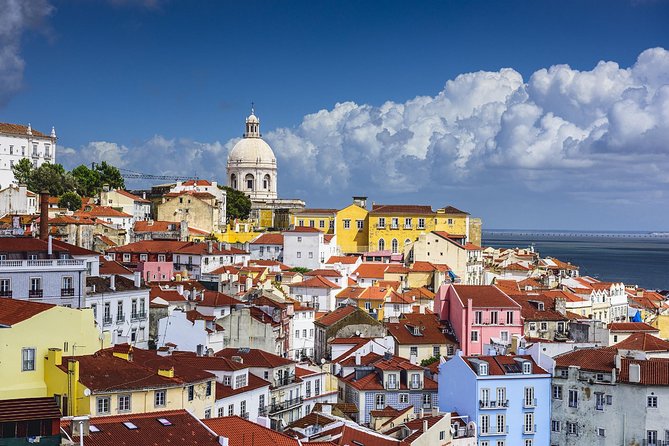
The National Pantheon comes next, viewed from outside. Its large dome and monumental scale make it easy to spot, while the building’s role as a mausoleum connects it with some of Portugal’s best-known men and women. Five minutes is enough for an exterior introduction, but not for a full interior visit.
From there, you enter Alfama more fully. This is the part of the day where the route feels most like a walk through a living neighborhood. You see narrow streets, ordinary homes, and the everyday setting that surrounds Lisbon’s Fado tradition.
That distinction matters. Alfama can be treated as a pretty maze for photographs, but the guide explains its connection to Fado and how the neighborhood’s physical character supports that musical culture. You will not attend a Fado performance as part of this tour, yet you will search out the streets and buildings associated with it.
Alfama’s viewpoints reward the long walk
Miradouro de Santo Estêvão is described as Alfama’s best viewpoint, with tiny streets and the district’s characteristic buildings around it. The view is less about one single monument and more about seeing how densely the old neighborhood is packed between the hill and the river.
At Igreja de São Miguel, you receive an exterior visit to one of the churches that survived the 1755 earthquake. The stop is short, but survival itself gives the building a useful place in the day’s earthquake story.
A former political prison appears later in the route. The building was converted into a museum dedicated to the memory of people persecuted under the Salazar regime. The tour explains that change, linking the old city to Portugal’s more recent political past.
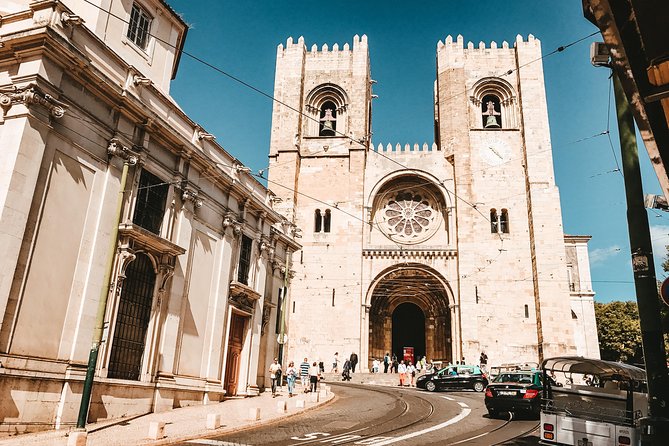
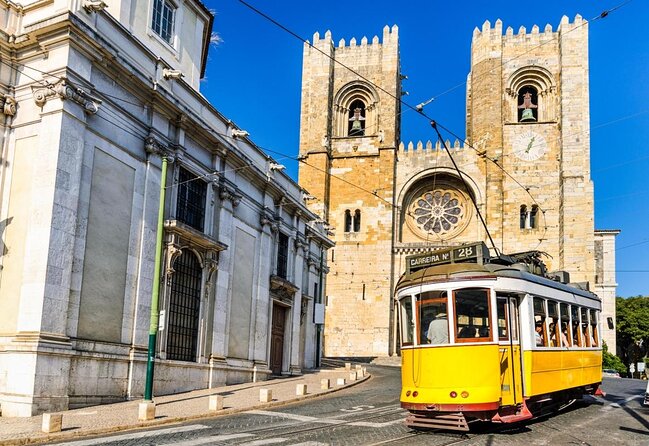
Lisbon Cathedral is the main interior church visit in Alfama. You receive a detailed guided tour inside, but admission is not included in the $39 price. Plan for that extra cost at the site, and remember that the scheduled visit is about ten minutes, so the focus is an introduction rather than an exhaustive examination.
The nearby Igreja de Santa Luzia combines religious history with a strong view over Alfama and the Tagus. Your guide explains Lisbon as a religious battleground during the Reconquista, giving the viewpoint a layer of meaning beyond its postcard appeal.
At Miradouro das Portas do Sol, you get another broad panorama. This is one of the route’s most memorable visual moments, but it is also a reminder that Alfama is hilly. The viewpoints are reached by walking streets that can be steep, uneven, and tiring after several hours.
The route finishes at the riverfront
The final Alfama stops include the Spiked House, a rare example of 16th-century palatial architecture. Its unusual facade is easy to recognize and gives you another example of Lisbon’s habit of hiding striking details in ordinary streets.
The tour ends at Praça do Comércio, also called Terreiro do Paço. The broad riverside square feels very different from Alfama’s tight lanes. Here, the guide connects the space with the Marquis of Pombal and the 1908 regicide, when King Carlos I and his son were assassinated.
Ending at the riverfront is practical. You are in the heart of central Lisbon, with access to public transportation and a clear point from which to continue your own sightseeing. The route does not include hotel pickup or drop-off, so you need to reach Saint Roch Church independently and make your own way home afterward.
How the $39 price compares with the effort
The price is strong if you want a broad orientation to Lisbon and prefer paying for a guide rather than separate entry tickets. Almost every listed stop is free, so the main value comes from the route design, explanations, and time saved in figuring out how the districts fit together.
You also receive a genuinely small-group format. The maximum is eight people, and when demand is low, the experience may become a private tour without a higher group size. That can make a long day more comfortable because you can ask questions, request a short pause, or discuss subjects such as politics and local culture in more detail.
Food and drinks are not included. One guide has been praised for recommending a good seafood restaurant and helping with lunch suggestions, but you should budget separately for your meal and any refreshments. A full day in Lisbon’s hills is not the time to assume you can go without water or a break.
The tradeoff is pace and stamina. A previous hot-weather outing felt too long for one participant, while other experiences benefited from the guide’s ability to reduce unnecessary ups and downs. Your enjoyment will depend heavily on weather, footwear, and your comfort with walking.
Who should book this full-day Lisbon walk?
I would choose this tour if you have one full day for central Lisbon and want the city’s history explained as you move. It suits first-time visitors who want to see the major old neighborhoods, as well as returning visitors who want more context for places they may have passed quickly.
It is especially useful for people who like churches, architecture, city viewpoints, Fado, political history, and local stories. The guide can also respond to questions about culture, street art, and politics, which makes the route more flexible than a fixed script.
I would not choose it if you want a relaxed day with long café stops or extended time inside major monuments. The route is not recommended for people with walking disabilities, and children must be accompanied by an adult. Service animals are allowed, and the meeting point is near public transportation.
Bring comfortable shoes, water, sun protection in warm weather, and enough energy for hills and steps. If you need a slower pace, ask about that before booking, since the route covers a great deal of ground in about eight hours.
Should you book it?
Book this tour if you want maximum historic coverage for a low price and are happy to spend most of the day walking. The combination of Alfama, Bairro Alto, Chiado, Baixa, Graça, churches, viewpoints, and political stories is hard to match in a short outing.
Skip it if your ideal Lisbon day is slow, highly focused, or built around long interior visits. For an active visitor who wants a well-planned first look at the old center, this is a practical choice, especially with a guide such as Rui or Andriy and a group capped at eight.
Free cancellation is available up to 24 hours before the 10:00 a.m. start time. Changes or cancellations made within 24 hours are not refunded.
FAQ
How long does the Historical Lisbon tour last?
The tour lasts approximately eight hours, beginning at 10:00 a.m.
Where does the tour begin?
The meeting point is Church of Saint Roch, at Largo Trindade Coelho, 1200-470 Lisboa, Portugal.
Where does the tour end?
The tour ends at Praça do Comércio, 1100-148, Lisbon.
How large is the group?
The maximum group size is eight people.
Is Lisbon Cathedral admission included?
No. Admission to Lisbon Cathedral is not included in the tour price.
Are food and drinks included?
No. Food and drinks are not included. Hotel pickup and drop-off are also not included.
Is the tour suitable for people with walking disabilities?
No. The tour is not recommended for people with walking disabilities and requires a moderate level of physical fitness. Children must be accompanied by an adult, and service animals are allowed.
Fresh finds around Lisbon
- Lisbon: Tuk Tuk City Tour★ 3.6 · 7 reviews
- Fatima Full day Private Tour★ 5.0 · 7 reviews
- Lisbon: Highlights and Hidden Gems Tour★ 5.0 · 7 reviews
- Private Tour to Evora and Monsaraz from Lisbon★ 5.0 · 7 reviews
- Discover Sintra Beauty with a Guided Journey from Lisbon★ 5.0 · 7 reviews
- Private Half-Day Tour to Sintra★ 3.4 · 7 reviews
- Lisbon: Sunset and Wine Catamaran Tour★ 5.0 · 7 reviews
- Nazaré: Beaches of Nazaré Guided E-Bike Tour★ 4.9 · 7 reviews
Historical Tours, compared.
Lisbon: History, Stories and Lifestyle Walking Tour
Read our review →
Lisbon: Live Fado Show with Port Wine in Historic Center
Read our review →
Lisbon: Fado Show with Wine in a Historic Venue
Read our review →
Explore Lisbon by Tuk Tuk: History and Viewpoints
Read our review →
Lisbon: Daytime or Sunset Boat Cruise with History and Wine
Read our review →
Private Tuk Tuk Tour Through Lisbon’s Historical Streets
Read our review →
Lisbon Sunset Sailing with Portuguese Wine and History
Read our review →
Lisbon: Guided Tuk-Tuk Tour Along the Historic Tram Line 28
Read our review →Browse the lists this tour appears in